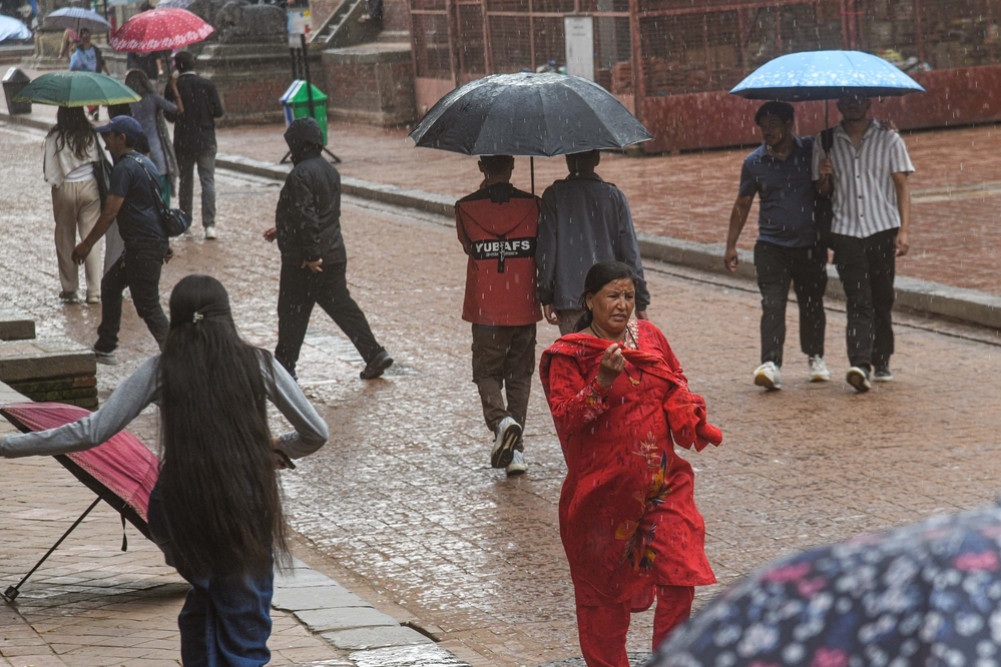
Meteorologists have predicted that the delay in the onset of the monsoon will also affect the rainfall system from South Asia to Nepal.
We use Google Cloud Translation Services. Google requires we provide the following disclaimer relating to use of this service:
This service may contain translations powered by Google. Google disclaims all warranties related to the translations, expressed or implied, including any warranties of accuracy, reliability, and any implied warranties of merchantability, fitness for a particular purpose, and noninfringement.
Monsoon has entered India three days later than its normal date. The India Meteorological Department (IMD) on Thursday announced the arrival of the southwest monsoon from the southern state of Kerala. Meteorologists have estimated that this delay and weak speed of the monsoon will also affect the rainfall system from South Asia to Nepal.
Monsoon usually enters India on June 1. The department had earlier estimated that the monsoon would enter on May 26. According to the department, the cloud cover has increased in the southeast Arabian Sea for the past two days, where the influence of the westerly wind has spread to a height of about 4.5 km above sea level. The speed of the westerly wind at low levels is about 20-25 knots. In the last two days, Kerala has received heavy rain along with heavy rain at some places. The department has stated in its bulletin that the southwest monsoon has been declared to have arrived as the necessary criteria for monsoon have been met.
It usually takes 10 to 15 days for the monsoon to reach Kerala from the Andaman and Nicobar Islands. This time, the monsoon had already become active in the Andaman region, the southeast Arabian Sea, the southwest and southeast Bay of Bengal on May 16. However, it could not reach Kerala on time. In this regard, the atmospheric pressure, wind pressure and weather systems such as cyclones formed in the Arabian Sea and the Bay of Bengal are considered important for the monsoon to advance.
The department has stated that at least 60 percent of the 14 weather stations, including Kerala, should receive 2.5 mm or more of rainfall for two consecutive days for a formal declaration of the arrival of the monsoon. Only if the speed of the westerly wind is strong, it helps in the arrival of the monsoon.
Due to heavy rains, the department had issued a warning in Alappuzha, Kottayam and Ernakulam districts of Kerala on Thursday. The department has predicted heavy rains for seven days in parts of Kerala, Tamil Nadu, and Karnataka.
Pre-monsoon effects have been seen in Rajasthan, Punjab, Haryana, Chandigarh, Delhi, Madhya Pradesh, Chhattisgarh, and Telangana. The department has warned of strong winds, thunderstorms, and rain at a speed of 50 to 70 kilometers per hour. Amidst the seasonal change, temperatures have reached around 40 degrees Celsius in some parts of Gujarat, western Rajasthan, Uttar Pradesh, Bihar, Maharashtra, and Tamil Nadu.
Meteorologists estimate that the monsoon may weaken with the late arrival. The Indian Meteorological Department had earlier estimated that there would be 92 percent rainfall from June to September, but after the latest revision, it has been reduced to 90 percent. The southwest monsoon, which is active in South Asia from June to September, accounts for about 75 to 90 percent of the annual rainfall. A weak monsoon in this region, which is highly dependent on agriculture, water resources and energy production, will affect the entire economy.
The average date of monsoon arrival in Nepal is June 13. 'Usually, the monsoon reaches Nepal within 12 to 14 days of its arrival in Kerala,' said Saroj Pudasaini, a meteorologist at the Department of Hydrology and Meteorology. 'This year, some slow movement has been seen in the monsoon process.' We can only tell when the monsoon will enter our country by analyzing various weather parameters, wind speed and rainfall patterns. Last year, it entered 15 days earlier on May 29.
This time, the monsoon system has developed late, so it will have a direct impact on Nepal as well, said Senior Meteorologist of the Department, Min Kumar Aryal. 'The monsoon system entering Kerala will enter Nepal after expanding,' he said, 'The department itself has already announced a forecast of below-average rainfall in most places during this year's monsoon.'

The forecast released by the South Asian Climate Forecasting Forum (SACF) of the World Meteorological Organization (WMO) has also estimated that South Asia will receive below-average rainfall this year. SACF predicts that there will be below-average rainfall in most parts of South Asia, but some areas in the northwest, northeast and south may receive normal or above-average rainfall. During this period, both the maximum and minimum temperatures during the day and night will be above average.
'El Niño' effect: From drought to flood fears
'Officially, the outlook of Sascof and the department has said that there will be less than average rainfall in the event of El Niño. When there is less rain and clouds, the natural maximum and minimum temperatures increase,' said another senior meteorologist, Varun Poudel, 'The percentage of possibility of temperature increase during the entire monsoon period is seen to be high.' The World Meteorological Organization issued a statement on Tuesday, saying that there is a 90 percent chance of 'El Niño' developing by November. 'Although there is some uncertainty about its strength and timing, many weather forecast models have indicated that this condition will be at least moderate and possibly strong,' the organization said. The World Meteorological Organization is the United Nations' climate agency. Meanwhile, UN Secretary-General António Guterres said the science is clear that El Niño is on the horizon in the coming months. In a video message
, he said it was almost 90 percent certain. “The world should take this as a climate emergency. El Niño will heat up an already hot world even more. Its impacts will be even more severe,” he said. “The most effective solution is to end our addiction to fossil fuels, accelerate the transition to renewable energy, protect the most vulnerable, and provide early warning systems for all.”