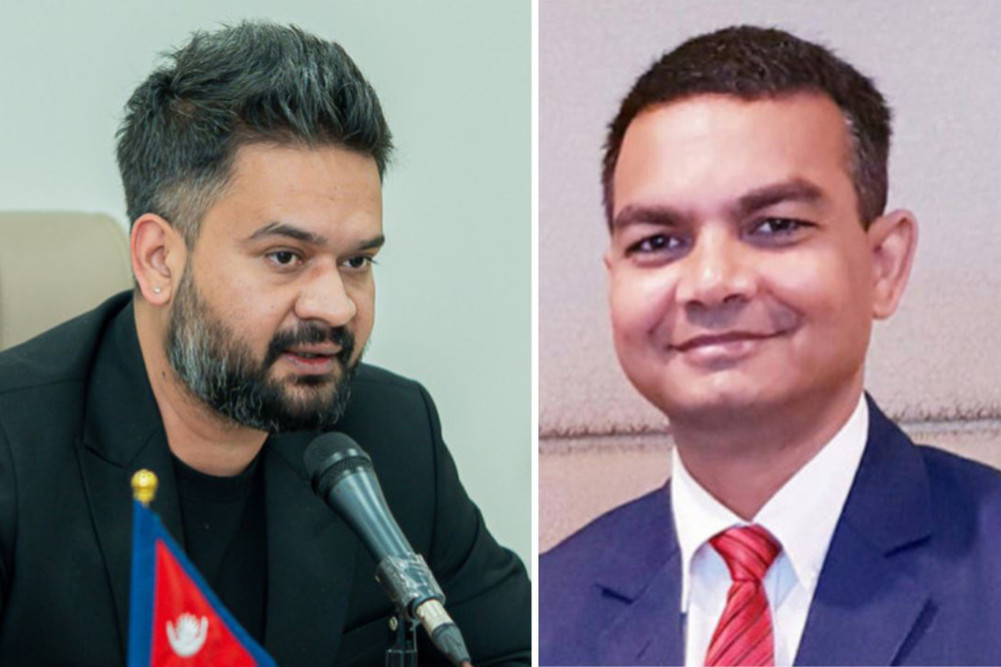
The incident of the incumbent secretary being arrested for sending a text message has created a stir in the employee community.
We use Google Cloud Translation Services. Google requires we provide the following disclaimer relating to use of this service:
This service may contain translations powered by Google. Google disclaims all warranties related to the translations, expressed or implied, including any warranties of accuracy, reliability, and any implied warranties of merchantability, fitness for a particular purpose, and noninfringement.
Secretary to the Vice President's Office Krishnahari Pushkar (Karna) is retiring next month on Ashar 24 after completing his five-year term as secretary. His secretaries were in the running to become the Chief Secretary eight months ago. But the Sushila Karki-led government chose Suman Raj Aryal.
Saying that he had to retire amidst the rush of work, he had been trying to meet the Prime Minister of his home district, Balendra Shah, for a few days. He requested officials from the Office of the Prime Minister and the Council of Ministers to meet him, and even sought the help of members of the secretariat. However, Pushkar, a special category employee of the Government of Nepal, was unable to meet Prime Minister Shah.
After not getting the opportunity to meet him, he sent a message to Prime Minister Shah's number before leaving the office on Thursday.
'Honorable Prime Minister, greetings. There is a provision that the tenure of the Secretary to the Government of Nepal is five years.' Respected Sir, if you look at it this way, the post of Chief Secretary must be given special attention, otherwise there is no possibility, sir. That is why my retirement is certain on Ashar 24. Meanwhile, I saw the advertisement for the post of ambassador, sir. I humbly request your information, guidance and necessary support in this regard,' Pushkar's message said.
Finally, he wrote that he was 'obedient' and had written his permanent address as 'Jaleshwor-4, Suga, Mahottari'.
After sending the message, he reached the Vice President's Office in Lainchaur. There was no reply to the message throughout the day. In the evening, a team of police inspectors from the Valley Crime Investigation Office reached the house at once.
'I have something to ask you, I have to go to the office,' Pushkar was surprised as soon as he heard it. At first, he was shocked, wondering what he had done that the police had to come and take him away. After a while, Pushkar learned that the reason for taking him to the Teku Police Office was a message he had written to Prime Minister Balendra Shah in the morning.
Following the order of the political leadership, the police arrested Secretary Pushkar and brought him back, but there was no basis to prosecute him based on the message he had sent to the Prime Minister. That is why the police had handed over Mrs. Abha Shrestha to the custody late on Thursday night. The incident of the incumbent secretary being arrested for sending a message has created a stir in the staff circle. In the past, prime ministers used to tell secretaries leading the ministry's personnel administration to contact them if they had any problems. If the current prime minister was trying to disrupt that, he should have asked the Prime Minister's Office not to contact him directly, but to come through the Chief Secretary. If he was taken into custody based on a message that came out when such an instruction was not heard, it was not right: Former Secretary Dwarikanath Dhungel According to former Secretary Dwarikanath Dhungel, in the past, prime ministers used to tell secretaries leading the ministry's personnel administration to contact them in case of any problem. 'If the current prime minister was trying to disrupt that matter, he should have asked the Prime Minister's Office not to contact him directly, but to come through the Chief Secretary,' Dhungel told Kantipur. 'If he was taken into custody based on a message that came out when such an instruction was not heard, it was not right.'
He said that he did not understand the reason for taking him to the police when there was a place to call and ask about the message. When KP Sharma Oli was the Prime Minister, Pushkar was the Secretary in the Ministry of Federal Affairs and General Administration. Balendra was the Mayor of Kathmandu Metropolitan City. A source close to him claims that Pushkar helped send a new officer when the government refused to change the administrative officer of the metropolis.
‘The decision to send Pradeep Pariyar there was made when he was in the ministry, he was coordinating with the political leadership at that time,’ the source said, ‘Based on that relationship, he also wanted to meet the Prime Minister and put his point across. When he did not get it, he sent a message to the number he had previously talked to.’
According to a source in the Office of the Prime Minister and Council of Ministers, Prime Minister Shah consulted the Secretariat as soon as he received the message.
An official in the office claimed that the message sent by the Secretary, breaking the ‘chain of command’, was not digestible when he was working to create a different image in transparency and good governance. ‘He did not even sit quietly so that the message could reach anyone who wanted to benefit by linking any such links,’ he said.
Immediately after, the Prime Minister's Office directed Inspector General of Police (IGP) Dan Bahadur Karki to investigate Secretary Pushkar. After that, SSP Santosh Khadka of the Valley Crime Investigation Office had sent a team to take him under control.
A senior Nepal Police officer, on condition of anonymity, said that they were only following the above order. 'He has already been released, so I did not think it was necessary to say anything more,' he said.
The secretary did not commit a criminal act by sending the message, if he had done so, it would have been a violation of discipline, and it would not be appropriate to take action by using the police. There was a civil service act to take action in this matter, it is wrong to use the police directly: Former Deputy Inspector General (DIG) of Nepal Police Hemanta Malla Thakuri
Former Deputy Inspector General (DIG) of Nepal Police Hemanta Malla Thakuri says that sending messages by employees should not be viewed as a 'criminal offense'. "The secretary did not commit a criminal act by sending the message. If he did, it would be a violation of discipline. It is not appropriate to take action by using the police," he told Kantipur. "There was a civil service act to take action in this matter, it is wrong to directly use the police."