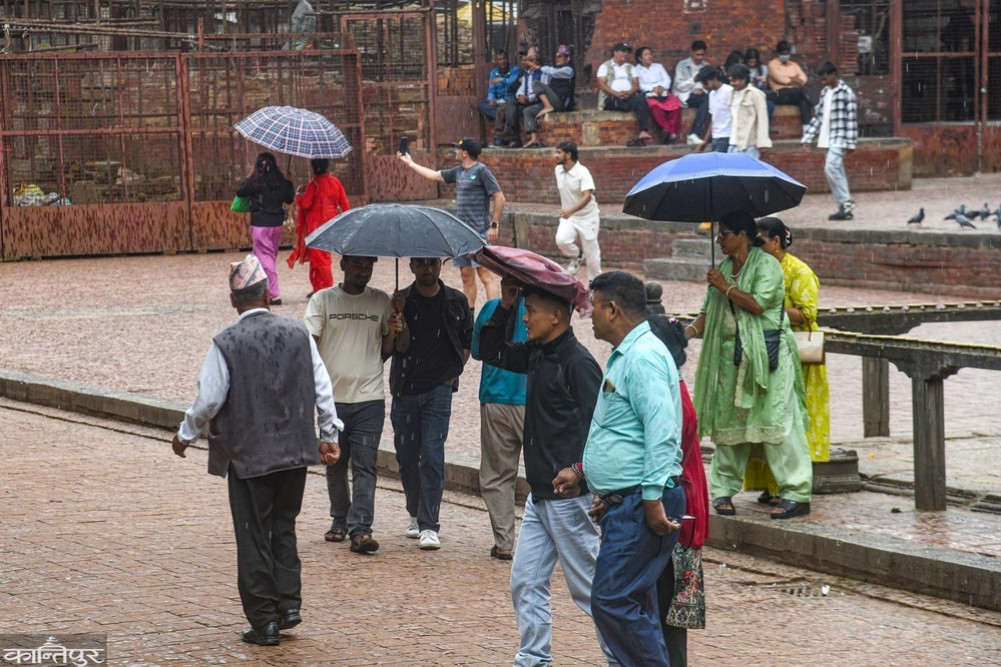
The monsoon system in Kerala, India, has not developed, due to which meteorologists have predicted that the monsoon will arrive in Nepal later than the average date.
We use Google Cloud Translation Services. Google requires we provide the following disclaimer relating to use of this service:
This service may contain translations powered by Google. Google disclaims all warranties related to the translations, expressed or implied, including any warranties of accuracy, reliability, and any implied warranties of merchantability, fitness for a particular purpose, and noninfringement.
The signs of a delay in the arrival of the southwest monsoon are becoming stronger. Meteorologists have said that since there is no sign of the monsoon entering the southern Indian state of Kerala this year, it will have a direct impact on Nepal. Last year, the monsoon entered Nepal on May 29, 15 days ahead of the average.
Senior Meteorologist at the Department of Hydrology and Meteorology, Minkumar Aryal, says that since the monsoon system has not developed in India, it will also have an impact here. 'The monsoon system entering Kerala will enter Nepal after expanding,' he said, 'It does not seem that the monsoon system has formed there immediately.'
The average date of the monsoon entry in Nepal is June 13. Usually, the monsoon reaches Nepal within 12 to 14 days of its entry in Kerala.
The India Meteorological Department (IMD) had estimated that the monsoon would enter from Kerala on May 26. Monsoon usually arrives there on June 1. The department has issued an update saying that it may arrive by June 3 as the monsoon system did not develop on that day either. The monsoon update released on Monday said that conditions are favorable for further expansion to more areas of the Arabian Sea, Kerala and some parts of Tamil Nadu within the next 2-3 days. Last year, the monsoon arrived in India on May 24. 'The monsoon reaches Nepal within 12 to 14 days after its arrival in Kerala. But, it has not started there,' said meteorologist Saroj Pudasaini. He says that 'some slow movement' has been seen in the monsoon process this year. 'A conclusion about the monsoon arrival can be drawn only by analyzing various weather parameters, wind speed and rainfall patterns,' he said, 'We are also continuously monitoring the monsoon system.'
Meteorologists also estimate that it may weaken with the delay of the monsoon. Although the India Meteorological Department had earlier estimated 92 percent rainfall from June to September,
it has been reduced to 90 percent after the latest revision . In a press briefing last Friday, Secretary of the Ministry of Earth Sciences M Ravichandran had said that signs of El Nino developing could weaken the monsoon. He has indicated that the temperature will also remain above normal and the monsoon will be weakest since 2015. Talk of 'El Nino' as the monsoon is about to enter, will the crisis of 150 years ago be repeated ? The southwest monsoon, which is active from June to September in South Asia, accounts for about
The department's Director General Mrutyunjay Mohapatra had said during a press briefing that the monsoon will enter India within seven days as the southwest monsoon is expected to spread further to some parts of the Arabian Sea and the Bay of Bengal. It usually takes 10 to 15 days for the monsoon to reach Kerala from the Andaman and Nicobar Islands. This time, the monsoon had already become active in the Andaman region, including the southeast Arabian Sea, southwest and southeast Bay of Bengal on May 16. Weather systems such as atmospheric pressure, wind pressure and cyclones formed in the Arabian Sea and the Bay of Bengal are important for the monsoon to advance towards Kerala. The department has said that for the formal announcement of the arrival of the monsoon, at least 60 percent of the 14 weather stations, including Kerala, should receive 2.5 mm or more rainfall for two consecutive days. Only if the speed of the westerly wind is strong, it helps in the arrival of the monsoon.
In Nepal, the monsoon usually arrives on June 13 (fourth week of Jestha) and leaves on October 2 (third week of Asoj). The Department of Hydrology and Meteorology has already made public the forecast of below-average rainfall in most places during this year's monsoon.
'El Niño' effect: From drought to flood fears
The National Disaster Risk Reduction and Management Authority has also projected that the risk will be high during this year's monsoon. The authority says that due to the assessment of below-average rainfall and an increase in average temperature, there is a possibility of glacial lake eruptions in some high mountainous places. Due to this, the risk of monsoon-related disasters such as floods, landslides, inundation, land erosion and flash floods is likely to be higher in the lower coastal areas.
The assessment of the high possibility of an increase in daily temperatures has mentioned that the general public in the southern Terai region of the country will also be affected by excessive heat or heat waves (hu).