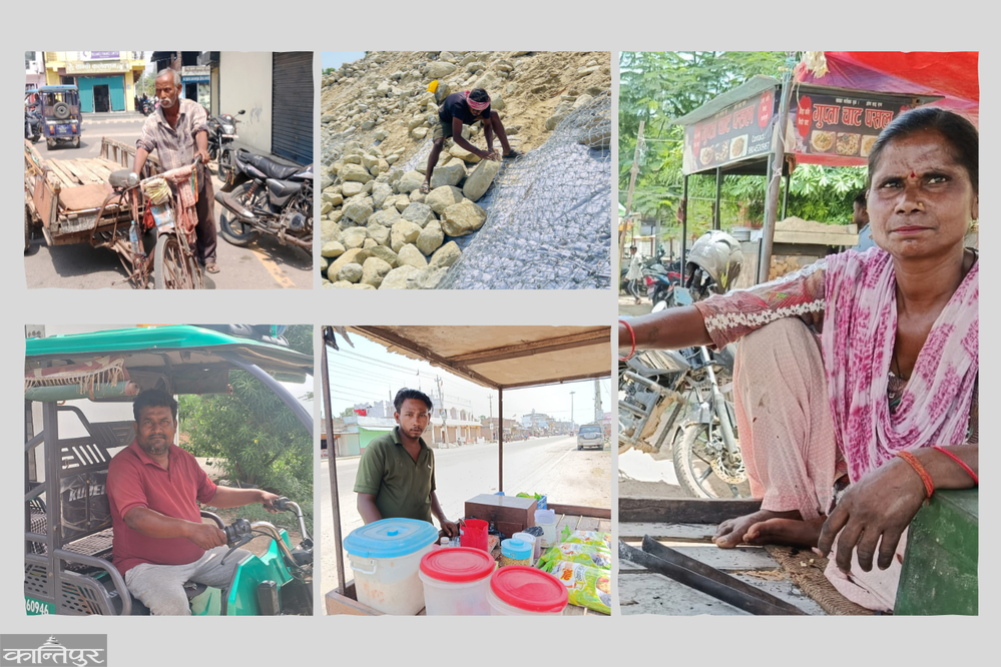
Many ordinary people are busy working all day in temperatures exceeding 40 degrees Celsius due to their responsibility to support their families.
We use Google Cloud Translation Services. Google requires we provide the following disclaimer relating to use of this service:
This service may contain translations powered by Google. Google disclaims all warranties related to the translations, expressed or implied, including any warranties of accuracy, reliability, and any implied warranties of merchantability, fitness for a particular purpose, and noninfringement.
For the past few days, the extreme heat has been a source of stress for the people of the Terai. Due to the hot wind (lu) blowing in the western region during the day compared to the east, the daily life of daily wage earners has become difficult. Due to the heat, some local levels have declared a holiday for schools, while some are conducting classes from the morning.
In the scorching heat, the general public has stopped leaving their homes except for essential needs. The markets are deserted in the afternoon. Some are busy working every day in the scorching heat, which exceeds 40 degrees, due to the responsibility of managing the family's expenses. Due to the heat, they cannot find work and the work they do, the families who work all day to make ends meet are struggling to light the stove.
'When there is no work due to the heat, there is no money to buy vegetables'
In the afternoon of mid-June, in temperatures around 40 degrees, 67-year-old Gopal Damai is looking for work in the streets of Mahendranagar, Kanchanpur, driving a rickshaw. He has been carrying goods in a rickshaw for 40 years, but it is difficult to find work. On top of that, the heat makes it impossible to do it even when he gets a job. The heat has added to the problem when old age makes it difficult to do many things. ‘I only work in the morning and evening, I can’t do it during the day,’ he said. ‘Someday I won’t earn a hundred rupees, I have to eat vegetables on credit.’ He said that in Jestha, he was able to earn only 200 rupees a day by carrying goods in a rickshaw.
He now transports goods in the area around the market. He carries goods for moving houses and tent houses. This income supports the family’s expenses. He said that the weather and age do not allow him to carry heavy loads. ‘You can’t carry bricks and cement, your back gets hot in the summer, and now you can’t lift heavy goods,’ Damai said. ‘I am worried about how to manage the household expenses.’
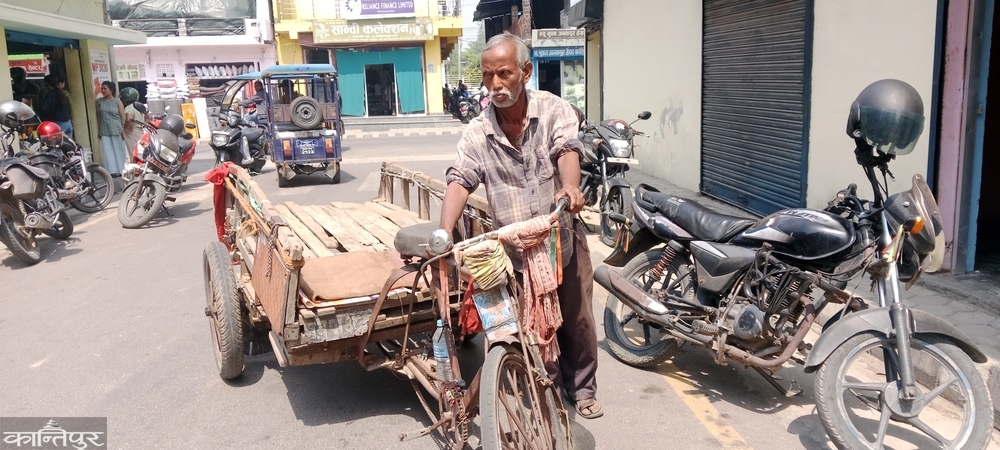
There are many ordinary people who are busy working during the day in the scorching heat of 40 degrees Celsius due to the responsibility of managing the family's expenses. After leaving at 7 in the morning and visiting the market, he returns home at 7 in the evening. In the afternoon, he finds a shade and rests in the cart. He said that sometimes he has to return home empty-handed. There is less activity in the market. There are fewer people walking around during the day. Due to the lack of activity, there is no work to carry goods. Mrs. Lalu is a patient of high blood pressure and diabetes. She needs regular medication. She has to buy essential food items and vegetables at home. That is why she is still driving a rickshaw even in her old age.
With the arrival of electric and petrol-powered autorickshaws, the work of pedal-pullers has decreased. There are only one or two people like him in Mahendranagar who drive rickshaws. It is only known that his ancestral home is Doti. His father Teji went to Haldwani, Uttarakhand, India when he was young. Gopal was born there. In 2043 BS, he came to Mahendranagar and built a hut in the slums of Salghari. He started driving rickshaws soon after and lives in his hut. Initially, he used to drive a two-wheeled cart. He used to carry goods for 8/10 kilometers from Mahendranagar. The expenses were good. He educated four sons. His daughter got married. His sons went to India.
Now that his son has stopped looking after him, the cart has become his old-age support. He said that his sons do not come home. He has repaired the two-wheeled cart and made a three-wheeled pedal-powered rickshaw. Lately, he used to transport goods from tents. It is difficult to find work now because it is not the wedding season. The work of moving tents is scarce. He pushes rickshaws on the road even in summer in the hope of getting work. ‘How can I drive a cart in my old age,’ he said, ‘I have to work hard even for my wife’s medicine.’ He says that he earns up to 5/700 a day when he gets a good job.
'Summer has reduced business by more than half'
Pooja Bhujuwa, 37, of Gulariya-6 in Bardiya, is busy selling roasted corn on the roadside near the land revenue office. She sells corn from morning to evening due to the heat of the cart. The steam coming from the road burns her feet. The 40-degree temperature gives her a headache. Even in such a rush, she has to burn firewood to roast corn. She worries about earning two or four paisas to meet household expenses.
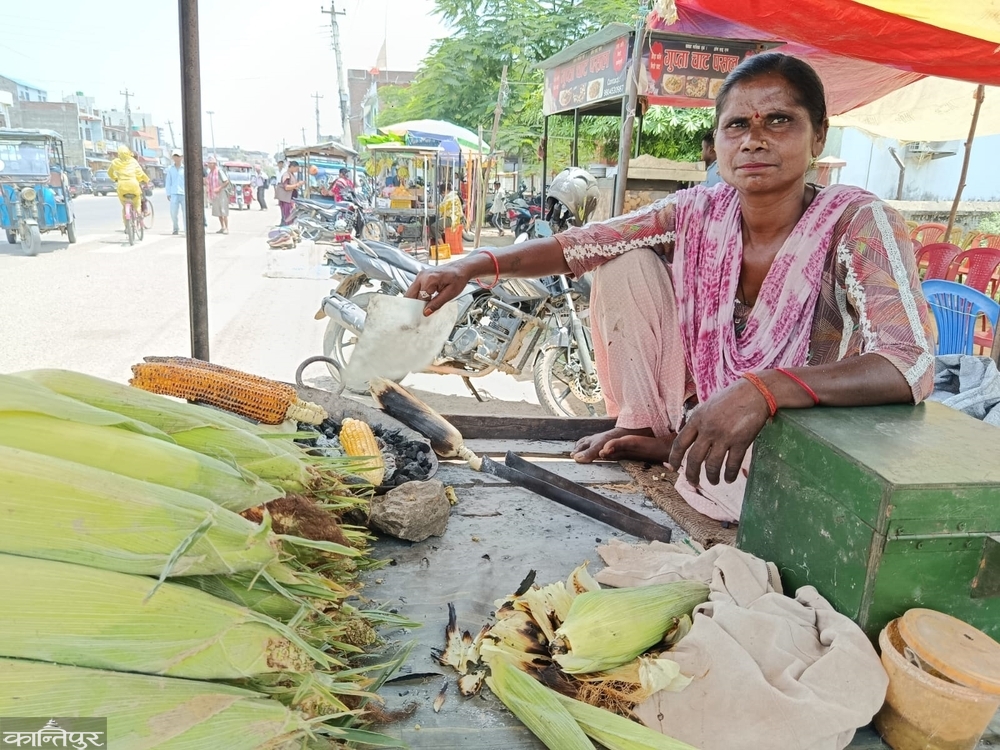
Pooja's husband has been gone for two years. She has two young sons. Since she became a husband, she has been doing seasonal business with a cart. Having a husband was a source of support. She sells vegetables and greens during the rainy season. She sells peanuts in the winter. Nowadays, since it is the season for green corn, she pushes her cart and sells corn near the land revenue office after doing household chores. By the time she cooks in the morning, her son buys corn from the field and brings it to her. ‘Business was good until Baisakh,’ she said. ‘After Jesath, the heat increased and people’s movement decreased, and our business also decreased.’
Earlier, more than 100 ghogas were sold in a day. Nowadays, it is difficult to sell 40 ghogas in a day, she said. One ghoga costs 15-20 rupees depending on the size. You have to buy coal. You have to pay 150 for a tin of coal. You have to pay 20 rupees to the municipality daily for placing a cart on the road and doing business. ‘It is very hot, it is not easy to roast corn on coal in the midday sun,’ she said. ‘How can you raise a child without doing anything? You used to earn 3-400 rupees in the evening by sitting in front of a fire all day and roasting corn and selling it. She has taken a loan of 5 lakh rupees from the village cooperative. She has to pay 12 thousand rupees in installments per month. She said that she is having trouble paying the installments as business has decreased. She said that the government should provide concessions to people like her who have no other income options due to the harsh weather.
‘I drive a cart 15 kilometers daily to make ends meet’
Due to the lack of work during the summer and the inability to do the work he does, the family that works all day is struggling to make ends meet. Maqbul Miyan (Kale Dai), 25, of Gulariya-7 in Bardiya, does not sleep well because of the worry of raising money. In the morning, he leaves his house to sell snacks on a cart. Due to the heat, schools under Gulariya Municipality are open from 6 am to 11 am. That is why Kale Dai reaches the school early to sell snacks.
Before the heat, schools were open from 10 am to 4 pm. Students used to eat snacks in the afternoon. There was business. However, since the morning classes started, students do not come out for lunch. When the sun rises by 11 am, students are in a hurry to return home. After school, he goes home to eat food by pushing a cart. ‘Who wouldn’t want to rest in the scorching heat when birds stop flying,’ he said, ‘You can’t make a living by resting. You have to sell chatpates in villages by pushing a cart.’
He said that he used to go to nearby villages like Gularia village, Chaugurji, Gularia Bazaar, Tulapur, Kothia, Suhelwa, Ashapur and other villages to sell chatpates. ‘Earlier, when the heat was less, we used to go far to sell chatpates,’ he said, ‘Since 10/15 days, we can’t go far by pushing a cart.’ He said that he has been walking 10 kilometers a day to sell chatpates for the past 5 years. Before that, he used to work in a hotel in Delhi, India. He returned after living in India for 12 years and has a family of four. He has a wife and elderly parents.
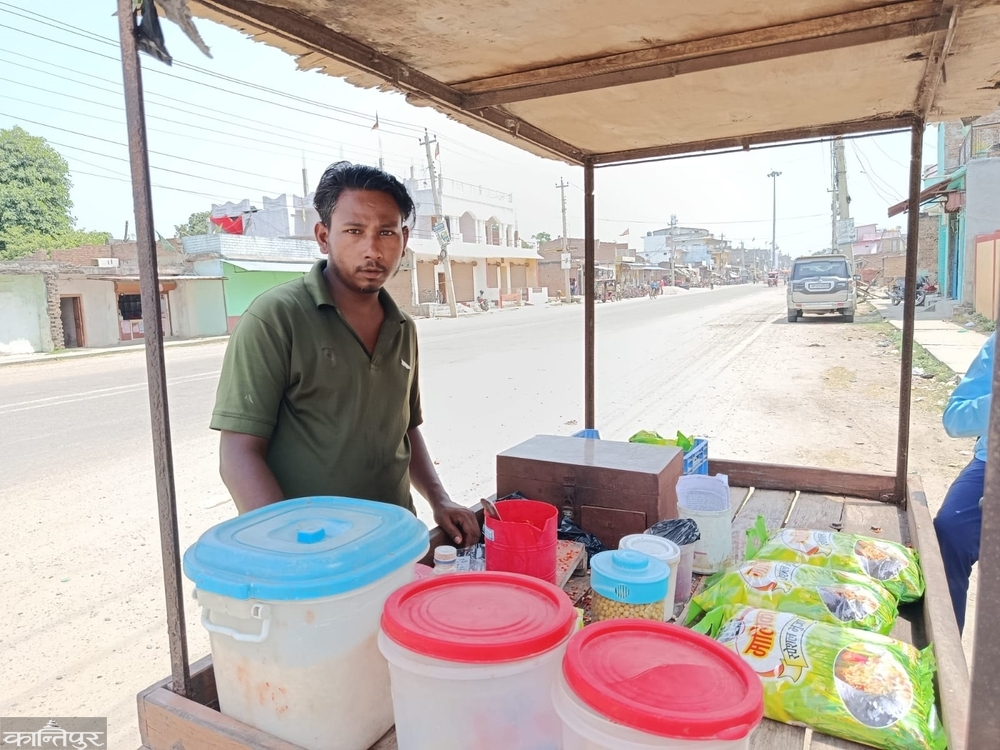
He said that he also takes care of his parents by selling chatpates. ‘My father is an asthmatic, and medicine costs a lot,’ he said, ‘I can’t afford to work because of the heat or the cold.’ He has nothing but a tin hut as his property. He said he is barely earning three or four hundred rupees. Even if he can reach far, he can earn six or seven hundred rupees a day, but the heat makes it difficult to walk continuously during the day.
‘We have to carry hot stones to fill the wire mesh in the bagar’
It is impossible to look at the sky without blinking. It is not until 9 in the morning that sweat starts flowing. Even at such a time, the laborers who have arrived in Saptari from India in search of work and money are seen working regularly. They are carrying stones heated by the sun and filling them in the gabion net (boulder crating). They came here a week ago from Samada and Ganaura villages in Supaul, Bihar to work as laborers. They were working on ‘boulder crates’ on Tuesday afternoon, wiping their sweat at the western dam of Khando River in Tilathi Koiladi-1.
‘The sun is unbearable. But our children who want to see the sun and heat will go hungry,’ said Shyam Kumar Mukhiya, 28, of Ganaura. ‘The hot wind was blowing until yesterday (Monday) and it was even more annoying.’ Although the wind brought relief at night, the heat intensified again on Tuesday. They spend 5/7 minutes in the shade when their hands start burning while working. ‘There is no regular work in our village and its surroundings. We came here because work is easy to find here until Ashar,’ he said. ‘When we return here after suffering, our family survives for 4/5 months. That is why we have to work even after enduring the heat.’
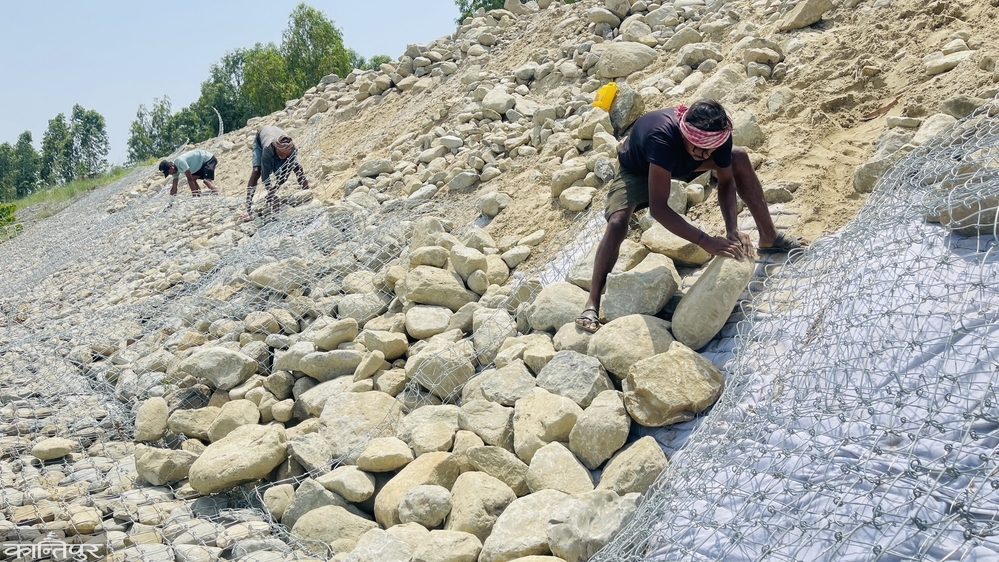
The headman, who has little land in the village, has 4 children who are studying. He has come here to support his wife and six others. ‘I could not study because of my poor financial condition, but I dream of educating my children to the highest level,’ he added, ‘No matter how hot the sun is, I have to work. When one of my relatives falls ill and returns home, I keep worrying that I will also fall ill.’
Akshyalal, the 58-year-old head of Samada, also has a similar compulsion. Since his salary alone cannot support the household expenses, he has brought his son Dhirendra Kumar with him. ‘Since there are old people, children, daughters-in-law, and grandchildren all at once, it is difficult to support them with my salary alone,’ said Akshyalal, ‘that is why my father and son have to work in the sun to support the family.’ He said that working in the sun all day makes it difficult for him to wake up in the morning. ‘I don’t even realize that it is already morning due to the fatigue of the day,’ he said, ‘Who can understand the pain of people like us.’
He said that he did not remember the night when he slept with a chain until he was about to turn 58. They said that their hands and feet were crushed and cut by the wire mesh while filling the stones. The workers deployed for the Khando River Management work being carried out by the Irrigation and Water Resources Management Project Rajbiraj have also been living in the huts built by the construction company. They earn 800 rupees (500 baht) a day while working from 9 am to 5 pm.
‘I have become accustomed to enduring the heat for a living’
At 2:30 pm on Tuesday, the hot sun and hot wind had reduced the traffic in the district headquarters of West Nawalparasi. Ramesh Kumar Chaudhary, a 45-year-old auto rickshaw driver from Ramgram Municipality-12, was waiting for passengers in front of the office of the Adarsh Cooperative Society after enduring the scorching heat of the road. Drenched in sweat, he was waiting for farmers to come to the cooperative to collect fertilizer. ‘It’s not just because it’s hot, we have to do our work,’ he said. ‘We have to go out to work even in the heat to cover our expenses.’
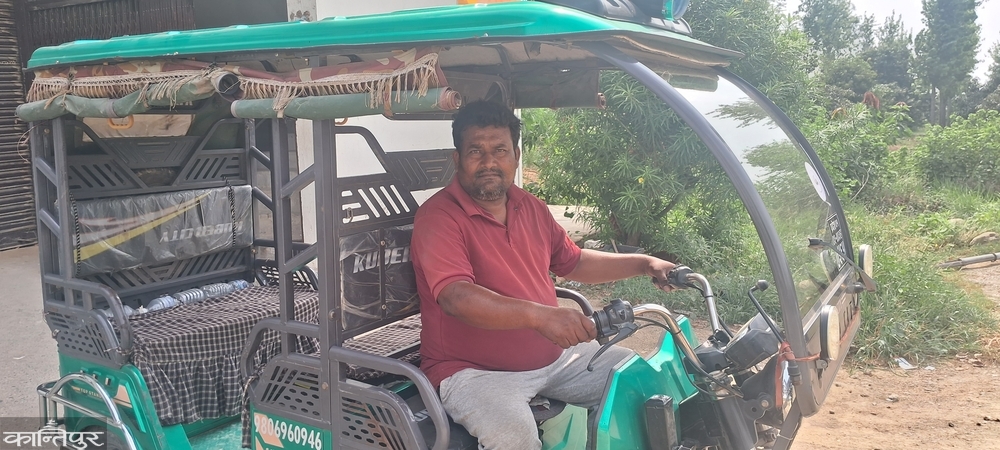
He leaves his home at 6 am with his auto rickshaw. Then he wanders the streets looking for passengers. Whether it is summer or rain, he works like this. ‘If you stay home because of the summer, who will pay for the house expenses in the evening,’ he said. ‘It is not a desire to drive a rickshaw in the heat, but a compulsion.’ He said that a few years ago, he bought an old auto rickshaw by saving the income he had earned while working in a brick factory. He said that he had to buy an auto rickshaw to support his family even after working in a brick factory all day long, so he decided to buy an auto rickshaw and make a living.
Summer weather is challenging. He said that the roof of the auto is heated in the hot sun, making it even more uncomfortable. He has two sons. The eldest son has gone to work in Delhi, India. He works in the construction sector there and sends some money. The younger son works as a driver. He also has to find time to eat. He earns between 1,000 and 1,500 per day. After deducting the auto rickshaw fee, fuel and household expenses, he saves 20 to 25 thousand per month. "Although it is uncomfortable to work during the summer, it is comfortable at other times," he said. "The heat has been taking a toll on those who work as laborers, work in construction materials, and sell goods on the streets. Seeing their suffering, I consider my own suffering to be small."