I will not and will not allow any action that would cast doubt on the institutional independence of the judiciary, the professional impartiality of judges, and the dignity of the justice delivery process: Manoj Kumar Sharma, newly appointed Chief Justice
We use Google Cloud Translation Services. Google requires we provide the following disclaimer relating to use of this service:
This service may contain translations powered by Google. Google disclaims all warranties related to the translations, expressed or implied, including any warranties of accuracy, reliability, and any implied warranties of merchantability, fitness for a particular purpose, and noninfringement.
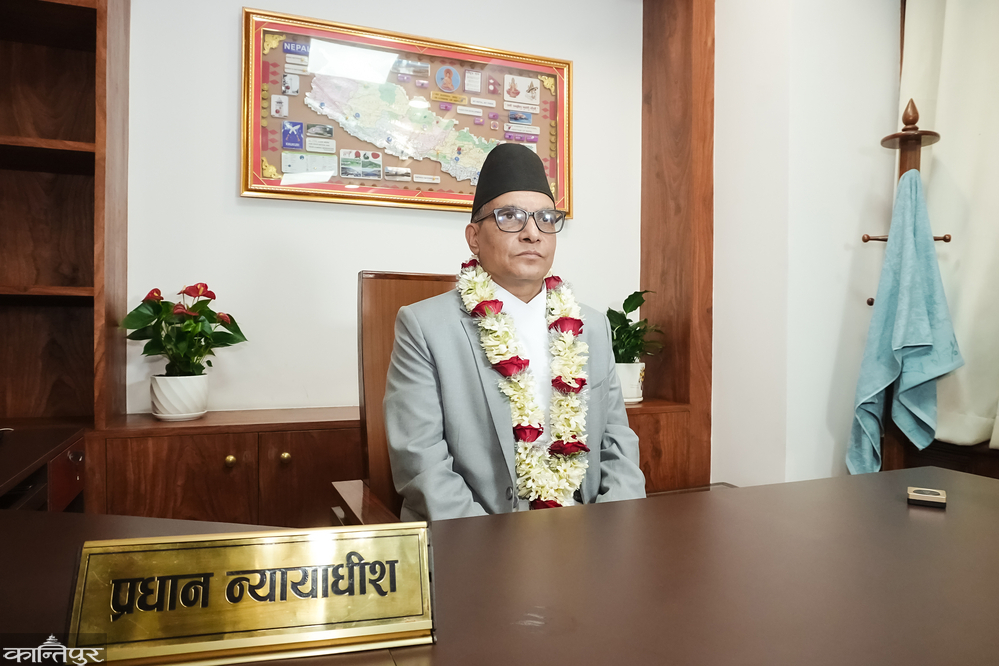
Manoj Kumar Sharma was appointed as the Chief Justice on Tuesday, the 12th day after his recommendation from the Constitutional Council. He was appointed as soon as the ‘fast track’ parliamentary hearing was approved. Sharma assumed responsibility as the 33rd Chief Justice on Tuesday itself.
The Constitutional Council had recommended Sharma as the Chief Justice on 24 Baisakh. There were many criticisms after Sharma, who is the fourth-ranked judge, was recommended, contrary to the tradition of making the senior-most judge of the Supreme Court the Chief Justice. Some are even suspecting that this will cast a shadow on the judiciary. Targeting this suspicion, Sharma said after taking office, ‘No interference in the dignity of the justice delivery process will be acceptable.’
The parliamentary hearing committee comprising members of the National Assembly and the House of Representatives conducted Sharma’s hearing in a fast-paced manner on Tuesday. The committee, which opened the complaint at 8 am and began hearing the case, unanimously approved Sharma's name at around 4 pm. Immediately after that, Sharma was appointed by President Ram Chandra Poudel. He reached the Supreme Court at 6 pm to take the oath.
After assuming the leadership of the court, Sharma said that the main goal of his tenure would be to build and protect an independent, impartial, competent and public-trusted judiciary. 'I will not do or allow any action that would raise doubts about the institutional independence of the judiciary, the professional impartiality of judges and the dignity of the justice delivery process,' he said.
Parliamentary hearing completed, approval, appointment and oath by the President, immediately assuming office. Sharma said that the use of information technology and good judicial governance would be his main agenda. He has also committed to strictly control any kind of irregularities, delay, opacity or undesirable activities in the judicial sector. He has also promised to take necessary steps to effectively control and eliminate the tendency of middlemen.
Newly appointed Chief Justice Sharma has also committed to increasing access to justice, making the Judicial Council effective and making the implementation of decisions effective . ‘Necessary laws will be amended and procedures simplified to make service delivery fast, efficient, transparent and effective,’ he said .
After the then Chief Justice Prakash Man Singh Raut retired on 18 Chaitra, the judiciary was under the interim leadership . Article 284 (3) of the Constitution states that ‘the Constitutional Council shall recommend for appointment the Chief Justice or any head or official of a constitutional body one month before the position falls vacant’ . But there were not enough officials in the Constitutional Council to make the recommendation within the time specified by the Constitution .
Sharma will remain at the helm of the judiciary until Asad 2089. Since the political changes of 2046 BS, no Chief Justice has completed a six-year term due to the age limit of 65 years. Sharma, on the other hand, will be only 62 years old when he retires.
Sharma hesitated when questioned by MPs
The Parliamentary Hearing Committee held open and closed discussions with seven complainants in the first phase on Tuesday morning. Before that, UML and NCP MPs on the committee had proposed not to hear and approve the complaint on the same day. But committee chairman Bodh Narayan Shrestha did not agree. In the past, it was customary to give one day for study after opening a complaint.
The committee had finished discussing the complaint at 12:30. The complainants had raised questions ranging from the 'Nepobaby' and Ncell verdicts to his educational and constitutional qualifications to be a judge. After the discussion on the complaint, the proposed Chief Justice Sharma reached the committee at 1 pm. The hearing began at 1:30 PM.
Initially, Sharma was given 20 minutes to present the action plan. Then the lawmakers asked questions. NCP lawmaker Barshaman Pun, mentioning that a complaint with evidence had been filed with the committee, said that Sharma was a 'Nepo baby' and that questions had been raised about his performance. He also asked when the recommendations mentioned in the report of the then Judge Harikrishna Karki that there is corruption and middlemen in the judiciary would be implemented.
I will not do or allow any action that would raise doubts about the institutional independence of the judiciary, the professional impartiality of judges and the dignity of the justice delivery process: Manoj Kumar Sharma, newly appointed Chief Justice RSP lawmaker Kabindra Burlakoti had asked, 'How do you reduce the influence of middlemen in the court? How do you resolve the situation where interim orders are issued in development construction cases and stop them?' He also had questions about Ncell's tax and qualifications.
RSP MP Deepak Bohora had questioned whether the court hearings would be broadcast live. RSP MP Rajiv Khatri raised the question of visiting the UML party office when he was a judge of the High Court. UML MP Padma Aryal asked, "Will there be factionalism among judges in the future? How will there be coordination between the bar and the bench?". The MPs also questioned Sharma for interfering in the registration of a writ against the recommendation by giving verbal orders to the Chief Registrar and Registrar after he was recommended as the Chief Justice. Finally, Chairman Shrestha asked questions ranging from providing a report to the committee every four months to the Ncell decision.
Sharma said that Ncell had paid some taxes after the previous decision and that the decision was made after an appeal as per the legal process, and he would not comment much on it. Regarding ‘Nepobaby’, he said that he was not aware of the legal provisions that disqualify someone if they were relatives. He claimed that he had qualified to become a judge of the High Court and that the constitution had abolished his position but that he had become a judge of the Supreme Court again due to his qualifications. He is the nephew of Damodar Sharma, who was the Chief Justice from 28 Chaitra 2070 to 24 Asoj 2071.
Sharma said that his focus would be on returning those who come to the court seeking justice by giving justice. He did not answer about the famous and controversial decisions he had made after the appointment of the judge to the UML party office. Sharma had answered the questions of the MPs without hesitation. Regarding the conflict between the Nepal Bar and the judge, Sharma claimed that there was no dispute with the Nepal Bar. Stating that the writ petition against the Chief Justice's recommendation is a matter of bench administration, he said that he would talk about it. While the parliamentary hearing was going on, the Nepal Bar had protested by lighting lanterns as the writ petition was not registered.
Sharma had submitted a 19-page action plan to the parliamentary hearing committee. The action plan includes issues ranging from forming a committee to study the problems seen within the judiciary to establishing a digital court. Sharma has expressed his commitment to reduce the court's caseload during his tenure. Sharma has expressed his commitment to submit a progress report to the parliamentary hearing committee every four months.
Sharma has promised to form another committee in the absence of implementation of the report on judicial reforms submitted by the committee led by the then Justice Harikrishna Karki in 2078 BS. Stating that the judges of the Supreme Court should be involved only in judicial work as per the constitution and law, he said that responsibilities will not be given to committees of an administrative and managerial nature.
Sharma has also committed to establishing an information technology-friendly court. He has put forward a plan to integrate case registration, time limit compliance, case flow management, witness examination, case proceedings and hearing stages, and even order and verdict writing into the information technology system within a year.
Sharma also said that he will take the initiative to make arrangements for the parties to appear in court online. He has also committed to developing a system for electronic tracking of cases from case registration to the verdict stage. He has also stated that he will study the use of AI in the court.
Similarly, Sharma has also promised to make arrangements for live broadcasting of court hearings. He is committed to strengthening judicial governance. Sharma's action plan mentions making the monitoring mechanism under the Judicial Council Act, 2073 and the meticulous monitoring by the Supreme Court's Monitoring Division more effective.
Sharma is committed to developing a schedule for the speedy disposal of complaints filed with the Judicial Council, holding regular meetings, and regularly monitoring whether the code of conduct of judges and employees is being followed. He has also said that a zero tolerance policy will be implemented to control possible irregularities and discrepancies in the court.
Sharma has said that a merit system will be implemented so that the recommendation for the appointment of judges by the Judicial Council objectively shows that the criteria prescribed by the constitution and law are met. For this, he claims that objective bases for measuring qualifications, abilities, experience and judicial integrity as per the constitution and law will be identified and developed, and accordingly the appointment will be made dispute-free, transparent and predictable.
He says that except in urgent cases where subject matter expertise is required, judges in the Supreme Court will generally be appointed by judges of high courts. He also said that while appointing judges to the High Court, preference would be given to judges and serving officers working in the district courts. Similarly, he said that special initiatives would be taken to revise the process of appointing judges to the district courts and that the basis of work as a bench officer would be given priority while appointing to vacant posts.
Additional Judge to Chief Justice
Born in Birgunj on 4 Ashad 2027, Sharma has done his BL from Nepal Law Campus in Kathmandu and LLM in Business and Constitutional Law from Pune University, India. He also did his PhD in ‘Freedom of Association in the Context of Nepal’s Labor Law’ from Tribhuvan University.
Sharma, who obtained his advocate’s license in 2051, had also provided legal advice to various companies and organizations while practicing law. He taught law to BBS level students from 2060 to 2065.
Sharma was an additional judge in the Court of Appeal from Jestha 2070 to Mangsir 2072. The Interim Constitution of 2063 had a custom of having additional judges in the Court of Appeal. Sharma was an additional judge in Butwal from Jestha 2070 to Bhadra 2071 and in Patan from Asoj 2071 to Mangsir 2072.
Sharma became a permanent judge of the Supreme Court on 6 Baisakh 2076. He has been a member of the Constitutional Bench since 23 Magh 2080. From 22 Paush 2079 to 12 Bhadra 2081, he was a member of the Access to Justice Commission and became its chairman. Sharma was a member of the Information Technology Committee of the Supreme Court from 2077-079.
Sharma's main challenge: Coordination with fellow judges and the bar
शर्माले पूरा कार्यकाल अर्थात् ६ वर्षसम्म न्यायालयको नेतृत्व गर्न पाउनेछन् । त्यसैले उनका लागि न्यायालय सुधारमा चाहेको काम गर्न समयको दबाब हुनेछैन । बिचौलिया र अदालतभित्र हुने भ्रष्टाचार नियन्त्रण गर्ने अवसर उनलाई छ । The first challenge for the newly appointed Chief Justice Sharma is to build a harmonious relationship with his own colleagues. Some judges are dissatisfied after the Constitutional Council recommended Sharma, who was in the fourth position, as the Chief Justice. When he was recommended, Sapana Pradhan Malla, Kumar Regmi, and Hari Prasad Phuyal were ahead in the ranking of judges. यसबीचमा प्रधानन्यायाधीश सिफारिसविरुद्ध परेको रिट सर्वोच्च प्रशासनबाट दरपीठ गर्नेदेखि इजलासले आदेश दिँदा पनि दर्ता नगर्नेसम्मका घटना भए ।
शर्माको सिफारिसमा नेपाल बार एसोसिएसन पनि विभाजित छ । रिट दर्ता नभएको विषयलाई लिएर मंगलबार बारले सांकेतिक विरोध स्वरूप लालटिन बालेको थियो । न्यायालय सुधारका लागि प्रधानन्यायाधीश शर्माले बारसँग समेत समन्वय गर्नुपर्ने हुन्छ । मुद्दाको लगत घटाउनेदेखि भ्रष्टाचार नियन्त्रण र शीघ्र सुनुवाइसम्ममा कानुन व्यवसायीहरूको भूमिका हुन्छ ।
अदालतमा मुद्दाको चाप बढी छ । २०६१ सालमा न्यायपालिकामा प्रथम पटक रणनीतिक योजना लागू गर्दा अदालतमा मुद्दाको संख्या १ लाख ७ हजार ६ सय ४१ थान थियो । गतवर्ष असार मसान्तसम्ममा यो संख्या ३ लाख ७५ हजार २ सय ८४ पुगेको शर्माले संसदीय सुनुवाइ समितिमा पेस गरेको कार्ययोजनामा उल्लेख छ ।
अदालतमा दिनमा औसत ७ सयभन्दा धेरै नयाँ मुद्दा दर्ता हुन्छन् । सार्वजनिक सरोकारका मुद्दाले मात्र पालो पाउने र आम नागरिकले जिल्ला, उच्च हुँदै सर्वोच्चसम्म वर्षौं धाउनुपर्ने अवस्था छ । गतवर्षको असार मसान्तमा सर्वोच्च अदालतमा पाँच वर्ष नाघेका मुद्दाको संख्या १ हजार २ सय ५८ थियो । जेन–जी आन्दोलनले सूचना प्रविधि उपकरणमा पुगेको क्षतिका कारण मुद्दा व्यवस्थापनमा समस्या छ ।
शर्माले पूरा कार्यकाल अर्थात् ६ वर्षसम्म न्यायालयको नेतृत्व गर्न पाउनेछन् । त्यसैले उनका लागि न्यायालय सुधारमा चाहेको काम गर्न समयको दबाब हुनेछैन । बिचौलिया र अदालतभित्र हुने भ्रष्टाचार नियन्त्रण गर्ने अवसर उनलाई छ ।
सर्वोच्च अदालतका पूर्वन्यायाधीश बलराम केसी पर्याप्त समय भएकाले आफूमाथि उठेका प्रश्नहरूलाई जवाफ दिने गरी प्रधानन्यायाधीश शर्माले कार्यसम्पादन गर्नुपर्ने बताउँछन् । पूर्वप्रधानन्यायाधीश ओमप्रकाश मिश्र सहकर्मी न्यायाधीशलाई मिलाएर लैजान र कार्यपालिकाबाट आउने दबाबलाई पनि रोकेर अघि बढ्न शर्मालाई सुझाव दिन्छन् । ‘पहिलो पुराना मुद्दा सक्नेतिर ध्यान दिँदै अदालतको छवि र जनआस्था अभिवृद्धिको काम गर्नुपर्छ,’ उनले भने, ‘अदालतभित्र देखिएका सबै विकृति अन्त्य गर्दै नयाँ न्यायालयको जग हाल्ने अवसर उहाँलाई छ ।’



