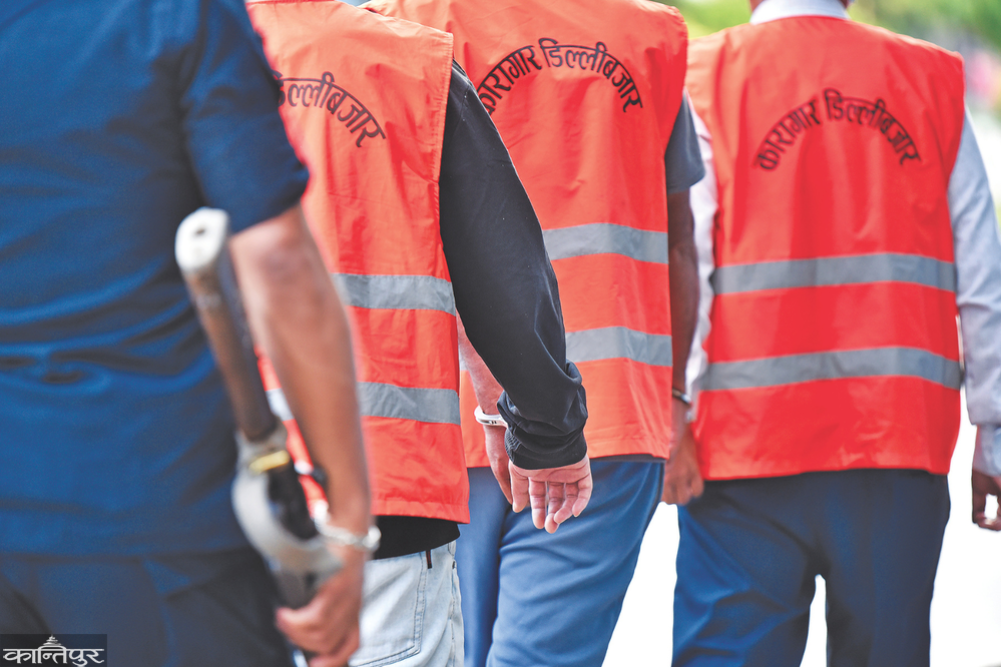
Kathmandu District Court found 95 percent guilty of 358 indecent assault charges last year, with half of the defendants serving more time in custody than their sentence until the verdict was delivered.
We use Google Cloud Translation Services. Google requires we provide the following disclaimer relating to use of this service:
This service may contain translations powered by Google. Google disclaims all warranties related to the translations, expressed or implied, including any warranties of accuracy, reliability, and any implied warranties of merchantability, fitness for a particular purpose, and noninfringement.
Safal Karki of Machhapokhari, Kathmandu-16, was walking near his lodge on the evening of 16th Magh, at around 5 pm. Suddenly, the police came. According to the statement given by 24-year-old Karki to the Kathmandu District Court, the police told him to ‘go to the lodge’.
‘The room is nearby, I will go slowly,’ he replied simply. That answer became the pretext for the team of Police Circle Balaju to arrest him. An urgent arrest warrant was issued. A report was made – ‘When he was found in a suspicious situation and asked about drugs, he instead argued and abused the police with obscene words, obstructing their work.’
Karki was then charged with indecent behavior towards the police. When District Attorney Jagat Bahadur Bohara filed a case in the Kathmandu District Court seeking one year in prison, Karki had already spent 14 days in custody.
When examining the entire case file, police report and court verdict, there is no information that Karki ever consumed, sold or transported drugs on that day or before. The question of on what basis a citizen who was walking on his own, on his own way, was stopped and interrogated is not answered in those documents. However, according to the law, when the police interrogate or search someone, reasonable grounds (probable cause) are required to be involved in a crime.
The day after the case was registered, on 1 Falgun, Judge Thakur Prasad Kharel pronounced the verdict – 14 days in prison, along with depositing two hundred rupees in the victim relief fund. While the names of the witnesses who allegedly saw Karki engaging in ‘indecent behavior’ were different in the charge sheet and verdict – sometimes Ram Tamang, sometimes Sudip Acharya.
The judge did not question such investigation. Acharya or Rai did not go to court as witnesses. The statement of the police who filed the report was also not taken. The court said that Karki's statement that the police were nearby and that he was going slowly was "he admitted to being involved in the crime."
In an analysis by Kantipur of 358 accused in 220 cases of indecent assault decided by the Kathmandu District Court in 2082, this incident is not an exception - it is one of dozens of similar natures. 95 percent of the accused in such cases have been found guilty. According to legal experts, when the court finds the arrested person guilty, it gives the same amount of time to validate the period spent in custody before the case was registered - as happened in Karki's case.
Earlier, an analysis of the arrest process of 788 people who were charged in three districts of the valley in the month of Falgun showed that 100 percent of the necessary documents were used in indecent assault. While it was two percent in banking fraud and zero in human trafficking. This raised a question, what is the impact of issuing urgent warrants on simple charges like indecent behavior? To find the answer, Kantipur examined a year-long decision. Which shows that the police have made the law on indecent behavior a tool to detain citizens who question them, and the court has become a place to formalize it.
Section 118 of the Criminal Code, 2074 BS, prohibits two types of acts under ‘indecent behavior’. Harassing someone in a public place or a place where one has no right to enter, or assaulting or harassing women, children or physically disabled persons.
The National Judicial Institute's explanatory note on the purpose of this section of the Code states, 'To maintain the dignity of women, children, physically challenged persons and other persons in public places and to protect their freedom to live independently.' In this, there is no place for the police themselves to be a party and initiate a case (as in Karki's case).
However, looking at the cases that have reached the court, there is also a significant number of cases in which the police have been accused of using abusive language against them or obstructing their work. In 52 of the 220 cases analyzed, that is, in one out of every four cases, the police were the complainants. The police have become the complainants themselves, the witnesses themselves and the investigators themselves. The chargesheets in these cases are also written in the same format and in the same sentence – ‘He abused and threatened the police on duty and behaved indecently by obstructing their work.’
Police spokesperson, Deputy Inspector General of Police (DIG) Abinarayan Kafle said that in order to maintain peace and security, the police arrest and file cases for indecent behavior when ‘disturbing’ police work needs to be controlled immediately. ‘The responsibility of maintaining peace and security lies with the police. When they are deployed for that work, they need to control the disturbers immediately,’ DIG Kafle said. ‘Since these cases are heard by the Chief District Officer, it is easier for us to work immediately.’
A joint secretary at the Attorney General’s Office says that there are many problems in such cases where the police themselves are the complainants. ‘We are discussing whether the police should decide to file a case as soon as the police submit the report in such cases,’ the joint secretary said.
Maharjan, a teacher from Chabahil, Kathmandu-7, is the victim of the problem pointed out by the joint secretary.
I went crazy in custody’
Maharjan (only surname used as he did not want to reveal his name) from Kathmandu used to teach in the same school with his wife. A family lived in his house on rent. Since the rent was due for about 18 months, there was a lot of bickering between the tenants and the landlords. Suddenly, the family accused Maharjan of sexually abusing their daughter on 17 Asho 2079 at 12:15 pm.
Maharjan was not aware of the accusation until the police came to his house at 9 pm – he was teaching tuition. Maharjan’s wife remembers, ‘The police came at night and said that they had to take your husband away. They didn’t say anything about why they had to take him away. They didn’t even give him a certificate. The other way – they took him from Khetaikhet.’
Maharjan said that he was at school that day, and that the digital attendance and CCTV footage there would confirm his statement. His wife said, ‘The police knew that he was at school at the time of the accusation.’ Then they should not have let him go. But they detained him for 25-26 days and filed a case of indecent behavior.’
In the report on indecent behavior, Maharjan is accused of obstructing women and children walking on a public road in Chabahil and arguing with the police and behaving indecently when they were reminded.’ However, Maharjan’s lawyer Pranil Pradhan said, ‘There was not enough evidence to show sexual abuse.’ Therefore, the police had to arrest him for indecent behavior. He conceived it himself and issued a warrant, and then detained him for investigation.'
Then, the complaint of sexual abuse was converted into rape and a case was registered at the Kathmandu District Court, while the case of indecent behavior was registered at the District Administration Office. The administration found him guilty and imposed a fine of eight thousand. Maharjan went to the District Court against that. In June last year, the court acquitted him, saying that 'it does not seem fair to punish a simple dispute with indecent behavior.' He was also found innocent by both the District and High Courts in the rape case.
In the experience of Advocate Pradhan, if the police want to investigate an incident and there is not enough evidence to detain him, a separate file for indecent behavior is prepared and another case is filed. He claimed that this was the case with Maharjan.
Maharjan's wife said, 'If I remember that time, it still feels like a kind of 'panic attack'. Tears well up in my eyes.' Maharjan adds, 'I went crazy in detention. I had heard that truth will prevail. Only the thought that it will happen one day saved me. Otherwise, I would have gone into complete depression.'
After that, Maharjan had to leave the school where he was teaching. Now he teaches in another. He has two young daughters. Life is getting back to normal. However, Maharjan does not want to make his full name public. Even after being acquitted in both cases, he fears that the stigma of rape charges still remains in society and the workplace. 'Who will give me back the 26 days I was detained at the Gaushala police post?' he asks.
Maharjan is one of the few accused in the indecent assault case decided by the Kathmandu District Court last year (2082) who were ultimately found innocent. The conviction rate in this case is extremely high (94.7 percent). Only about 5 percent (19 people) of the verdicts last year were acquitted. Yet, they spent an average of 25 days in custody – like Maharjan. Deepak Gajurel of Nuwakot has spent the most, 80 days.
When examining additional data from this case, it is seen that the average length of detention for those found innocent (25 days) is longer than the average length of sentence for those convicted and sentenced (20 days).
About half of those sentenced had already spent more time in custody than the prescribed sentence. On average, they spent 11 days in custody longer than the court had given them. The verdict released them from continuous detention, but could not bring back the free days they had been deprived of due to unjust detention.
Among those who suffered such a fate are four young women working in a dance bar. On 9 Falgun 2081, around 7 pm, Dina Tamang was walking around eating snacks. Manisha Rana Magar was at Gongabu. Maya Dhakal was sitting near Gate No. 1 of the New Bus Park. Sapna Thakuri was returning from her sister's house by taking a Pathao. The police arrested all four.
The report said, 'While questioning the women who were stealing, looting and engaging in immoral activities based on the complaint of the Buddhamarg Toll Development Committee, Gongabu, they abused them with abusive language and behaved indecently.'
The court asked for a bail of Rs 5,000 for all of them. After paying the bail, they were put on trial. Then the court ordered the witnesses to be examined. The police who filed a report alleging that they had behaved indecently did not go to court. The court ordered them repeatedly, but the police did not go.
All four gave the same statement in court – they had not abused anyone, nor had they argued with the police. Dina Tamang said, ‘The police caught them while they were walking around eating.’ Maya Dhakal said, ‘They took them while they were sitting.’ Sapna Thakuri said, ‘They made them get off the bus and put them in a van and took them away.’
The court wrote in its verdict, ‘There was no evidence or complaint of theft or looting. It is natural to argue and argue when questioned on unfounded allegations. It did not seem that indecent behavior could be considered just because there was an argument with the police.’ All four were acquitted. But, by then, all four had spent 18-18 days in custody.
Thus, for some, such ‘illegal’ imprisonment is limited to a few days like these four girls or Maharjan of Chabahil. But, for many, it is months long.
The detention of Tshiring Sherpa from Solukhumbu is one such case.
30-day sentence, but 4 months in custody
He is a carpenter by profession. Around July 2082, while he was walking on the Thapathali road in search of work, the police took him into custody as ‘suspicious’. According to the police report, during the interrogation, Tshiring Sherpa argued with the police, made noise and disturbed public peace. But Sherpa’s statement is different. He says that the police caught him while he was walking on the road looking for goods. ‘There was no shouting, no abuse,’ he said in court.
The police themselves became the complainant in this case. However, there is no such detail in the file that shows that Sherpa’s behavior obstructed the police’s work. A case of indecent behavior was registered based on the ‘suspicious movement’ and the alleged dispute that followed.
The court ordered his release on a bail of 10,000 rupees. But Sherpa did not have that much money. He was sent to jail. He had not been convicted till that day. However, now he had to wait until the end of the case in jail along with those convicted in other criminal cases. The verdict came four months later. The court sentenced him to 30 days in prison and a fine of 1,000 rupees. However, by that time, Sherpa had already spent about 122 days in jail. He spent 92 days in jail more than the sentence he had been sentenced to.
Abhishek BK is another example of such ‘injustice’.
BK, 26, from Bakaiya-4 Majikhola in Makawanpur, has been living in Kathmandu-16 Mananggate as a daily wage labourer.
On the morning of 11 Jestha 2082, he had an argument with Saroj Gurung on the street near Malla Hotel in Thamel. According to Gurung’s complaint, first there was verbal abuse and then a beating. Gurung was injured, some of his cash was lost and his mobile worth Rs 15,000 was also damaged. However, in his statement to the court, BK called the incident a ‘normal fight’ and claimed that he did not take any money.
The court did not see any grounds to keep him in custody immediately. It decided to release him on bail of Rs 12,000. According to the court process, this was his only way to freedom. But, like Sherpa, he did not have the money to post bail. He was sent to jail – just like Sherpa.
After about seven months, his case came to court. On December 21, District Judge Khimananda Bhusal sentenced him to six months in prison, the highest sentence given by the court in the 2082 BS indecent behavior case. But by the time the verdict was delivered, BK had already spent 27 days more in jail.
‘Indecent behavior’ is a new offense added to the 2074 BS code. But its roots go back to the Panchayat period. King Mahendra had enacted the ‘Certain Public (Offences and Punishments) Act’ in 2027 BS. Section 2 of it provided for ‘obstructing any public servant in the performance of his official duties’ as an offense. Under that law, which was made to ‘maintain peace and order’, the police used to take action for obstructing their work. The act was repealed after the code was implemented. But the police are using the same act through the law on indecent behavior.
In fact, Section 101 of the Code provides for imprisonment of up to three years for those who physically resist arrest. However, to use this provision, the police must prove that a warrant was issued in accordance with the law and that the accused physically resisted. According to legal experts, it is difficult for the police to gather such evidence, because wherever the police have made a report stating that there was obstruction in the investigation, in reality, there was no such obstruction. And, when making an arrest under indecent behavior, the police do not have to gather any evidence other than a report.
Similarly, Section 85 of the Code provides for imprisonment of up to one year for ‘obstructing any public servant who is about to perform his duty’. The police can also take action under this section.
In the Code, cases under Schedules 1 and 2 are investigated by the police and taken to court by the government prosecutor, while any case under Schedule 3 must be directly filed in court by the affected body or person. Cases under Section 85 fall under Schedule 3, and if the police have to prosecute someone who obstructs them in their work, the police personnel concerned must go directly to court. To circumvent that legal provision, the police file cases under indecent assault in cases where they are said to have obstructed their work.
Police spokesperson, Deputy Inspector General of Police (DIG) Kafle said that the police have a practice of taking cases to court only through government lawyers, and they do not take them directly to court. ‘Since these are Schedule 3 cases, we file cases through government lawyers rather than going directly to court for indecent assault,’ he said. ‘However, we have only taken cases of indecent assault through government lawyers in cases where we have obstructed the police, harassed women, children or the disabled, and disturbed peace and order.’
In cases that started with police reports, most of them have spent more time in detention than the sentence they were sentenced to. It seems that the accused in the cases initiated by the police spent an average of about 8 days in custody more than the prescribed period.
In this process, there are also some people who were found guilty in the verdict, but in the end, the court saw fit to fine them only a small amount of money, and not to sentence them to prison. But by then, they had already spent weeks in jail.
Looking at the statistics, it seems that the court only imposed a fine on 34 out of 358 people. However, all of them had already spent a few weeks in police custody. It seems that they spent an average of 14 days in such custody. Of which, Saroj Tamang (19 years old) of Budhanilkantha-10 and his friend Shubham Adhikari (20 years old) spent the most in police custody, 25 and 23 days respectively.
When asked about the ministry's perspective on the risk posed by the current practice of the police in cases of indecent behavior, Anand Kafle, a spokesperson for the Ministry of Home Affairs, said, "We have been telling the police, as well as the Chief District Officer, to implement the intent of the law in regional security seminars." "We have been giving instructions to work according to the procedure of the law," he said.
"That was a directive on the general application of all laws, is there any directive on cases of indecent behavior?" In response, spokesperson Kafle said, "There is none."
The report submitted in Ashar 2081 by the Criminal Justice Administration Reform Task Force formed by the Attorney General's Office has acknowledged this problem at the government level. The report states, ‘The period of investigation and detention for common offenses such as indecent behavior should be reduced (from 25 days) to a maximum of 15 days.’ The report also suggests redefining indecent behavior and limiting its use.
Somkant Bhandari, currently the head of the Kathmandu District Attorney’s Office, was the member secretary of the task force. He says, ‘We suggested substantive reforms based on the assumption that there were incidents of violation of personal freedom.’
Associate Attorney Bhandari said that the problem arose because everyone from the police to the attorney general and judges could not grasp the spirit of the new law. He said, ‘The laws came from new concepts. The attitude of the working officials has not improved accordingly. That is why the problem has arisen.’
It has been two years since the Attorney General’s Office submitted this report. There has never been a discussion on this in Parliament. The law is the same. And, the biggest victims of this are those who cannot even afford a lawyer in court for their defense.
Those who cannot afford a lawyer
Seeing a 95 percent conviction rate in indecent assault cases, a natural question arises – is the police investigation and the defense of the government prosecutor so effective in this case? Is the evidence collected so irrefutable? However, the analyzed judgments say that the reason is that the accused do not have the ability to defend themselves in court.
Of the analyzed judgments of last year, only 23 people were able to hire their own lawyers. That is, only 6 percent. Out of every 100 people accused of indecent assault, 94 cannot even afford a lawyer. Of the remaining, only 17 received the services of a paid lawyer – that is, only 5 percent have access to the free legal services provided by the court to those who cannot afford to hire a lawyer due to their financial situation. Of the remaining 241 people, it is not mentioned in the judgment whether or not they received the opportunity for legal defense.
If the accused admits his involvement in the case, the court can give the final verdict on the same day of the closed hearing. In such a situation, those who cannot afford to hire a lawyer do not even get the opportunity to demand free legal services. When reading the verdict, the court seems to have held the final hearing on the same day without their legal defense, citing reasons such as their confession and lack of witnesses. Whereas, the constitution, as a fundamental right, gives the accused the right to consult their legal practitioner from the time of their arrest. However, district judges are making the final decision in the cases of accused who did not get the opportunity to consult legal counsel right before their eyes.
Another problem in this entire process is how the court is understanding the accused's confession. Let's look at the example of Safal Karki. He had said, 'The room with the police is nearby, I said I would go slowly, and there was a general argument in the process.' However, the court interpreted that as him admitting the charges.
Another person who is ‘victimized’ by the court’s interpretation is Rajkumar Majhi.
According to his statement, on 27 Magh 2082, at around 5 am, he was going to work from Balkumari towards Jadibuti. He had just started cutting tickets at the Triveni counter of Tata Sumo. While boarding the bus, he got into a scuffle with a policeman who was not wearing a uniform, which led to an altercation. After that, he and his friend Shyam Rai were taken to the police station. He said in his statement, ‘I have not behaved indecently with anyone.’
The police, in their report, stated that they were arrested at the Sinamangal bus stop for ‘creating a fake crowd by crowding women and elderly passengers and intending to pickpocket’. Along with that, they were presented as hardened criminals, saying that they had been ‘arrested in various criminal activities before’. Such a claim further strengthens the case against the accused, because if found guilty, the punishment will be one and a half times higher.
In the court, Majhi said, ‘The police report is false. The police took us for questioning after an argument about a scuffle in the car. We did not do anything with the intention of picking pockets by inciting a crowd. The police brought me from the bus station in Balkumari. I had not gone to Sinamangal. I have not behaved indecently with anyone.’
Thus, Majhi had denied all the allegations in his statement and only mentioned that he had been scuffled. The court interpreted the statement as ‘admission of guilt’ and pronounced the verdict on the same day. According to the provisions of the Code of Criminal Procedure, if a confession is found, a decision can be made without further evidence. That means, he did not even get the opportunity to hire a lawyer or get paid legal aid.
In this case, the police had sought additional punishment based on the previous case, showing him as a repeat offender. However, when searching for additional documents related to it, Kantipur found many inconsistencies. The charge sheet mentioned that Majhi was sentenced to three and a half years in prison by the Kathmandu District Court in rape case number 073-Rich-1416. Whereas the accused in that case was Bishnu Khatri and he was acquitted, which has nothing to do with this indecent behavior case.
Looking at the details of the Kathmandu District Court, it appears that a theft case was registered against Majhi in 2075 BS, not rape. Although he was convicted by the District Court, he was later acquitted by the High Court in 2078 BS, which is not mentioned in the charge sheet. Thus, since it was not established that Majhi had been convicted in any previous case, the indecent behavior case for the first time should have fallen under the jurisdiction of the District Administration Office and not the District Court. In his ruling on February 13, Judge Ishwori Prasad Bhandari did not declare Majhi a repeat offender, but sentenced him to 10 days. By then, Majhi had already spent an additional 6 days in custody.
Three sides appear simultaneously in this case.
First, saying ‘I was pushed’ is not an admission of guilt, but the court interpreted it as proof. Second, the verdict was made on the same day due to that interpretation, which closed the door to hiring a lawyer. Third, the police tried to use the acquitted case as evidence of a repeat offense. The court ultimately stopped the police’s move, but for that, Majhi had to be imprisoned first and lose the case. This defeat will make him a repeat offender in other cases in the future.
A first-time offender can be sentenced to a maximum of one year in prison or a fine of ten thousand rupees, or both. But if the accused has already been convicted in a case, he is considered a 'repeat offender' and the punishment increases by one and a half times. This provision of repeat offenders determines where the case is registered. According to Article 152 of the Constitution, cases that can be punished with a sentence of more than one year fall under the jurisdiction of the court, while cases of less than that are handled by the District Administration Office (CDO). Therefore, the case of a person accused for the first time goes to the CDO. The case of a repeat offender is heard in the district court. As Kantipur analyzed the cases of repeat offenders that reached the Kathmandu District Court, most of them are accused who have been convicted in some case before.
The relationship between legal representation and conviction is clear in the analysis of these cases. The percentage of convictions for those who hired private lawyers is about 83, which is about 13 percentage points lower than the total convictions. While the conviction rate for those who were sentenced without consulting a legal professional on the same day they were brought for a detention order is 98 percent. In the last year's verdicts, the conviction rate for those who had paid lawyers is 100 percent. That is, paid lawyers could not acquit a single person. The question has arisen, is this the personal failure of one lawyer or a structural problem in Nepal's criminal justice system?
Advocate Harka Bahadur Rawal says that the police are 'widely misusing' the law on 'indecent behavior'. 'This is an excess of state power on innocent citizens,' he said, who is a member of the Criminal Reform Task Force formed under the leadership of the Attorney General. 'They are also charging those who should not be charged. Many are suffering unnecessarily.'
Advocate Rawal said that this is a matter of human rights violation and that the police should understand it as a restriction on fundamental rights. ‘It is difficult to reduce (abuse) unless such police are held accountable,’ he said.
(This is the second story in a three-part series on the misuse of arrest warrants and its impact. Read the first story here ) This is how data was collected