I don't understand why the Metropolitan Police ordered the deletion of photos and videos from inside the holding center where the displaced people from Sukum were being held.
We use Google Cloud Translation Services. Google requires we provide the following disclaimer relating to use of this service:
This service may contain translations powered by Google. Google disclaims all warranties related to the translations, expressed or implied, including any warranties of accuracy, reliability, and any implied warranties of merchantability, fitness for a particular purpose, and noninfringement.
A large group of Kathmandu Metropolitan Police arrived in a vehicle. Holding me by the arm, one of the city police officers told the other police officers, 'He was inside and filming, what should we do now?' The metropolitan police officers questioned them in turn, 'With whose permission did you film?' I gave them all the same answer, 'What is the order not to film, whose is it?' A metropolitan police officer asked, frowning, 'With what order did you come here to film? Show me your papers.' I showed my journalist ID card and said, 'This is my right to film. This is my papers.' The police officers argued, 'Why are we going around firing guns just because we have guns?'
After the blabbering continued, I said, 'I won't film or take photos, just let me understand the situation there.' The policeman who held my arm insisted, 'First delete that video. Then you can talk.' I said, 'Why delete something that has already been filmed? You can't just say delete.' He kept insisting, 'Didn't you hear me say delete?' Gradually, his voice grew louder. Menuka Waiva, a journalist from Ukera.com, who was nearby, was also listening to this. At that time, she was also experiencing anxiety while trying to enter the center. She later said, 'They also made me anxious.'
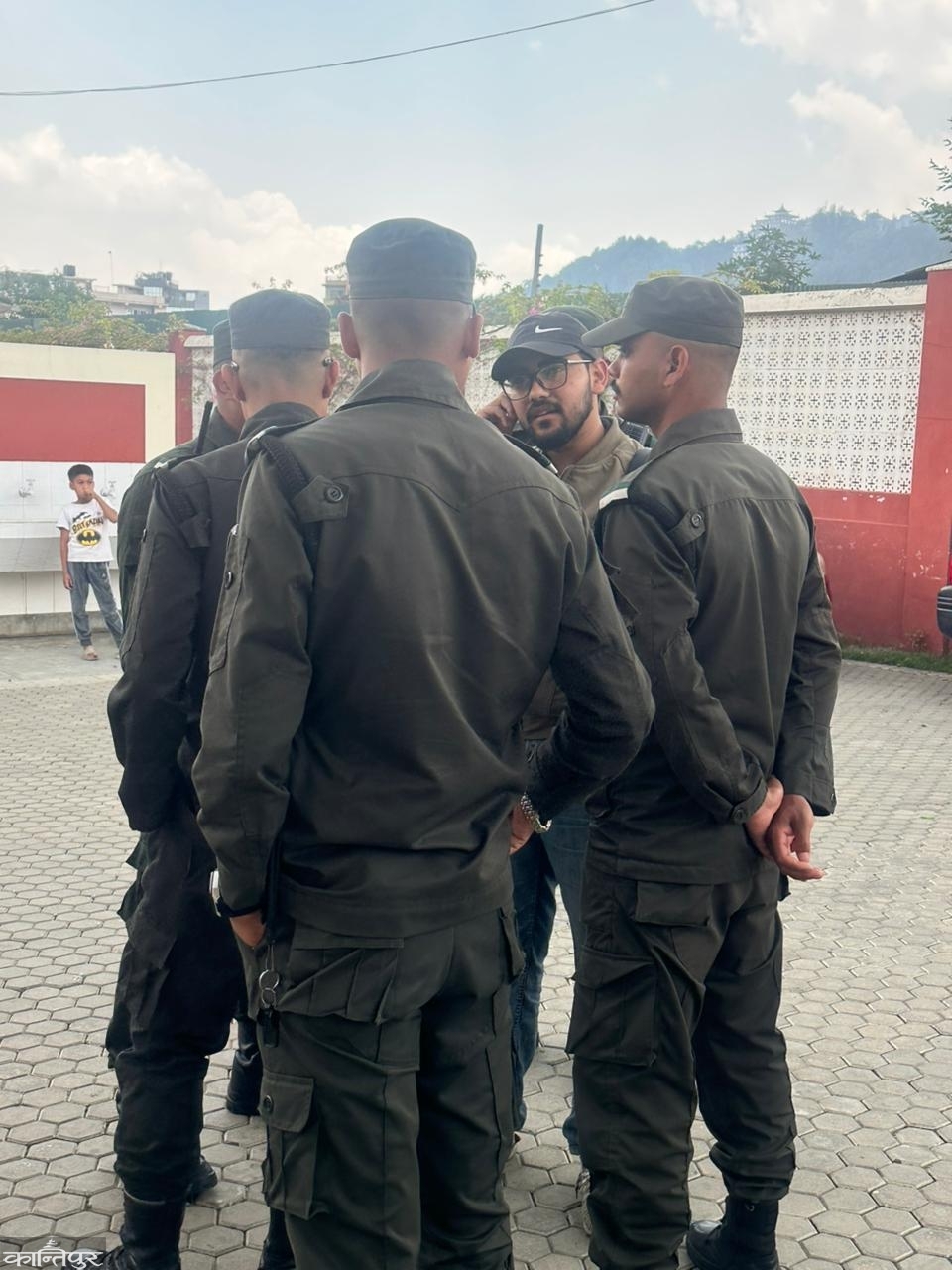
I wanted to talk to the displaced people inside. But the policemen were insisting that I not go. 'First delete it and then go,' the city policeman said. I said a little softer, 'I won't film it now, but you can keep my phone.' I will just write it down after talking.' But the city police refused. I was opening my mobile. He was looking at me and said, 'Don't you agree to delete it?' I pretended to delete it to avoid it, but the city police had already sent the pictures and videos I had taken to the editorial team.*
000
On Wednesday, it was 11 am when I reached the 'Holding Center' at the Radhaswamy Satsang Center in Kirtipur. Last Saturday, the government had displaced the squatters from Thapathali, Gairigaun, Shantinagar and Manohara and kept them there. I had reached there to report on their condition. There were two constables of the Nepal Police at the gate. They did not stop me. I got inside. The scene there was different from what the government had said. A large tent-like hall but without walls. It was surrounded by yellow sheets. Where the displaced people could see piles of belongings. And the beds spread on the floor and the 'family number' written on the side could be seen from afar.
Knowing that it would be a bit difficult for a journalist to go inside, I had talked to one of the displaced people living in the holding center in the morning. When I arrived, he had just finished eating. I sat next to the bed made of black plastic foam and talked to him. He told me about his surprise after the rain at night. Showing the bed, he said, 'Yesterday, water got inside and it was no problem! This bed is also completely wet.' There is no place to dry. The children's clothes are also wet.' His mother and wife also told him about the night's trouble.
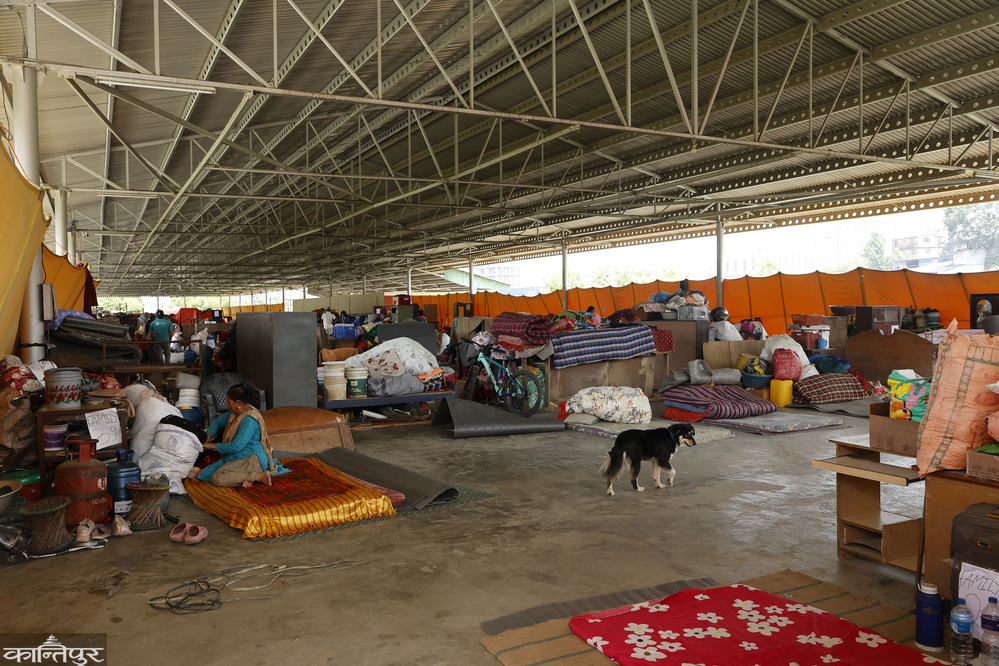
I learned from their stories that there was talk of giving them a tent. He said, 'There are so many of us, who will give us such a small tent? Who will stay?' Shortly after he said this, some soldiers from the Armed Police Force came and said, 'Where are we going to move this stuff? We have to put up a tent here.'
Until Tuesday, the displaced people who had taken shelter here like him had been spending the night on black plastic foam and hammocks. After the rain on Tuesday night added to the problem, preparations were being made to pitch a tent here. While I was filming this scene, a man grabbed my arm and said, 'Why are you taking photos here?' I asked, 'Why can't you take photos?' The person who held my arm was a Metropolitan Police officer from Kathmandu Metropolitan City. He said, 'No, no, no' and forcibly pulled me away. I turned on the video on my mobile. While holding my arm and pulling me out, the police officer said, 'The press is prohibited here. You are not allowed to film anything inside.'
I asked, 'Why is it not allowed?'
He replied, 'There is an order from above.'
I asked again, 'Where is the order from above? What is the order?' He was shocked. He called the Nepal Police constable who was standing there, 'Sir, come here, he is filming a video.'
The constable also said, 'Sir, you are not allowed to film photos/videos here.' I also asked him, 'Why is it not allowed?' Their only answer was - 'Order from above.' Even as I was talking, the Metropolitan Police kept holding my arm. I told them, 'Whose order is it not to pull? And if not, who gave you the right to grab my bag?'
The Metropolitan Police was holding me with one hand, and with the other hand, he was calling someone on his mobile and saying, 'Sir, come here, someone is taking photos and videos. You have to come.'
In a moment, another constable arrived. He said, 'Sir, he has gone inside and made a video.'
I asked the same constable, 'You are not allowed to take photos?'
The constable replied, 'Have you taken orders?'
I asked back, 'Who needs orders? Who should we take orders from?'
He replied, 'We have been told that, we are working accordingly.' The constable pointed towards the Metropolitan Police and said, 'Call there.'
The Metropolitan Police tried to get me out of the compound and said, 'Don't walk there, sir is coming.'
Another constable said, 'Don't discuss with us, talk to sir.'
I asked him, 'I didn't discuss. You grabbed me and dragged me while I was inside.' The Metropolitan Police kept repeating, 'This is not allowed here.'
A mother came nearby and said, 'We should be allowed to shoot videos.' She was one of the displaced. 'Even if the government insults us and makes us sit up, can't anyone come and meet our relatives?' The mother looked at the police and said, 'You have filmed all our videos. You have filmed what we eat, you have filmed what we sit. You only show the good things on the outside. Why didn't you show the bad things on the inside? Even when they try to film it, they don't let you?'
The mother also expressed her anguish at being imprisoned in the name of security. 'Every time we go out, even before we go to buy slippers, we have to write down our names! Did we come by stealing? Did we come by killing ourselves?'
The police constable said, 'How can you not understand, is that for you...'
At that moment, my mobile camera turned off. I didn't realize it. The city police took me by the arm and took me towards the Nepal Police station.
000
The videos and pictures I had taken were deleted in the crowd of the Metropolitan Police near the gate. I couldn't resist there . I had to talk to the displaced characters . So I said, 'Okay, it's deleted, let me in .'
They said again, 'Now there's no video-photo available . It's just monitoring .' A Metropolitan Police officer with a star sign said, 'If something difficult happens to them, stop them .'
The Metropolitan Police officer who held me by the arm followed me . I entered the hall again . I started talking to the displaced . But the police were roaming around me .
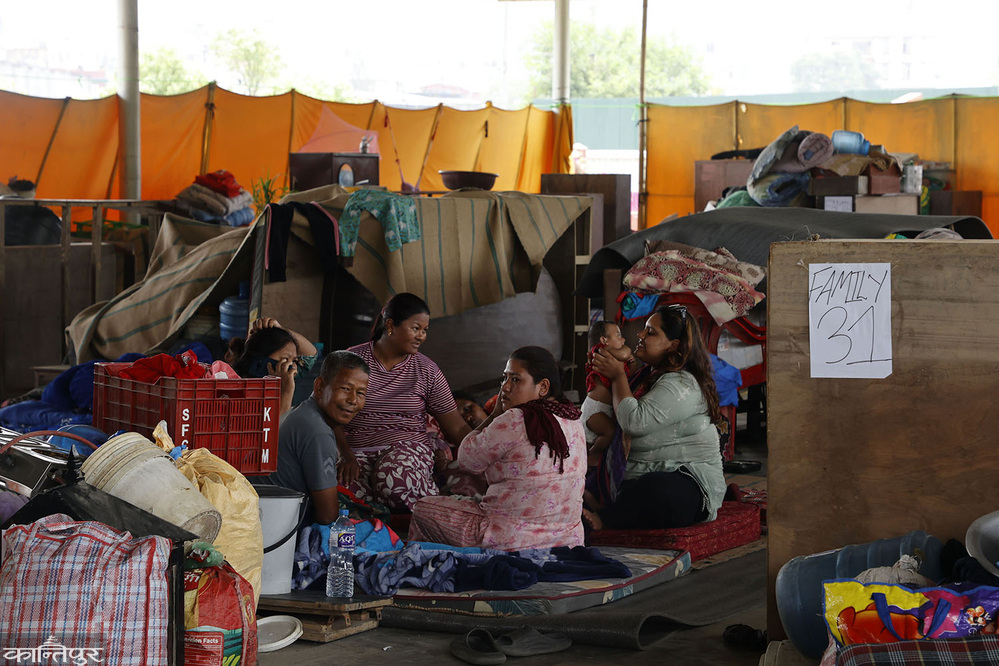
72-year-old Kanchhi Maya Ghale narrated her ordeal . She said, 'Until yesterday, they used to bring rice in a box, I wouldn't have eaten anything for an old man . Today, they cooked it here .' She also said that after coming there, she started feeling cold . She said, 'It seems like the cold has caught up with me, my body is starting to ache.'
She said that she has not been able to sleep since the miking in the settlement on Thursday. 'I have not been able to sleep since I heard the miking in the settlement. I have not been able to sleep since I was brought here on Saturday. The rain that fell last night would have made me sleep even more,' Kanchhi Maya said, 'I sleep a little bit during the day. What can I do with a child making noise like that!'
Although Kanchhi Maya's life is in Kirtipur, her heart is in Thapathali. The scene of the dozer running in her house on Saturday morning keeps coming back to her. 'Now only dust, mud and broken zinc sheets are moving before my eyes,' Kanchhi Maya lamented, 'The state has not even seen that hut that was built with pain and suffering.'
Her countless memories of 20 years are buried in that rubble. Kanchhi Maya, who was born in Magh, 2012, remembers her birth date and the bittersweet moments of the past by heart. On Poush 2, 2064, she had arrived in that corner of Thapathali looking for shelter. 'I had brought the baby in my arms, carried bamboo poles from Tinkune to Tinkune, and built a small hut by digging the ground with my own hands.'
She had arrived in Thapathali in 2068 BS. She was getting emotional as we talked. At that moment, the Metropolitan Police, who was sitting nearby and listening to our conversation, came and said, 'Now it's done.' He was about to end the conversation. At that moment, I spoke to Kanchhi Maya in her Tamang language and asked for her telephone number. The Metropolitan Police did not understand the conversation in Tamang.
A little further away, 53-year-old Pakacha Tarim Kasai was seen. I had been following Kasai since the bulldozer was deployed in the settlement on Saturday. He had separated from his wife at Dashrath Stadium on Saturday. We had published his story in Kantipur. However, they were seen together now. I was trying to talk to them, but the Metropolitan Police were sitting behind and saying, 'Jam, now jam.' *Updated.