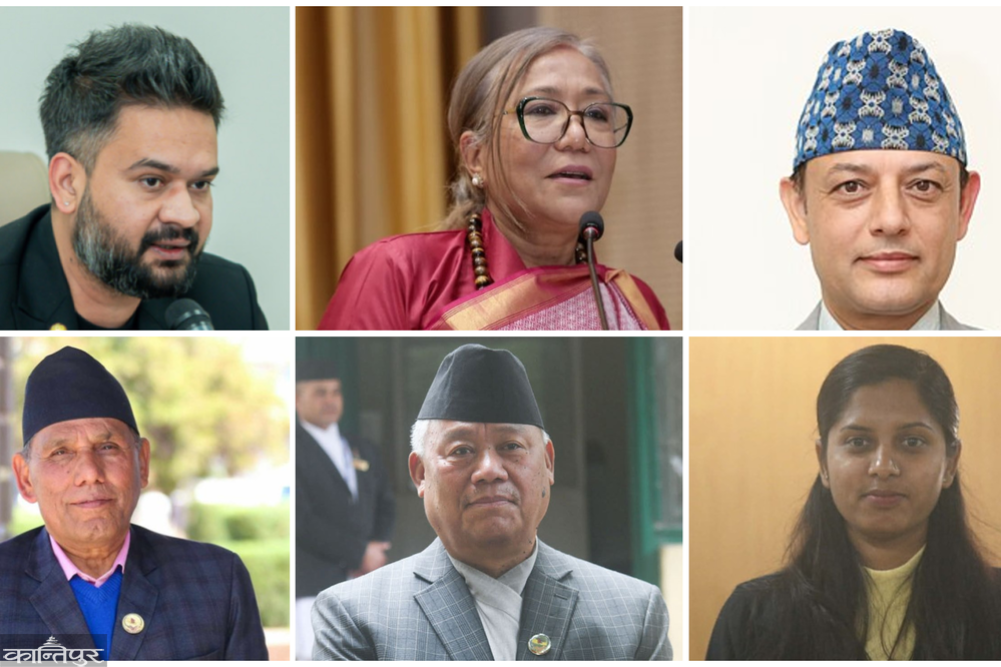
If Malla becomes Chief Justice, women's participation in the council, which has been accused of being non-inclusive in the past, will reach 33 percent.
We use Google Cloud Translation Services. Google requires we provide the following disclaimer relating to use of this service:
This service may contain translations powered by Google. Google disclaims all warranties related to the translations, expressed or implied, including any warranties of accuracy, reliability, and any implied warranties of merchantability, fitness for a particular purpose, and noninfringement.
The long-vacant Constitutional Council has been completed with the election of Bhishma Raj Angdembe as the leader of the parliamentary party by the main opposition Nepali Congress on Monday.
When the Constitutional Council was vacant for 8 months, the Chief Justice of the Supreme Court, judges and office bearers of other constitutional bodies could not be recommended.
The Constitutional Council has a constitutional provision to be headed by the Prime Minister and consist of six members. Where the Chief Justice, Speaker, Speaker of the National Assembly, Leader of the Opposition and Deputy Speaker will be members.
The current council includes Prime Minister Balendra Shah, Acting Chief Justice Sapana Pradhan Malla, Speaker Dol Prasad Aryal, National Assembly Chairman Narayan Dahal, Leader of the Opposition Bhishma Raj Angdembe and Deputy Speaker Rubi Kumari Thakur. However, in the event of a vacancy in the post of Chief Justice, the Law Minister is required to participate as a member in the meeting to recommend the Chief Justice as per Article 284 of the Constitution.
The Constitutional Council, which has been accused of not being inclusive in the past, will have two women members if Malla becomes the Chief Justice. In such a situation, women's participation in the Constitutional Council will be above 33 percent. Similarly, Opposition leader Angdembe is from the Janajati community, Prime Minister Shah is from Madhesh, and Deputy Speaker Thakur is from the Madheshi Dalit women. Acting Chief Justice Malla is also a tribal woman.
The Constitutional Council will recommend the appointment of the Chief Justice, heads of constitutional bodies and office bearers. Currently, the posts of Chief Justice, Chief Election Commissioner, one member of the Commission for the Investigation of Abuse of Authority, one member of the Human Rights Commission, office bearers of the Women's Commission and the Finance Commission are vacant. Similarly, ambassadors of various countries are also vacant.
The path to the recommendation of the Chief Justice has been opened
With the completion of the Constitutional Council, the path to the appointment of the Chief Justice by the Supreme Court, which was run by Kamu, has been opened. After Prakash Man Singh Raut retired due to age limit, the Supreme Court has been running by Kamu.
Malla has been running the Supreme Court as a senior judge. Although the constitution provides for a recommendation one month before a vacancy occurs, the Constitutional Council was incomplete due to the dissolution of the House of Representatives by the government formed after the Gen-G movement on 23 and 24 Bhadra, which resulted in the absence of the Speaker, Deputy Speaker and the leader of the main opposition party.
The Constitutional Council was completed after the election held on 21 Falgun with the elected House of Representatives. The Judicial Council had already recommended the names of six people who had completed three years of eligibility for the future Chief Justice of the Supreme Court.
The Council had sent the roster of Sapana Pradhan Malla, Kumar Regmi, Hari Prasad Phuyal, Manoj Kumar Sharma, Nahakul Subedi and Til Prasad Shrestha to the Constitutional Council.
The names of all those who had completed three years as judges of the Supreme Court were recommended as per the constitution. Since the Chief Justice has been appointed without considering the seniority in the past, it seems that the Constitutional Council will take the same path this time too.
Legal vacuum remains
Even though the Constitutional Council was completed on Monday, the legal vacuum remains
After assuming the responsibility of the Prime Minister in the interim government, the Sushila Karki-led government had brought an ordinance on the Constitutional Council targeting the appointment of the Election Commission, ambassadors and the Supreme Court, but
President Poudel had stopped it . Before that, the President himself had also sent back the bill on the functions, duties and powers of the Constitutional Council, which had been passed by both houses during the time of the then Prime Minister KP Sharma Oli. The President had pointed out 5 issues that needed to be improved in the bill. In which, it was asked to reconsider issues such as those that could be decided by a majority of the number present. Oli had issued a new ordinance and appointed 52 people to the constitutional commissions. He had issued an ordinance so that decisions could be made by a majority of the number present and appointed Prem Kumar Rai, the head of the Commission for the Investigation of Abuse of Authority, at that time. However, the ordinance could not be passed by the parliament within three months. Oli himself dissolved the parliament. The legal complications related to the Constitutional Council that began after that still persist. The Shah-led government is preparing to resolve the legal complications through an ordinance. A minister said that the government is preparing to bring some ordinances including some other laws as it is having problems with its daily work, and one of them is related to the Constitutional Council.
The government had called the parliament session on 10th Baisakh and postponed it. The parliament session that was recommended to the President on 8th Baisakh was sent a recommendation for postponement less than 24 hours later. Although preparations were made to start the budget session of the parliament from 17th Baisakh, the government had taken this decision because the work would be difficult if some ordinances were not issued in favor of the council. The government is probably preparing to send those ordinances to the President's Office by Tuesday and call a parliament session.