The campaign to remove encroachments, initiated after the interest of Prime Minister Balendra Shah and the directives of Home Minister Sudhan Gurung, is part of the Fewa Lake conservation program included in the government's 100-point agenda. However, before the bulldozer was used, neither compensation was finalized, nor was an assessment of the affected land and structures, nor was a master plan prepared for what to build in the vacated area.
We use Google Cloud Translation Services. Google requires we provide the following disclaimer relating to use of this service:
This service may contain translations powered by Google. Google disclaims all warranties related to the translations, expressed or implied, including any warranties of accuracy, reliability, and any implied warranties of merchantability, fitness for a particular purpose, and noninfringement.
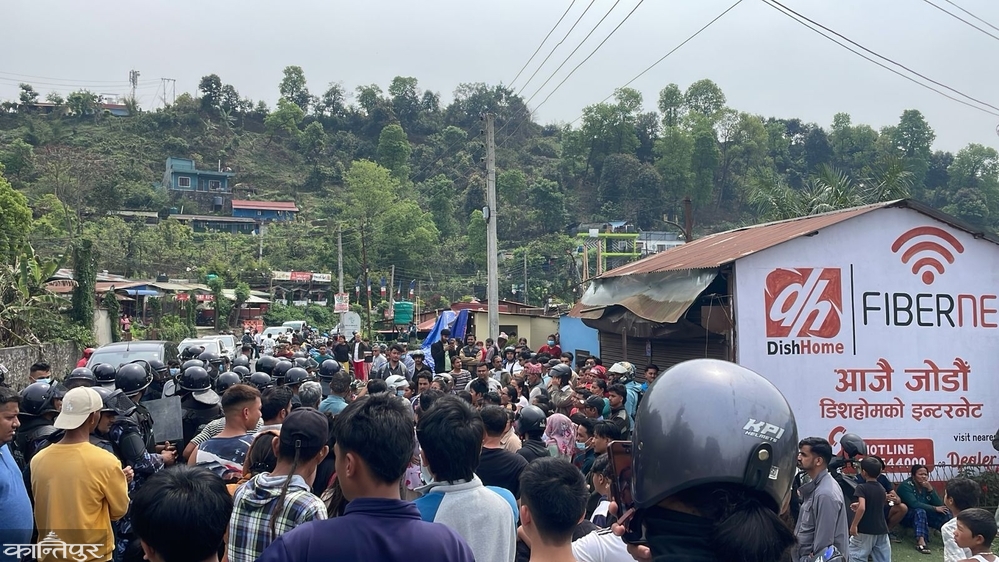
Manju Thapa of Khapaundi, Pokhara-18, who was sleeping with her two sons, was woken up by a phone call on Chaitra 21. After her friend told her about the dozer coming to demolish the structures on the banks of Fewa Lake at 5:15 am, she rushed out. She was overcome with joy when she saw the dozer running at the Palm Beach restaurant near her house. “As soon as I woke up, I felt like I was in a dream,” she said, recalling that misty morning on Saturday. “The neighbors around me had not woken up yet. My husband, two sons, and I went out and asked for help.”
Earlier, she had received information that only structures built within the 65-meter boundary of Fewa Lake would be demolished after the Supreme Court’s verdict and that structures with land titles would be removed only after the compensation for the structures was finalized. In Khapaundi, located in the northwest of Fewa Lake, her family was building a house and running a shop on their ancestral land. Her house was also symbolically demolished by a bulldozer from the metropolis. ‘The workers of hotels and restaurants on the lake shore from Sedi to Khapaundi were scattered,’ she said, ‘The children, the elderly, and the sick in the families who had built mud houses had to get up and walk.’
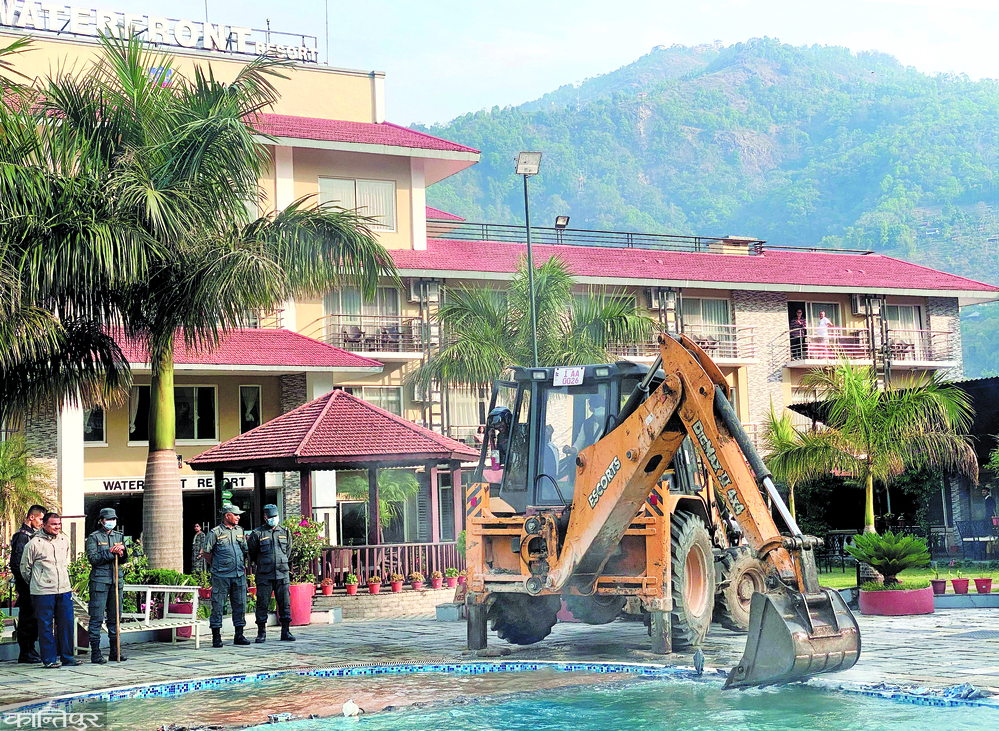
The day after Prime Minister Shah called expressing interest in the conservation of Fewa Lake, Pokhara Metropolitan Mayor Dhanraj Acharya told Kantipur, ‘We will start implementing the 65-meter standard by demolishing the building of our Education Division.’ But on Chaitra 21, the bulldozers were started from the water front resort in Sedi.
Ishwar Baral, a local from Lakeside whose land falls within the 65-meter standard, also expresses the same pain. ‘We have not encroached on anyone’s land, nor have we encroached on the state’s land. This is land with a private document belonging to a person,' he says, 'The state keeps squatters in one place by giving them a document. Now, it is going to make people with a document a squatter.'
Amrit BC, manager of Water Front Resort, said that his foreign guests were terrified when the metropolis suddenly started using dozers in the tourist area in the morning. 'The sleep of the guests who were staying was disturbed,' he said, 'After hearing that it was demolished, guests who are currently in the country and abroad have expressed their concerns after using our services.'
This campaign, which was launched after the interest of Prime Minister Shah and the directive of Home Minister Sudhan Gurung, is part of the Fewa Lake conservation program included in the government's 100-point agenda for governance reform. However, the implementation process of the directive has been widely criticized. Before using the dozer, neither compensation was finalized, nor was the affected land and structures assessed. Similarly, a master plan for what to build in the vacated area has not been prepared.
 It seems that the decision was taken in the 15th meeting of the Kaski District Council held on 15 Ashad 2064 that no physical structures could be built within 65 meters of the lake's shore. The meeting on 28 Shrawan 2064 had made the only decision to keep a 65-meter buffer zone around Fewa Lake. After seeing that the decision was not implemented and encroachment on the lake increased, advocates Khagendra Subedi and Ramesh Ghimire filed a writ petition in the Supreme Court on 10 Magh 2067, making 16 different bodies, including the Office of the Prime Minister and Council of Ministers, as defendants in the matter of Fewa Lake conservation. After that, the then Prime Minister Baburam Bhattarai formed a committee under the leadership of Bishwo Prakash Lamichhane, Chairman of the Pokhara Valley Urban Development Committee, to investigate the encroached land around Fewa Lake. The committee submitted its report on 3 Jestha 2069.
Based on Lamichhane's report, on 16 Baisakh 2075, a joint bench of Supreme Court Justices Om Prakash Mishra and Sapna Pradhan Malla issued a permanganate on 11 different issues in the name of the opposing body. The decision is considered historic in terms of Fewa Lake conservation. The order included instructions to establish the four forts of Fewa Lake within 6 months, remove structures within 65 meters within 6 months, acquire the surrounding land for long-term conservation of the lake with compensation if necessary, and control the Gegran flowing from the source.
After the decision was not implemented for a long time, advocate Subedi filed a contempt of court case in the name of the opposing party. To implement the decision, in 2077, the then Prime Minister KP Sharma Oli formed a committee to determine the four forts of Fewa Lake, demarcate and map it under the chairmanship of Kaski UML leader Punya Poudel. There are two different reports from the committee led by Lamichhane and the committee led by Poudel regarding the contaminated land.
If the Supreme Court's decision of 16 Baisakh 075 and the motivated order of 4 Asar 080 are implemented, many government structures within 65 meters of the shore of Fewa Lake will be demolished. The Education Division building of Pokhara Metropolitan City is located on the damside at the bottom of the lake. The nearby police station, Nepal Tourism Board and Immigration Office buildings, Kedareshwor Temple, Ratna Temple built by King Mahendra and Hima Grih should also be demolished. However, even though the demolition of private structures has started, the work of using dozers has been stopped before the demolition of government structures. Pokhara Metropolitan City Mayor Acharya said that the structures will be demolished only after issuing another notice.
Although it was said that the implementation of the standards will start after demolishing government buildings, the locals and tourism entrepreneurs around Fewa Lake are worried after the demolition of structures on land with numbered red papers was started first under the instructions of the federal government. Stakeholders have expressed concern that the demarcation based on the highest water level is not scientific, that the land and structures within the 65-meter standard are being used without determining proper compensation, and that the dozers have been used without any assessment of the land and structures within the 65-meter standard. Locals are also concerned that the government has started demolishing structures within the 65-meter standard after paying billions of rupees in compensation.
According to Poudel, coordinator of the Charkilla Determination, Demarcation and Mapping Committee, the state will have to acquire an additional 3,300 ropanis of private land when implementing the 65-meter standard. ‘There are houses and hotels of people who have lived on this land for generations. Implementing the 65-meter standard means that the state will have to spend about 45 billion rupees on compensation alone,’ he said. ‘Does the Nepal government have this budget?’ He said that this is not only an economic but also a constitutional issue. The Constitution of Nepal recognizes the right of citizens to property as a fundamental right. There is a constitutional provision that proper compensation must be given if private property is taken for public benefit.
‘It is illegal to demolish the land within 65 meters of Fewa Lake, those who have land titles and those who have structures built with state permission, without compensation. This is not even within the dignity of the state,’ says Poudel. He said that the court’s decision mentions two things (removing the structure and providing compensation) together. ‘If the state only removes the structure but does not talk about compensation, it will be an injustice to the citizens,’ he said.
The Poudel committee had proposed that the federal government should bear 50 percent, the provincial government 35 percent, and the Pokhara Metropolitan City 15 percent on the issue of sharing the responsibility of compensation. ‘This budget should be planned in such a way that it is distributed in installments over a period of 5 to 10 years,’ he says, ‘Decisions made on impulse may get applause for a while, but they do not provide a long-term solution. Demolition is not only bravery, construction and management are also conservation. What will be built there after demolition? Does the state have a master plan for it?’ Although it is said that the implementation started eight years after the Supreme Court’s verdict, this is not the first time that a dozer has been used on the structures on the lakeshore. During the previous Metropolitan Mayor Man Bahadur GC’s tenure, a campaign to remove structures within 65 meters had also been launched on 28 Mangsir 077. However, since the case was pending in the Supreme Court, the locals filed a writ petition in the High Court demanding that the current structures not be demolished. ‘The High Court had issued an order not to demolish the current structures and not to build new structures,’ said the then and current Metropolitan Deputy Mayor Manju Devi Gurung, ‘We did not demolish them, but it did not stop the construction of new structures either.’
The Supreme Court’s order of 4 Asad 080 had paved the way for the implementation of the 65-meter standard. After that order, a committee was formed under the coordination of Chief Minister Surendra Raj Pandey to implement the verdict. The committee formed a technical subcommittee to assess where the 65 meters from the place where the pillar was buried, how much compensation should be given and how much land should be demolished within 65 meters, and how many physical structures are still to be assessed. However, those works are still incomplete.
But the office of the Pokhara Valley Urban Development Committee, which houses the committee's secretariat, was burned down in the Gen-G movement. After that, the work began from the beginning, said Prakash Subedi, head of the Office of the Valley Urban Development Committee. According to him, the meeting of the facilitation committee held on 3 Chaitra had directed the technical subcommittee to work to submit a report within two months. 'Based on that, the committee was prepared to submit a report with suggestions on how much compensation should be given to the federal government, and only after the compensation issue was finalized and the land was brought into the government's name, the structure within 65 meters would be removed,' he said. 'The work was done on a fast track after the directive came from the home administration.'
The locals also demanded that the structures should be demolished after finalizing the compensation. But after Shah became the Prime Minister, the first meeting of the Council of Ministers included the issue of removing encroachments on Fewa Lake in the 100th agenda, and Pokhara Metropolitan City came under pressure. The facilitation committee met on Chaitra 17 and directed the technical subcommittee to prepare the report within Chaitra. According to committee member and Metropolitan City Mayor Acharya, the technical subcommittee has completed about half of the work. ‘Currently, the work of measuring the pillars buried in the field and mapping them is underway,’ he said, ‘After that, the area within 65 meters will be determined.’ He informed that the plot within 65 meters will be cut on the trace map and the pillars will be buried only after the compensation is finalized.
However, when asked whether the dozer was used under pressure from the association without completing those processes, Metropolitan City Mayor Acharya did not answer. He said that the dozer was used symbolically and it was postponed until further notice. He recalled that after the decree of 4 Ashar 2080, notices were repeatedly issued asking not to build structures within 65 meters and to remove the existing structures. He said, ‘Instead, ask why it was not implemented within 6 months but took three years!’
According to Naveen Baral, the chairman of the Fewa Lake Standard Victims’ Concern Committee, the most painful aspect of the implementation of this standard is that those people have been branded as land mafia, whose grandfathers plowed the land. ‘We who live on the banks of Fewa Lake are not enemies of the lake. We are a civilization that grew up with the lake,’ he says.
According to him, many have built houses and commercial structures on land that was said to have been registered after the survey of 032 BS with the permission of the state. They have taken loans by pledging the land in banks. ‘If this land was illegal, why did the state allow it to be bought and sold? Why did the Land Revenue transfer it? Why is the metropolis continuously collecting taxes?,’ he asks, ‘Coming here today and forcing people to sit without compensation is a clear violation of human rights.’
Not only the dozer is controversial, questions have also been raised on the basis of demarcation. According to Baral, small pillars buried about five decades ago used to separate the lake and the boundary of the person. ‘Now, by giving the name of high flood level, the work of burying boundary pillars has been done by entering the land where the person has a land title deed,’ he said, ‘neither the locals were consulted nor any scientific basis was taken while demarcating this boundary.’
Mukti Timilsina, a local of Chankhapur, Pokhara-18, agrees with Baral. According to him, the agricultural land of Fewaphant, which was submerged for a few hours due to the flood, was brought within the lake boundary in the name of ‘high flood level’. ‘It is said that the Fewa rift, which was submerged by floods due to incessant rains during the rainy season, has been set as the lake boundary,’ he says, ‘This is a funny example of lake demarcation in the world.’ His nearly 25 ropanis of farm land falls within the lake boundary.
 He argues that the demarcation done by the committee formed under the leadership of Poudel, former coordinator of the Fewa Lake Demarcation and Mapping Committee, is very practical and fact-based. ‘No one has sought compensation for the land that has been submerged,’ he said, ‘Our question is about the situation where hundreds of people have to become squatters when poles are buried much higher than the lake boundary in the name of high flood level.’ Although those registering land within the lake water may be mafias, those affected by the criteria include small farmers, residents who have lived there for generations, and businessmen who invest with the permission of the state, so it would be unfair to lump everyone in the same basket and label them as mafia.
Poudel says.
Archives burnt in Gen-G movement
The federal government had formed a 5-member investigation committee on 23 Chaitra to determine the land within the four forts of Fewa Lake. The committee formed under the coordination of Shiva Prasad Regmi, Director General of the Department of Land Management and Records under the Ministry of Land Management, Cooperatives and Poverty Alleviation, included Dinesh Kafle, Director of the Survey Department, Narendra Poudel, Deputy Secretary of the Ministry, Subash Bhandari, Chief of the Survey Office, Kaski, and Govinda Sunar, Officer of the Land Revenue Office, Kaski. The committee is responsible for determining the land within the latest official area of 5.726 square kilometers (11,255 ropani 11 anna 1 paisa) published in the Nepal Gazette on 17 Falgun 077.
The area was based on the recommendation of the Four Fort Determination, Demarcation and Mapping Committee formed under the leadership of Punya Poudel in 077 BS. According to the report submitted by the committee, it is mentioned in the gazette that 1,479 ropanis 2 anas 3 paisa 3 daam of 747 plots of land within the boundaries of the lake were registered in the name of individuals and the land deeds were taken. Out of that, in 032 BS, 916 ropanis 8 anas 1 paisa 1 daam of land in 518 plots were registered by individuals in the field book. After that, at various times, as per the provisions of the Land Revenue Act, 034, 477 ropanis 12 anas 2 paisa 2 daam of land in 151 plots were registered by the Land Revenue Office, Kaski. The number of plots remaining to be registered is 76 and their total area is 133 ropanis 9 anas 1 paisa 3 daam. By the order and correspondence of the then government and the authorized body, 1 ropani 8 anas 2 paisa has been registered in three plots of land. By the court decision, an area of 83 ropanis 5 anas 2 paisa 2 daam of 75 plots has been registered. Some of these lands have been blocked by the Pokhara Valley City Development Committee, while 59 plots are blocked in various banks and financial institutions.
The Union Government committee was given the responsibility of verifying these details. The seven-day time given to the committee ended on Sunday. However, according to Govinda, an officer of the Land Revenue Office, it has been difficult to find old details as all the records were burnt in the Gen-G movement. The committee has prepared a report concluding that it was unable to verify the file as the Kaski Land Revenue has digital records only after 2076 and documents before that were not found.
Despite that, the report prepared by the Chief Minister-led facilitation committee has shown that the area of the lake has reached 6.343 square kilometers (12,468 ropanis) based on the highest water level (high flood level) measured during the heavy rains in Pokhara on 20 Ashad 2081 through drone survey and DGPS technology. This is about 1,213 ropanis more than the data published in the gazette. This discrepancy between the area published in the report and the gazette is considered to be the main reason for the current dispute over the area of Fewa Lake.
Businessmen angry, tourism sector worried
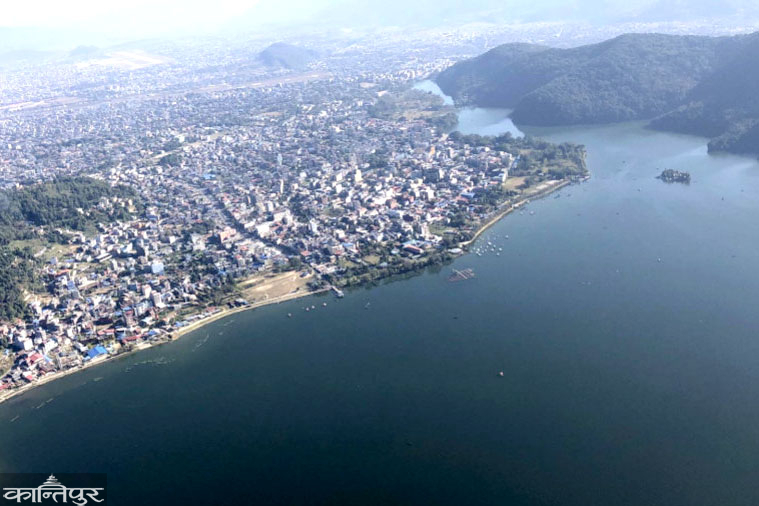 According to Bikash KC, who runs Hotel KC in Damside, entrepreneurs who have been involved in the tourism business in Lakeside for forty years are now in deep confusion. ‘We have taken permission to operate our houses and businesses,’ he said, ‘Sewage from the Seti Canal and the Firke River is mixed in Fewa Lake. All the waste from the market goes into Fewa Lake. The government agencies need to pay attention to that.’ He demands that the businessmen be displaced only by providing compensation at the prevailing market price. Dipendra Karki, who runs a hotel in the Chautara area of Gaira in Lakeside, says that double compensation should be given. ‘Double compensation should be given so that we can buy a house with that money,’ he says, ‘so that we can educate our children, and pay off bank loans. The state should do this work, do it soon.'
Hari Bhujel, the owner of Lakeside Gaurighat-based Hotel Ranivan Arcade and vice-chairman of the Pokhara Tourism Council, questioned the scientific basis of the demarcation. 'Why only 65 meters? Why not 100 meters? Why not 30 meters? And what is the basis for saying that Fewa Lake will survive by making it 65 meters? What is the master plan for it?' he said, 'The lands acquired from the locals yesterday are now covered in only grass and leaves. What is the guarantee if this 65 meters does not remain the same for years to come?' He expressed anger over the government's failure to utilize the areas acquired from the locals, including Basundhara Park and Komagane Park, so far.
Fewa Lake Criteria Victim Concern Committee Chairman Baral says that even if the state can take a person's land by paying compensation, the locals should be satisfied by completing the process. He demanded the formation of a competent and impartial investigation committee to distinguish which land is truly encroached and which land is legally owned by the individual. ‘The citizens should be taken into confidence to protect Fewa Lake. But what is happening now is injustice to the citizens,’ he says, ‘If the state does not understand our pain and does not protect our rights, we will be forced to choose the path of struggle.’
Pokhara Chamber of Commerce and Industry, Pokhara Tourism Council, Hotel Association Pokhara and other organizations have also urged the 65-meter standard to be cleared only after providing compensation to businessmen and locals and proper management. Amrit BC, manager of Water Front Resort, says that indiscriminately using dozers on large and self-employed businesses without a plan in the tourist capital, the government should also think about the impact on the goal of increasing personal income.



