The federation believes that limiting government advertising to government media will create direct pressure on press freedom.
We use Google Cloud Translation Services. Google requires we provide the following disclaimer relating to use of this service:
This service may contain translations powered by Google. Google disclaims all warranties related to the translations, expressed or implied, including any warranties of accuracy, reliability, and any implied warranties of merchantability, fitness for a particular purpose, and noninfringement.
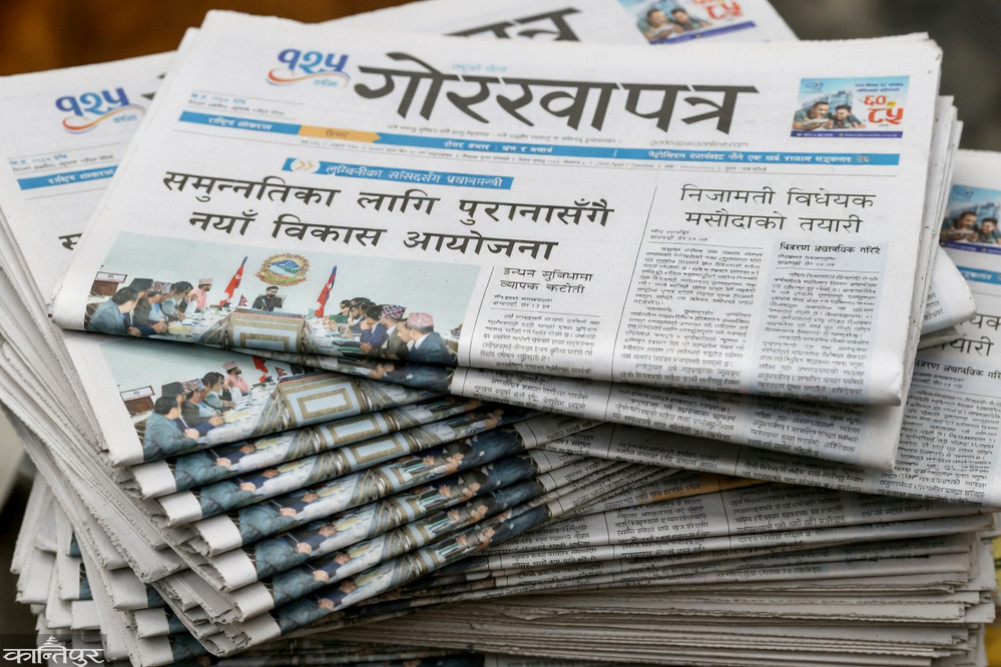
After the Office of the Prime Minister and Council of Ministers decided to give government advertisements only to government media, Gorkhapatra is currently full of advertisements. Previously, Gorkhapatra advertisements, which were usually printed on 18 to 20 pages, became 38 pages on Monday, while today it is 30 pages.
After government agencies implemented the circular of the Prime Minister's Office, almost all government advertisements have been removed from private sector media. Some stakeholders have approached the court, saying that this step has harmed private media.
A team of the Federation of Nepali Journalists met Minister for Communications and Information Technology Bikram Timilsina on Monday and drew attention to this decision. The team, led by Federation President Nirmala Sharma, submitted a memorandum to the minister and demanded that the decision be immediately withdrawn.
The Federation believes that limiting government advertisements to government media will create direct pressure on press freedom. The Federation has also warned of agitation, saying that this will reduce independent journalism, which is the voice of the voiceless. Similarly, a legal battle has also begun against this decision of the government. Advocate Anantaraj Luitel filed a writ petition in the Supreme Court on Monday
on behalf of Nepal Media Society and Media Alliance Nepal. In the writ, the circular of the Prime Minister's Office dated Chaitra 18 is said to be illegal and unconstitutional. It is claimed that the right to freedom of expression and equality guaranteed by Articles 17, 18 and 19 of the Constitution has been violated. The writ states that restricting access to information to a single medium will stifle the rights of citizens and undermine the fourth organ. Gorkhapatra has published notices (advertisements) of everything from invitations to tenders to court deadlines and public hearings. The pages of the newspaper are filled with notices from local levels to federal ministries and various constitutional bodies. Court deadlines and contract notices related to banking offenses have taken up space. After the implementation of the policy of giving advertisements only to government media, Gorkhapatra has been flooded with information. According to the Nepal Advertisement Board, Gorkhapatra used to earn Rs 1 billion annually from government advertisements. The total market for government advertisements is Rs 4 to 5 billion. The operators complained that private sector print media received only Rs 50 to 60 crores of government advertisements annually. The remaining Rs 3.5 billion was lost in the process.
There were allegations of misuse of state funds in collusion with some advertising agencies and employees. Questions were also raised about the tendency of media outlets to give discounts of 15 to 95 percent to advertising agencies. Instead of stopping these distortions, media operators are worried that the government has adopted a policy of not giving advertisements to private companies.
The private sector had been questioning the policy of providing both annual budget and advertising to Gorkhapatra. Now, the new decision to provide advertising only to government media will further increase Gorkhapatra's income, but the private sector will be affected, saying that the government's decision is discriminatory.