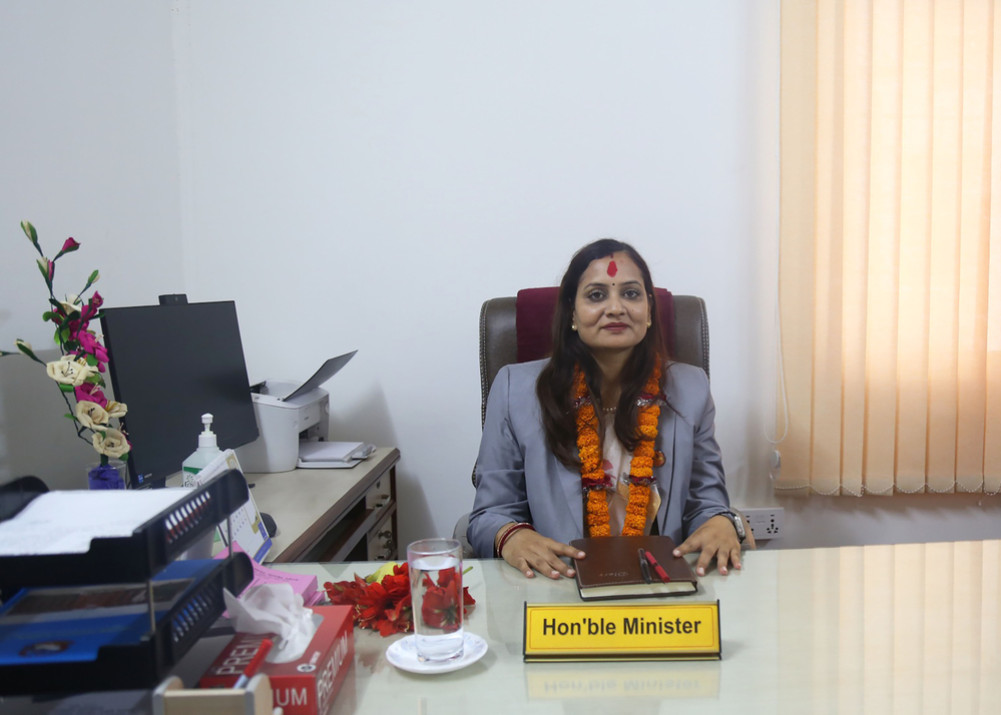
The challenges facing the newly appointed Minister of Health are to improve the health insurance program, expand the number of health workers, including doctors, in government health institutions, end quotas in appointments, and eliminate irregularities in procurement, and issue timely laws, regulations, and policies in the health sector.
We use Google Cloud Translation Services. Google requires we provide the following disclaimer relating to use of this service:
This service may contain translations powered by Google. Google disclaims all warranties related to the translations, expressed or implied, including any warranties of accuracy, reliability, and any implied warranties of merchantability, fitness for a particular purpose, and noninfringement.
38-year-old Nisha Mehta, who entered politics from a nursing profession, was appointed Minister of Health and Population on Friday after becoming a proportional member of the National Independent Party. Despite being active in the health service, she was associated with the party since its inception as an ordinary member. In the 2079 elections, the NIP had also included her in the proportional list to become an MP. However, she could not become an MP. This time, she reached the federal parliament to represent the new generation. She got the responsibility of Minister of Health and Population in the Balendra Shah-led government.
After completing her master's degree in nursing from the University of Gwalior, India, she returned to Nepal and worked at Birat Teaching Hospital in Biratnagar. As the administrative secretary of Nepal Police Wives Association, Koshi Province, she played an important role in conducting health camps, programs related to women and children, and community-centered activities.
Her contribution in making the association active and dynamic is considered significant. This shows her leadership skills, organization management and community engagement skills. Her husband, Dr. Saroj Singh Koshi, is the Chief of the Provincial Police Hospital and Deputy Superintendent of Police (DSP). Family support has played an important role in her political journey. She was elected as a proportional representative from the Madhesi cluster from Inaruwa.
Challenges of the Health Minister
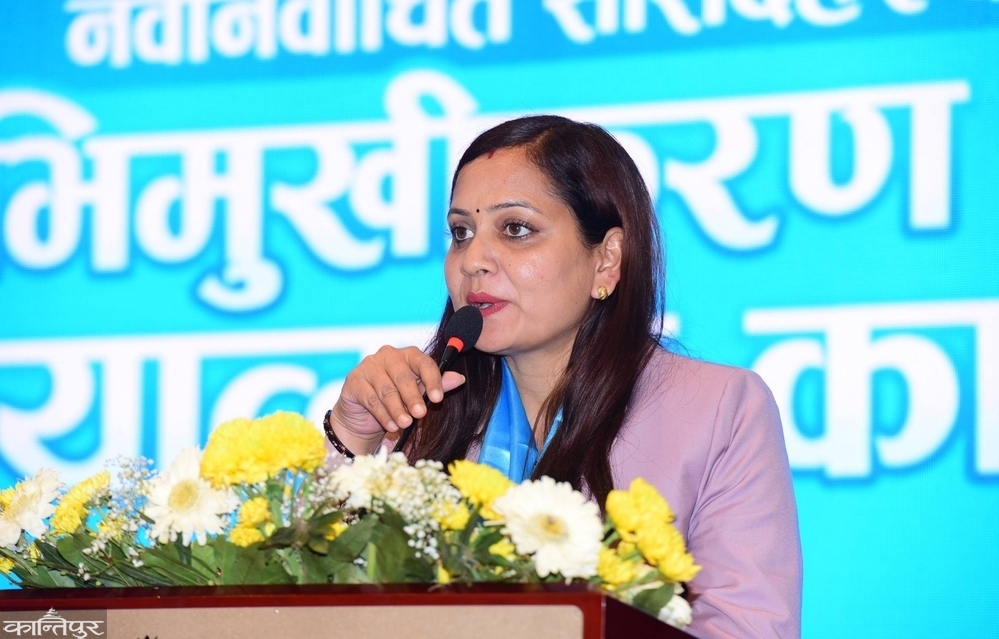
While the Ministry of Health is welcoming the new Health Minister, the health insurance program that provides affordable and quality health services to the citizens is unhealthy. The economic crisis has brought the insurance program to a standstill. Former Secretary of the Ministry of Health, Tanka Barakoti, says that strengthening the health insurance program should be the minister's first task. He said that comprehensive reforms are needed in the insurance program.
An amount of 10 billion was allocated for the program in the fiscal year 2082/083. 11 billion was required to pay the arrears of the last fiscal year. The government has given an additional Rs 1 billion in grant. The Health Insurance Board has stated that Rs 11 billion in arrears have been paid. Only Rs 3.5 billion has been collected from premiums. Currently, Rs 2 billion is being spent monthly and Rs 24 billion annually. The ministry has also concluded that health insurance cannot be continued without resource provision.
Former Secretary Barakoti suggested that the health insurance should be made sustainable by including the people of the organized sector in health insurance. ‘Health insurance cannot be operated solely on the basis of grants provided by the government,’ he said. The provision in the Act to include civil servants, teachers, army, police, private sector and other people of the organized sector in compulsory insurance has not been implemented. The National Independent Party’s manifesto that reached the government also mentions improving the health insurance program.
The second biggest challenge in the health sector is the management of health workers, including doctors. There has been no increase in the number of posts in government health institutions since 2048 BS. If the health sector is to be improved, posts should be kept on the basis of the number of patients and services. Dr. Barakoti said. ‘The manpower in the health sector is low. It is running on the basis of the manpower of 2048 BS. Quality health service cannot be provided by hiring health workers on contracts,’ he said. ‘The number of patients in regional hospitals is very high. There are few health workers, including doctors.’
The constitution has made provision for the government to provide basic health care free of charge. Not all citizens have been able to get that right. Citizens’ medical treatment is becoming expensive. Former Secretary Barakoti says that the ministry should pay attention to providing basic health services from local levels to remote areas. Even though the government has a policy of providing basic health services to all wards, it has not been able to reach 130.
Dr. Barakoti pointed out that the lack of budget in the health sector is another problem. He suggested that at least 10 percent of the budget should be allocated. Currently, only about 4 percent of the budget is allocated to the health sector. The death rate from non-communicable diseases such as cancer, heart attack, stroke is increasing. He said that budget is also needed for its reduction and prevention. 'Only investment in the health sector will bring results,' he said. He said that since the service facilities provided to health workers are satisfactory, it should be reconsidered. 'There is a lot of investment in studies in the medical sector. Service facilities are lacking,' he said. 'By increasing service facilities, the compulsion of a health worker to work in more than one health institution should be removed.'
Irregularities in the purchase and supply of medical equipment, tools, and medicines are another problem in the health sector. Experts say that the newly appointed minister will have the main responsibility to reduce it. In the past, irregularities in procurement were common with the connivance of the Health Minister. Former Health Minister Dr. Sudha Sharma had also pledged to make the procurement process completely transparent and end corruption upon assuming office. She has suggested that a free medicine distribution system and a Medicines Affairs Division should be set up to enhance the monitoring role of the ministry. While leaving the ministry, she has suggested that doctors, nurses and other health workers should be paid a fair wage.
Arun Upreti, a doctor at the Karnali Institute of Health Sciences, Jumla, says that an Act on Health Services based on Informed Consent should be issued immediately. He says this will transform health services from doctor-centric to service-recipient-centric. He suggests that mandatory social audits should be arranged in hospitals for transparency, accountability and service quality improvement. ‘To strengthen health services in remote and inaccessible areas, adequate and targeted investment should be made in infrastructure, manpower, equipment and supply systems.’ Along with this, special incentives, security and career development opportunities should be ensured for health workers working in such areas,' he said.
Political participation and nepotism in appointments at health science institutes and large hospitals are another extreme problem. Ministry officials say that it is the challenge of Health Minister Mehta to overcome this.
They comment that due to participation in appointments, there has been an increase in instability and arbitrariness in health institutions. There is a suggestion that the appointment process should be carried out through open competition.
Even the Health Service Act has not been issued according to federalism and the new Constitution 2072 BS. They said that it will be the responsibility of the newly appointed minister to issue an act to integrate health workers and the health system at the local level, state and union levels. After the ministry building was completely damaged in the Genji movement, services have been provided from a prefab building built by the World Health Organization inside Singha Durbar. The reconstruction of the building will be the responsibility of the newly appointed minister.
What is there in the RSP's manifesto about the health sector?
The RSP has also committed to strengthening the health insurance program. 'We will expand the health insurance program in a more robust model to ensure quality health services and access to every citizen. We will organize all health-related social security programs through a single-door system. We will move forward with the government's main priority area of work by including medicines, treatment services, and mental health within the health insurance program,' the RSP's manifesto states. 'We will implement a prevention-oriented strategy rather than a treatment-oriented strategy for non-communicable diseases such as cancer as the main goal.'
It has been announced that at least one state-of-the-art disability rehabilitation resource center will be established in each province to ensure quality and integrated health services for citizens with disabilities. It is stated that screening tools and manpower will be placed at the local level to detect autism, hearing loss, vision-related, and other neurodevelopmental problems in children in a timely manner. The Rashtriya Swayamsevak Sangh (RSS) has announced that yoga and meditation programs will be conducted through schools, communities and health institutions for disease prevention, mental health strengthening and overall lifestyle improvement.
It has been announced that minimum standards will be set in the basic health sector across the country and an integrated model will be implemented with ensuring human resources, adequate medicine supply, easy access to essential equipment and basic infrastructure.
It has been stated that a division will be established to make mental health services easily accessible to citizens. It has been promised that a specialist doctor will be arranged 24 hours a day in each district to provide primary mental health services. ‘By 2087, we will reduce the individual, family and national burden caused by preventable disabilities to a minimum.’ It has been said that the early identification and early intervention system for disability rehabilitation will be extended to lower-level health institutions.
It has been announced that a desk will be established at the local level to identify autism, hearing loss, vision and other neurodevelopmental problems seen in children. ‘We will conduct yoga and meditation programs through schools, communities and health institutions for disease prevention, mental health promotion and overall lifestyle improvement,’ the pledge states. It has been announced that a burn treatment fund will be established to ensure free and quality treatment for burn victims. It is stated that the process of building a world-class specialized burn hospital will be taken forward.