The government has completed the appointments of the Chief Secretary and Inspector General of Police without controversy, but has not been able to take both political parties and Gen-G into confidence for the main mandate election.
We use Google Cloud Translation Services. Google requires we provide the following disclaimer relating to use of this service:
This service may contain translations powered by Google. Google disclaims all warranties related to the translations, expressed or implied, including any warranties of accuracy, reliability, and any implied warranties of merchantability, fitness for a particular purpose, and noninfringement.
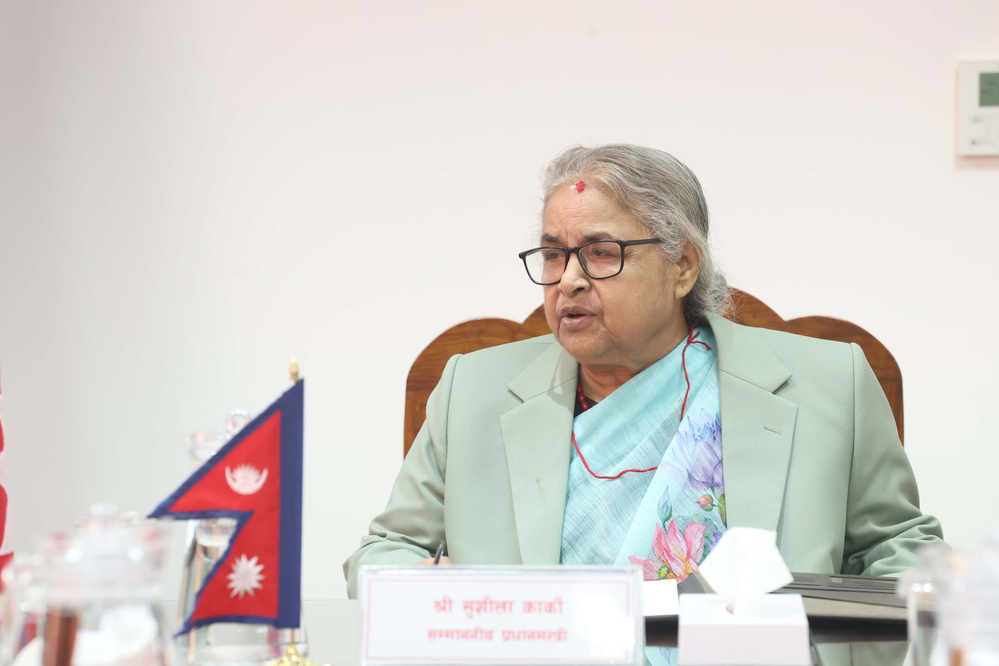
The government formed under the leadership of former Chief Justice Sushila Karki on the basis of the Gen-G movement has completed 101 days. Half of the government's term has ended in terms of the main 'mandate' of holding elections to the House of Representatives within six months. During this period, the government seems to be leading the country towards elections, but it has not been able to perform as expected by the common citizen in terms of controlling corruption and laying the foundation for good governance.
Karki was appointed Prime Minister on 27 Bhadra after the then Prime Minister KP Sharma Oli resigned under pressure from the Gen-G movement. On the same day of her appointment, the House of Representatives was dissolved on her recommendation and a general election was announced for 21 Falgun. Political party registration has been completed as per the election schedule that was brought soon after. The Council of Ministers, concerned ministries, security agencies and the Election Commission are making preparations for the election.
While preparing for the election, the government does not seem to have been able to take the major political parties into confidence. There has been no dialogue between the government and the top leaders of the main parties including the Congress, UML, and the Nepal Communist Party regarding the election. Even the parties that seem ready to go to the election have started criticizing the government for not being able to create an environment. On the other hand, the Congress and UML have approached the Supreme Court demanding the restoration of the House of Representatives. Therefore, the court's decision on the election is also a matter of waiting.
It seems that the government is trying to prioritize addressing the issues of Gen-G, but Gen-G itself is not able to trust the government. There are various opinions coming from the Gen-G leaders regarding the elections. The Gen-G group is protesting from time to time with various demands. Complaints have been heard that the government has not been able to do as expected in terms of controlling corruption and maintaining good governance. Even the youth who participated in the Gen-G movement say that despite some positive signs, the work in controlling corruption has not been as expected. Constitutional scholars, former administrators, and human rights activists also seem to agree with their analysis.
The Karki government, which was formed on the strength of the movement questioning the working style of the previous government, could not escape controversy. Attorney General Savita Bhandari Baral, chosen by Prime Minister Karki, decided not to prosecute the egg smuggling case, which was linked to her own organization. Despite widespread criticism, the government remained silent. Chief Personal Secretary Adarsh Kumar Shrestha had appointed family members and relatives in the Prime Minister's Secretariat. This was corrected after news of this came out.
The Supreme Court overturned the Cabinet decision to abolish the Land Disputes Resolution Commission and its district structure. The cabinet issued an interim order not to implement the decision to recall ambassadors from 11 countries, but the government disobeyed it. The Supreme Court also overturned Energy Minister Kulman Ghising's decision to remove Hitendradev Shakya from the executive director of the Nepal Electricity Authority.
It took a long time to complete the cabinet. The cabinet has been expanded four times to 14 members. Four ministers were appointed about three months after the Karki government was formed. There was also a situation where controversial figures in ministerial appointments had to be recommended and later withdrawn. The property details of no one in the cabinet have been made public.
The government had formed a commission under the leadership of former judge Gauri Bahadur Karki on 5 Asoj to investigate the incidents of 23 and 24 Bhadra. As the commission is yet to submit its report, it remains to be seen how the government will proceed with further investigation and action against the perpetrators of the incidents three and a half months ago.
The government also decided to declare the deceased of the Gen-G movement as martyrs, treat the injured and provide relief. Some of the injured still have complaints about the treatment arrangements. A 10-point agreement was signed between the government and the Gen-G representatives on 24 Mangshar to give legitimacy to the Gen-G movement.
Meanwhile, the government's appointment of the Chief Secretary and the Inspector General of Nepal Police has been free from controversy. It seems that agencies such as the Commission for the Investigation of Abuse of Authority, the Central Investigation Bureau (CIB) of the Nepal Police are now able to work more independently than before. Cutting the unauthorized and unwanted benefits that some people are taking while in office and after retirement is a positive step by the government. The Prime Minister's Secretariat has also been downsized to reduce the state's expenditure. Meanwhile, some offices and posts that were deemed unnecessary have been cut. Everyone praised the government's readiness in information dissemination and rescue during the floods and landslides of Asoj. Some victims are complaining about relief and reconstruction.
Minister Ghising's vindictive decision
Prime Minister Karki, while expanding the cabinet for the first time on 30 Bhadra, gave former Executive Director of Nepal Electricity Authority Kulman Ghising the responsibility of the Ministry of Energy along with physical infrastructure, cooperative development. As soon as Ghising became the minister, on 5 Asoj, Executive Director of the Authority Hitendradev Shakya was transferred to the vacant Water and Energy Commission and Manoj Silwal was appointed as the Executive Director.
The previous government led by KP Sharma Oli had removed Ghising from the Executive Director of the Authority on 11 Chaitra and appointed Shakya. When Ghising became a minister, he removed Shakya in the same style, which was criticized as vindictive. Shakya went to the Supreme Court. A joint bench of Supreme Court Justices Nahakul Subedi and Shrikant Poudel overturned Shakya's proposal and the government's decision on November 23, saying that Ghising's proposal and the government's decision were vindictive and arbitrary.
'When the Executive Director of the Electricity Authority had to be removed from the said post, he could be removed according to the procedure and basis mentioned in the Nepal Electricity Authority, Executive Director or General Manager's Regulations on Services, Conditions and Facilities, 2061 or the performance agreement signed with him, but since it was seen that he was removed from the said post without following any such procedure, the proposal of the opposing departmental minister to remove him from the said post appeared to be biased and vindictive,' the order states. 'The decision and action taken based on such proposal could not be considered as a fair, just and reasonable decision based on proper reasons.'
Decision to abolish the Land Resolution Commission overturned
The government decided to abolish the Land Resolution Commission and its district structure on October 23. Then on 9 Kartik, the chairman of the commission, Hari Prasad Rijal, filed a writ petition in the Supreme Court. A bench of Justices Kumar Regmi and Shantisingh Thapa issued an interim order on 13 Kartik. A bench of Justices Saranga Subedi and Shrikant Poudel overturned the government's decision to abolish the commission on 15 Mangesh.
The Council of Ministers had decided to abolish the commission on the proposal of the then Minister for Land Management, Cooperatives and Poverty Alleviation Anil Kumar Sinha. The decision to abolish the commission was taken on the grounds that the land titles prepared at that time could be distributed and the data obtained would be recognized, but new work would be prohibited. After the Supreme Court overturned it, questions arose about the functioning of the government.
Controversial decision of the Attorney General
Savita Bhandari was appointed as the Attorney General on 29 Bhadra on the recommendation of Prime Minister Karki. A month later, on 31 Asoj, Bhandari made a controversial decision that involved a conflict of interest. She decided not to prosecute Hope Fertility and Diagnostic Pvt. Ltd., located in Babarmahal, which was involved in egg smuggling. Bhandari is the founding shareholder of Hope Fertility. The head of Hope, Dr. Swasti Sharma, who was involved in the investigation, is Bhandari's daughter, Sanima. Bhandari's daughter, Dr. Pratyusha Baral, also works at Hope.
When questions were raised publicly about the Attorney General, who is the Prime Minister's legal advisor, granting immunity to an organization of which she is a shareholder, Prime Minister Karki remained silent. After the government's own Attorney General, formed on the basis of the movement for good governance, decided to have a conflict of interest, Transparency International Nepal suspended Bhandari from membership.
Disobedience of interim order regarding ambassador recall
The government decided to recall its ambassadors from 11 countries on 30 Kartik. A writ was filed in the Supreme Court, saying that the decision went beyond the 'mandate' of maintaining elections and good governance.
The Supreme Court issued an interim order on 11 Kartik not to implement the decision to recall ambassadors. However, the government made the recalled ambassadors appear at the Ministry of Foreign Affairs. Some ambassadors are still appearing at the ministry.
Controversial appointment in the Prime Minister's Secretariat
It was revealed that Prime Minister Karki's Chief Personal Secretary Adarsh Kumar Shrestha had appointed his wife and relatives to the Secretariat. Adarsh, who had taken the same privileges as the Secretary of the Government of Nepal, had appointed his wife Sangita Shrestha, relative Kamala Shrestha, and administrative assistants Poonam Shrestha and Rabina Shrestha as deputy sub-inspectors. After this matter became public, Prime Minister Karki removed everyone else on 10 Mangsir, leaving only 6 people in the Secretariat.
The secretariat currently has only Chief Advisor Ajaybhadra Khanal, Public Relations Advisor Govinda Narayan Timilsina, Chief Personal Secretary Adarsh Kumar Shrestha, Press Coordinator Ram Bahadur Rawal, Personal Branch Officer (Photographer) Keshav Thapa and Public Health Expert (Unpaid) Man Bahadur KC.
The government was criticized for its attempt to grant tax exemption to Dolma Impact and the demolition of houses for road expansion in Hetauda despite an interim order from the Supreme Court. In recent days, questions have also been raised about the appointments made by the government in various bodies. The government formed on the strength of Gen-G's movement was expected to form a small cabinet and despite the Prime Minister's commitment, it has been criticized for increasing it to 14 members. Experts also analyze that the expected results have not been achieved when the Prime Minister himself holds important ministries such as foreign affairs and defense.
10-point agreement between government and Gen-G
A 10-point agreement was reached between the government and Gen-G on 24 Mangsir. This agreement, made to give legitimacy to the Gen-G movement, was approved by the Council of Ministers. It has institutionalized and documented the Gen-G movement and made everyone accountable to the constitution. The government has also participated in the 10-point agreement by including the demands raised by Gen-G. Prime Minister Karki himself has signed the agreement on behalf of the government. Bhoj Bikram Thapa has signed on behalf of Gen-G.
Controversial-free appointment
Previously, most of the appointments made by the government used to be controversial. The appointment of the IGP of Nepal Police was always complicated. The Karki-led government decided to make Dan Bahadur Karki the IGP on 24 Kartik. The appointment of Karki, who was ahead in the rankings, became controversial. After the then Chief Secretary Ek Narayan Aryal retired, the government appointed Suman Raj Aryal, who was ahead in seniority, as the Chief Secretary on 23 December. This decision was also not controversial.
The government had formed a commission led by former judge Gauri Bahadur Karki on 5 Asoj to investigate the incidents of 23 and 24 Bhadra. The commission has completed the work of taking statements from the concerned persons. However, the government has extended the deadline by one month after the commission failed to complete the work within the initially stipulated three-month period.
The work being done by the government in preparation for the House of Representatives elections appears satisfactory. Prime Minister Karki herself has been in constant dialogue with the second-tier leaders of political parties since the commission. She has said that she will not be in the government after 21 Falgun. Some major political parties, however, have been raising doubts about election security.
‘ The government has not spoiled the work’
Former Chief Secretary Bimal Koirala said that even though the government could not work according to the spirit of the Gen-G movement, it did not spoil the work. ‘Although the government was formed to bring good governance and eliminate corruption, it does not seem to have done so,’ he said, ‘but the government has done well on some issues. The court had to stay some decisions.’ He analyzed that the issue of controlling corruption has been overlooked as the government was too focused on elections.
Constitutional scholar and senior advocate Shambhu Thapa said that since the government formed from scratch has completed 100 days, it should not be viewed as a 100-day government. ‘There is no evaluation of the government until the elections are held. This is not a permanent government,’ he said, ‘therefore, there is no honeymoon period in this. The government is evaluated only by what it does after Falgun 21, there is no need to evaluate other issues.'
Senior advocate Bhimarjun Acharya says that this government has the opportunity to become a 'role model' but is failing in that. 'Some work that needs to be done should be initiated. It seems that there is some confusion. This government was formed because there is a challenge,' he says, 'The government does not seem to be able to become a role model in terms of corruption control and good governance.' He also said that the government has not been able to really rise to the occasion in a way that gives a message that people outside the party also run the government well. Acharya's analysis is that the state, which should be strict in bringing those involved in the criminal acts that took place on 23 and 24 Bhadra, has been weak. 'The government seems to have deviated from the subject in some matters. It is confused. There is still time. The government should work to streamline the legal system. It should be strict on crime,' he said, 'The government should hold elections on 21 Falgun anyway, let it be done.'
Khemraj Regmi, former president of Transparency International Nepal, which works against corruption, commented that the government, whose main agenda is good governance, did not seem to have done anything wrong intentionally, but it did not exercise discretion in some of its actions. ‘This government was formed for six months. One or two decisions have been controversial. Some positive actions have been taken, such as stopping wasteful spending, stopping politically motivated projects, and terminating contracts that had not been worked on for years,’ he says, ‘but the court had to stay decisions such as recalling the ambassador and removing the executive director of the Electricity Authority.’
 Regmi says that the government is preparing for the main ‘mandate’ election. ‘The government also seems to be working on peace and security,’ he says, ‘it seems that the parties are trying to create an environment for participating in the election. It seems that the then Prime Minister should take responsibility for the incident of 23 Bhadra, so it seems that they are protesting. It is also being said that there will be no elections from this perspective.'
Human rights activist Charan Prasai commented that the government is focused on Gen-G but has not gained the trust of Gen-G. 'The government has not yet realized that it belongs to other citizens,' he said. 'It does not seem that Gen-G has been able to gain complete trust either. It seems that the citizens do not have trust either. There has been a lot of talk. No action has been taken.'
Prasai also argued that the work done by the Gauri Bahadur Karki-led inquiry commission does not show confidence in stopping impunity. 'It seems that the government has moved forward in a way that encourages impunity. The government is stable but its performance is weak,' he said. 'The environment for elections has not yet been created. It does not seem that the citizens believe that elections will be held.'
Political analyst and geopolitics expert Chandradev Bhatta said that the government's performance has been average. 'The decision to recall the ambassador has become controversial. The government has not been able to play a diplomatic role,' he said. 'When the Gen-G movement has caused a loss of 5 percent of GDP, it should have attracted new investors and taken the old ones into confidence, but the government does not seem to be able to do that.'
Bhatta said that there is still doubt that the election will be held on the scheduled date. 'We still have to create an environment that will ensure election security by returning the weapons looted from the police and the escaped prisoners during the movement,' he said.
Congress leader Shyam Ghimire argues that the government has failed to eliminate corruption and maintain good governance. 'Another important responsibility of the government is to hold the election on 21 Falgun, but it has not been successful in creating the environment for that either.'
Prime Minister Karki says that the interim government has made good governance and elections its vision in line with the spirit of the Gen-G movement. He says that the government is determined to hold the election on the scheduled date in a fair and fearless environment. Home Minister Om Prakash Aryal claims that the government is leaving no stone unturned in maintaining peace, security and good governance. ‘The government is working with good governance as its top priority,’ he says, ‘election-focused work is also being done.’
Government spokesperson Jagdish Kharel, Minister for Communications and Information Technology, claims that the government is above average. He says that the government’s main responsibility is to maintain good governance and prepare for the election, so work is being done accordingly. ‘Due to the government’s continuous efforts, the environment for the election on 21 Falgun is being created. The election will take place,’ he said.
Positive signs: Gen-G leader
Gen-G leader Pradeep Gyawali says that although the demands raised in the movement have not been fully addressed, it can be considered a positive start on the issue of good governance. ‘जुन अनुपातमा भ्रष्टाचारविरुद्ध काम हुनुपर्थ्यो, त्यो तहमा भएको छैन,’ उनले भने, ‘तर यस अवधिमा अख्तियार दुरुपयोग अनुसन्धान आयोगलगायत निकायमार्फत अदालतमा पुगेका मुद्दाहरूले सकारात्मक संकेत देखाउँछन् ।’ दलहरूले वर्षौंसम्म सत्तामा रहँदा लुकाएका फाइल खोलेर अनुसन्धान अघि बढाउन सरकारले अग्रसरता नलिएको ज्ञवाली बताउँछन् । ‘अहिलेको सरकारले यस्तो काम गर्नुपर्थ्यो, जुन निर्वाचनपछि आउने सरकारका लागि समेत मार्गनिर्देशन बन्न सकोस्,’ उनी भन्छन्, ‘तर सरकारले आफ्नो मुख्य ध्यान निर्वाचन भन्दै गर्दा कताकता मूलभूत विषयमा अलमलिएको हो कि भन्ने देखिन्छ ।’
नेपाल जेन–जी फ्रन्टका संगठन विभाग प्रमुखसमेत रहेका जेन–जी अगुवा युजन राजभण्डारी पनि ज्ञवालीको भनाइसँग सहमत छन् । ‘केही हदसम्म सकारात्मक सन्देश दिने काम भएका छन् तर यो पर्याप्त होइन,’ उनी भन्छन्, ‘सरकारको मुख्य जिम्मेवारी निर्वाचन गराउने भए पनि भ्रष्टाचारविरुद्ध बलियो सन्देश दिने गरी काम गर्नुपर्छ ।’
जेन–जी मुभमेन्ट एलायन्सका अमित खनाल कुनै राजनीतिक पृष्ठभूमिबिना चुनिएको सरकारले जसरी काम गर्ला भन्ने जुन अपेक्षा थियो, त्यसअनुसार हुन नसकेको बताउँछन् । ‘२३ र २४ भदौको आन्दोलनका सन्दर्भमा दोस्रो दिनका धेरै पक्राउ परेका छन् तर पहिलो दिन दमन हुँदा सरकारको नेतृत्वमा रहेका केपी शर्मा ओलीको अहिलेसम्म बयानसमेत भएको छैन,’ उनी भन्छन्, ‘निर्वाचनलाई लिएर सरकारले लिएको अडान प्रशंसनीय छ तर सरकारले जेन–जीसँग भएको सम्झौता कार्यान्वयन भएको छैन ।’
जेन–जीको प्रतिनिधित्व गर्दै युवा तथा खेलकुदमन्त्री बनेका बब्लु गुप्ता पहिलेको सरकारको तुलनामा अहिले भ्रष्टाचार नियन्त्रण भएको र सरकारले पनि फरक तरिकाले काम गरिरहेको दाबी गर्छन् । ‘पहिले जस्तो हरेक कुरामा बार्गेनिङ र सेटिङ छैन, अकुत धनसम्पत्ति जोड्ने काम भएको छैन,’ उनी भन्छन्, ‘पुराना फाइल खोल्ने सन्दर्भमा प्रमाण जुटाएर काम गर्नुपर्नेछ । त्यसैले केही समय लागेको हो ।’ घाइतेले उठाएको माग गृह मन्त्रालयसँग जोडिएको उल्लेख गर्दै उनले भने, ‘ती विषय पनि क्रमशः सम्बोधन हुँदै जान्छन् भन्ने ठानेको छु ।’
सकारात्मक काम
२३ भदौको आन्दोलन र २४ को प्रदर्शनको जाँचबुझ गर्न आयोग गठन
प्रहरी महानिरीक्षक (आईजीपी) र मुख्यसचिव नियुक्ति विवादरहित
मनसुनजन्य विपद्मा पूर्वतयारी, राहत र उद्धार प्रभावकारी
प्रधानमन्त्री र मन्त्रीका सचिवालय सदस्य र खर्चमा कटौती
निर्वाचन तयारीमा पटक–पटक सर्वपक्षीय बैठक, प्रधानमन्त्री नै सक्रिय
जेन–जी र सरकारबीच १० बुँदे सम्झौता, कार्यान्वयन गर्न कार्यदलहरू बनाउने सहमति
ठूला भ्रष्टाचारको अनुसन्धान र मुद्दा दायरमा छैन हस्तक्षेप
कर्मचारी सरुवा, बढुवामा हालसम्म देखिएको छैन विवाद
त्रिविमा हडपिएको जग्गा, नागरिक उड्डयनको सुधारलगायतका प्रतिवेदन सार्वजनिक
विवादित निर्णय
डिम्ब तस्करीमा महान्यायाधिवक्ता संलग्नतामा सरकार मौन
विद्युत् प्राधिकरणका कार्यकारी निर्देशक हितेन्द्रदेव शाक्यलाई हटाउने निर्णय सर्वोच्चबाट बदर
भूमि आयोग र जिल्ला संरचना खारेज, सर्वोच्चबाट पुनःस्थापना
राजदूतहरूलाई फिर्ता बोलाउने निर्णयमा सर्वोच्चको अन्तरिम आदेश, सरकारबाट अवज्ञ
मन्त्रीको सूचीमा विवादित पात्रको सिफारिस, विवादपछि फिर्ता
डोल्मा इम्प्याक्ट फन्डलाई पुँजीगत लाभकर छुट दिने निर्णय
२४ भदौको लुटपाट र आगजनीमा संलग्नलाई फौजदारी कारबाही नगर्न परिपत्र
प्रधानमन्त्री र मन्त्रीहरूको सम्पत्ति विवरण अझै गोप्य
सर्वोच्चको अन्तरिम आदेशलाई अनदेखा गर्दै हेटौंडा सडक छेउको बस्तीमा डोजर



