The increasing use of AI in politics appears to be adding challenges not only to the nature of information flow, but also to the democratic process itself.
We use Google Cloud Translation Services. Google requires we provide the following disclaimer relating to use of this service:
This service may contain translations powered by Google. Google disclaims all warranties related to the translations, expressed or implied, including any warranties of accuracy, reliability, and any implied warranties of merchantability, fitness for a particular purpose, and noninfringement.
A short video was posted on Wednesday morning from the Facebook page of Rastriya Swatantra Party (RSWP) leader and outgoing MP Asim Shah.
In the eight-second video, a person who looks like RSP President Ravi Lamichhane, Minister for Industry, Commerce and Energy Kulman Ghising and Kathmandu Metropolitan City Mayor Balen Shah are seen walking together. Posted at 8:28 am in the morning, leader Shah has captioned the video as ‘Coming Soon Together – Falgun 21’.
However, the video that is going viral is not real. The video, created with the help of AI (Artificial Intelligence) technology, seems to be trying to convey different messages. On the one hand, a symbolic message has been conveyed that Ravi, Kulman and Balen are together, while on the other hand, some users on social media have commented that Dharan Mayor Harkaraj Rai should also be included. Some have interpreted it as a ‘media trial’. The caption, ‘Falgun 21’, has also been interpreted in political circles as a sign that Ravi, Kulman and Balen may stand on the same political front in the upcoming elections.
This is not the first example of AI-generated content in political circles. As the use of AI technology has increased in recent times, Nepali politics has not been able to remain untouched by its impact. The latest example of this is a video that appears to show UML leader Pradeep Gyawali crying .
The news that Gyawali left the UML general convention held at Bhrikutimandap on November 11 was published in some media outlets. After that, photos and videos that appeared to show him crying began to spread on social media.
In a short time, those materials went viral on platforms including Facebook, X (old Twitter), TikTok, etc. However, in reality, those photos and videos were not real. A video of him talking to journalists on November 3rd was edited with the help of AI technology to spread the wrong message.
Another photo created using AI during the UML general convention also became very popular on social media. The photo, which shows the convention venue being packed with people, garnered widespread attention after it was posted by a responsible leader and worker within the UML. Later, it was confirmed that the photo was also created by AI. Use in propaganda
UML general secretary candidate Surendra Pandey has also posted
AI-generated content from his official social media account. In the 21-second video posted at 8:34 am on Tuesday, he presented the work he did as Finance Minister through AI. The photos published in the newspaper have been animated in the video. With a sad background sound, photos of Nepali Communist Party leader Pushpalal Shrestha, UML leader Madan Bhandari and Bharat Mohan Adhikari are also being ‘moved’. Similar AI-generated video materials have been posted from an account called ‘

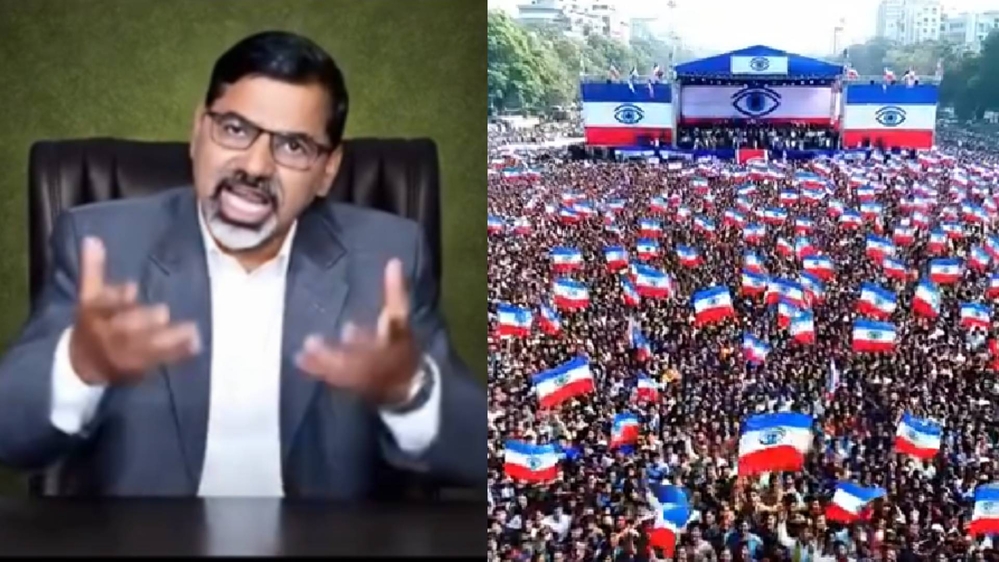
Surendra Prasad Pandey Secretariat ’. Is the only UML that has used AI in propaganda? No. Recently, AI-generated materials have also been used to promote other parties and defame leaders. A video of a person who looks like Progressive Democratic Party leader Janardan Sharma speaking is found on social media, in which he appears to have expressed, ‘I did not split the party, I broke your illusions. It is a thousand times better to become a mason who lays a new foundation than to die buried in a dilapidated house.’ Similarly, workers of the same party have also posted AI videos that appear to be a big propaganda rally.
AI-generated videos have also been made praising Nepali Communist Party coordinator Pushpa Kamal Dahal ‘Prachanda’. In one video, a photo of Dahal is placed on the left, while on the right, a large crowd carrying Nepali flags is seen chanting slogans like ‘Ravi, Balen, we don’t know anyone, we won’t vote for Congress UML’.
Videos praising a person who looks like Ravi Lamichhane, the president of the Nepali Congress Party, are also going viral. In one video, a person who looks like Ravi is seen walking with a white tiger. In the background, an audio that sounds like Ravi’s voice plays – ‘I am a man of the ground, I can stoop to the ground… Media headlines must scare people who commit crimes. The Nepali Congress Party is not a party of cowards, Ravi Lamichhane is not a leader of cowards.’
Excuses too

AI seems to be being used not only for propaganda, but also as an excuse to hide mistakes. A video of money being burnt during a fire at the residence of Nepali Congress President Sher Bahadur Deuba during a protest on Bhadra 24 was released.
Deuba's secretariat denied the video, claiming that it was created by AI. Later, Deuba also tried to distance himself by saying that all those videos were created by AI. However, it has been confirmed that those videos were not created by AI. Kantipur had also fact-checked this.
Delay in investigating the burnt money
Old is discredited, new is praised
Most of the AI-generated content that goes viral on social media is of a kind that mocks the leaders of old parties. Deepfake videos that appear to show UML Chairman KP Sharma Oli and NCP Coordinator Dahal fighting each other, that appear to show Dahal being arrested by the police while Congress President Deuba, Oli and Dahal are sitting together, and that appear to show Congress General Secretary Gagan Thapa grazing goats are all over social media.
On the contrary, content praising the so-called new or alternative leaders is more common. Videos that appear to show Balen Shah and Oli fighting, scenes that convey the message that Balen won and Oli lost, and videos that appear to show Oli being hit with a bell by Rabi Lamichhane have also been widely shared.

Signs of AI increasing in elections
AI Association Nepal President Shailendra Raj Giri says that the direct and indirect use of AI in politics is increasing. ‘The use of AI in itself is not bad, but its misuse is being used to spread misinformation, which is a criminal act,’ he says.
As the elections approach, such use will increase, says advocate and executive director of Digital Rights Nepal Santosh Sigdel. ‘Political parties, groups supporting them or activists can use AI content to create an atmosphere in their favor or to harm the opposition,’ he says. ‘Groups that do not want elections or want to disrupt elections can also use such content.’
According to journalist and fact-checker Umesh Shrestha ‘Salokya’, it has now become very easy to create propaganda content using AI. ‘A deepfake video can be made from a single photo. This is a good aspect of technology, but its misuse is a serious problem,' he says.
Similarly, journalist and fact-checker Deepak Adhikari also says that it is becoming more complicated to identify AI-generated content. 'Earlier, AI content could be easily distinguished.' Now, as technology improves, it is becoming difficult for users to distinguish between real and artificial,' he says.
Lack of regulation Using someone's photo or voice for misleading purposes is a crime under cyber law - Shailendraraj Giri
AI Association President Giri also says that using AI with wrong intentions is an illegal act. 'Using someone's photo or voice for misleading purposes is a crime under cyber law,' he says.
However, the draft code of conduct made public by the Election Commission does not have a clear provision on the use of AI. Although propaganda, misleading information and hate speech are prohibited, there is no direct mention of AI-generated content.
Considering this as a serious weakness, advocate Sigdel says – ‘The Election Commission must formulate a clear policy on the use of AI. A system is needed to distinguish which use is legal and which is illegal.’ According to him, the commission should coordinate with ‘Big Tech’ companies to develop a mechanism to identify and control misleading AI content during elections. Journalist and fact-checker Shrestha also emphasized that the Election Commission should clarify the use of AI in the code of conduct.
The increasing use of AI in politics seems to be adding challenges not only to the form of information flow, but also to the democratic process. How deep its impact will be in the upcoming elections, its regulation and accountability are still unclear.


