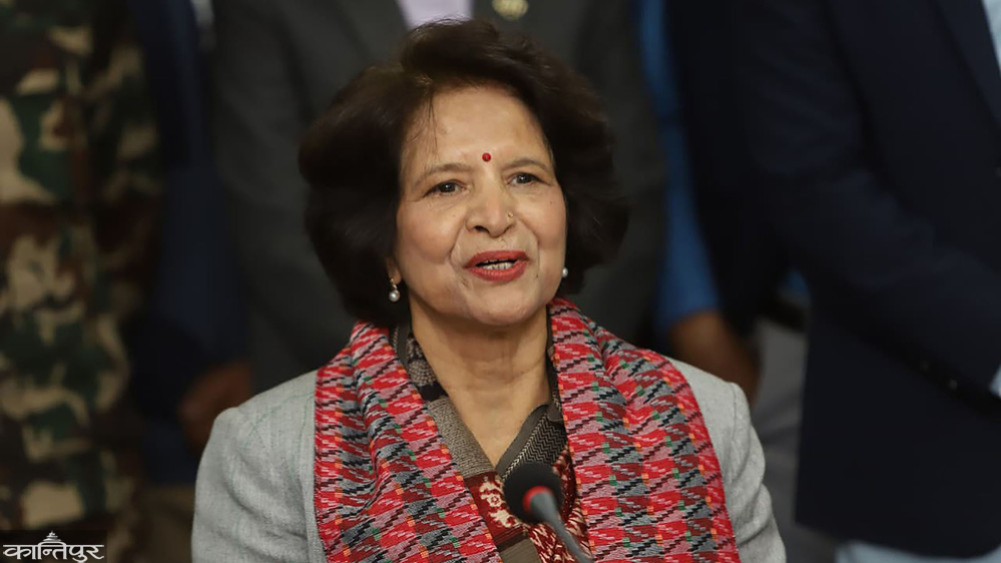
Where will the newly appointed Health Minister start the work of reforming the health sector? Will the steps he has taken begin to solve the problems seen in the health sector?
We use Google Cloud Translation Services. Google requires we provide the following disclaimer relating to use of this service:
This service may contain translations powered by Google. Google disclaims all warranties related to the translations, expressed or implied, including any warranties of accuracy, reliability, and any implied warranties of merchantability, fitness for a particular purpose, and noninfringement.
After Dr. Sudha Sharma, who spent nearly three decades in the Ministry of Health and its subordinate bodies, became the Minister of Health in the Sushila Karki-led government, there has been interest in where she will start the work of health sector reforms.
We have tried to explain to Sharma, who retired as secretary in 2068 BS and rejoined the Ministry of Health after 14 years, what are the main issues of health sector reform. After assuming office, Minister Sharma, while responding to the media, had pledged to make the procurement process completely transparent and end corruption. Will there be any signs of reform during her four and a half months in office?
Manpower Management: There is currently a huge shortage of manpower in government health institutions. There are a total of 32,000 vacancies across the country. While the Ministry of Health has been saying that at least 100,000 additional manpower including doctors, nurses and paramedics is needed. Health institutions are being added at all three levels of the country but due to insufficient manpower, citizens' access to health services is becoming more complicated. Will she take any steps to overcome this problem?
Effective health insurance: Effective implementation of health insurance has become the most complicated issue now. The government introduced the concept of health insurance 9 years ago to ensure that the general public can get affordable and easy treatment. However, citizens are suffering as even government hospitals are unable to implement it. As per the provisions of the Health Insurance Regulations, 2075, once insured, it must be renewed every year. However, The renewal rate of insurance is decreasing every year. And the arrears of the Insurance Board have reached around 24 billion. Will the newly appointed minister start some work to improve it?
Lack of equipment: The problem of equipment shortage and misuse in the health sector is not new. The government spends more than 2 billion every year on equipment procurement. However, there is indiscriminate management of equipment. There is a tendency to place equipment where it is needed, but to store it in unwanted places based on rumors and pressure. Can something be done to end this and manage it properly?
Solving the problem of nurses - Nurses working in various private hospitals and educational institutions in the country have been wearing black armbands since Kartik 4, demanding government-level wages. The Nepal Nursing Association has given the government a deadline of Kartik 18 to create an environment for meeting their demands. The ministry has already instructed to provide government-level wages, but many health institutions have not implemented them. In addition, there is a risk that the nursing workforce will continue to migrate if they have to work for low wages. Services at Manipal and Gandaki Medical Colleges in Pokhara have been affected for the last two weeks after the nurses went on strike. Although the outpatient services are open, both hospitals have not admitted new patients. What will be the newly appointed minister's initiative to solve this problem?