30,752 missiles have been burned in the ongoing phase and 93,071 missiles in the archive phase. How will the work of justice progress now?
We use Google Cloud Translation Services. Google requires we provide the following disclaimer relating to use of this service:
This service may contain translations powered by Google. Google disclaims all warranties related to the translations, expressed or implied, including any warranties of accuracy, reliability, and any implied warranties of merchantability, fitness for a particular purpose, and noninfringement.
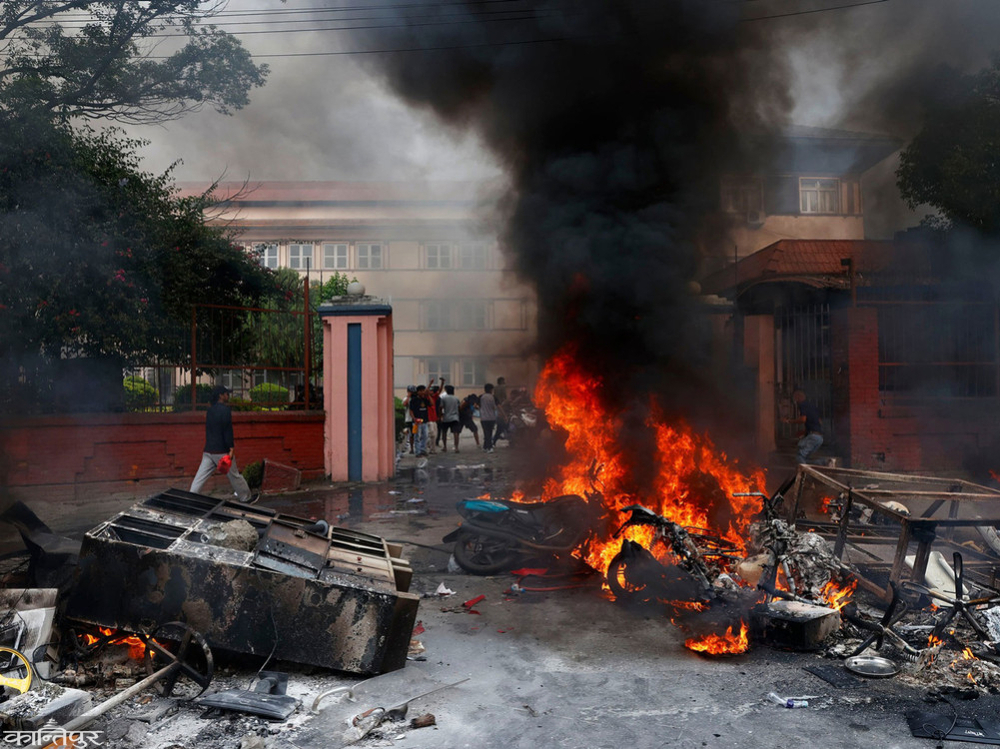
During the Gen-G movement on 23 and 24 Bhadra and the subsequent protests, courts, including the Supreme Court, were set on fire and vandalized. During the vandalism, the Supreme Court was burned to the ground, while 23 courts across the country were set on fire and damaged. 933,000 cases have been burned. Out of which, about 200,000 cases were pending. Tens of thousands of people seeking justice are interested and curious about how so many cases are heard. We have tried to explain in 5 questions and answers how service recipients who have been burned by missiles can get judicial services and what the process is.
Along with the court, the case files were also burnt. How will the hearing be held now?
During the protests on Bhadra 24, courts across the country were set on fire and vandalized. About 933,000 cases were burned and destroyed due to arson. The Supreme Court has preliminary information that 30,752 ongoing cases and 933,000 archive files were lost in all the courts that were set on fire and vandalized. According to the data on Bhadra 22, there were about 200,000 cases in courts across the country. Out of 24,234 cases in the Supreme Court, 20,034 files were burnt.
The Supreme Court has found only 2,509 files for writs and 1,691 for cases. 197,000 files for archives have been destroyed. According to Supreme Court spokesperson Arjun Koirala, the ongoing cases can be returned as they are being processed elsewhere. The Supreme Court has already started the process of creating files for ongoing cases. The full court of the Supreme Court issued the ‘Directive on the Acquisition and Verification of Files and Documents Destroyed Due to Special Circumstances, 2082’ on 5 Asoj. Accordingly, five methods/measures have been adopted to retrieve the destroyed files.
The directive mentions collecting copies of documents/records related to the case before a court or body, collecting judgments and documents uploaded on the websites of the Supreme Court and other government bodies, and collecting documents held by judges and employees in the course of the performance of court work. It has also been said to collect documents exchanged electronically between various courts, other government bodies and judges and bench officers and to collect them through ‘appropriate means’.
The Supreme Court has also laid the foundation for how to prepare the details of the collected files and other cases. The files will be classified based on the names, surnames, country of residence, contact numbers, nature of the case, case number, civil, criminal, writ, contempt of court, petition, report or other, and on the basis of what nature the files are and on the basis of what stage they are in, such as those in the process of action, those whose full text of the judgment has been decided and is yet to be prepared, or those who are in the process of implementing the judgment or those whose implementation of the judgment has been completed and are in the form of records.
In the case of an appellate court or body, the files will be classified based on which jurisdiction the files fall under, whether it is the original jurisdiction or the appellate jurisdiction, and in the case of the Supreme Court, the files will be classified based on which jurisdiction the files fall under, including appeal, writ, petition, case referred, retrial, petition report, review or constitutional bench. The files will also be prepared based on which bench the files will be presented to, whether it is a single, joint, full or grand full bench. Files may also be prepared on other grounds as required. After the details of the destroyed files are prepared, a field-wise and summary record book will be prepared. The directive states that after preparing the details of the destroyed files by courts other than the Supreme Court, a copy should be sent to the Supreme Court. The files received in this way will be uploaded on the Supreme Court website and a copy will also be provided to the Attorney General's Office, the Government Attorney's Office, the Nepal Bar Association and other bodies.
How are burned files revived? Should the service recipient submit the file himself or does the court request it?
The Full Court of the Supreme Court (full meeting) has issued the 'Directive on the Acquisition and Verification of Files and Documents Destroyed Due to Special Circumstances, 2082' on 5 Asoj. Accordingly, it has been said that five methods and measures will be adopted to obtain the destroyed files.
The Supreme Court had issued a notice to avoid confusion in getting the date of filing. In that notice, it was asked to come to get the date and filing within 30 days of the issuance of the notice by the court. Initially, the Supreme Court administration itself will prepare a report detailing the destroyed documents. The Supreme Court will prepare a report detailing all the details including the parties/opponents of the case, their contact numbers, and the status of the case. The Supreme Court is preparing to issue a notice to request the destroyed documents. The parties to the case will have to submit the documents to the Supreme Court based on the notice it has given, giving a period of about two months.
The guidelines state that requests should be made to the parties to the case, the government attorney's office, lawyers, or other concerned bodies to obtain the files. It has stated that if there is a situation where the files can be obtained from any other body or person, that can also be accepted.
Service recipients are confused. What should they do?
Supreme Court spokesperson Arjun Koirala said that there is no need for service recipients to remain confused. Service recipients do not need to go to the court where their case is currently being heard. The Supreme Court has issued a notice on Asoj 6 itself, requesting them to appear in court gradually, as the deadline and date of any case are not known. The Supreme Court has now said that the parties to the case can appear in court in their turn after 30 days of the notice to be issued. In a few days, the full court is preparing to take the date and time and issue a notice regarding the presentation. After 30 days, the court will be able to appear in court and take the time, date and presentation in its case. Spokesperson Koirala said that there is no need to rush to the court to see what will happen or whether the case will be lost. He said that it will be possible to appear in court after 30 days as easily as during the Covid period.
Will lawyers and government lawyers be asked to help prepare the file or not?
The Supreme Court has also determined the priority order for receiving the file. If the destroyed files are in any other court or body, it will retrieve those files from there. If the verdict or other documents have been uploaded to the Supreme Court or government body, it will also take that as a basis. Some judges have taken documents to study the case or write the verdict. The Supreme Court will also consider the documents held by judges and employees as a basis. Even if a copy of a file destroyed by arson is submitted, the Supreme Court will examine and verify its authenticity. A separate committee has also been formed for that. Now, when submitting a photocopy of a burned file, the court will mandatorily keep the digital copy safely.
The Supreme Court will have a committee of the registrar who handles cases, the city registrar who handles cases, and the field supervisor. It is envisaged that the committee will also have employees of the court in the special court and other district courts. ‘The committee will verify the file by considering aspects such as the authority, relevance and reliability of the documents received,’ the directive states. ‘While verifying, it may adopt necessary and appropriate measures such as comparing and identifying documents received from the parties to the case, legal practitioners, government attorney’s offices or other bodies.’
The other party may raise questions on the document submitted for verification. If it submits evidence along with facts, the committee formed by the court will have to keep other evidence in the case file as well, and the judges will decide that dispute in the bench.
Once a copy of the destroyed file is prepared, the court should proceed with the case only after informing both parties. The directive stipulates that from now on, the case of the file destroyed due to arson must be clearly written in the full text of the judgment on the case of destroyed files. The Supreme Court has stated that false documents of files destroyed by arson should not be submitted, and has also warned that action will be taken according to the prevailing law if anyone submits them.
What services are now open in the Supreme Court? When will other services start?
The Supreme Court has opened the service of writs and some petitions. The Supreme Court had previously heard only habeas corpus petitions. Now, it is preparing to open writs and petitions gradually. According to Spokesperson Koirala, along with writs, petition number 73 and simple petitions have started being registered in the Supreme Court. Now, after Chhath, the Supreme Court is preparing to start appeals, petitions to be registered as duplicates and other services. The Supreme Court is also preparing to start hearings after Chhath. The Supreme Court has prepared five benches for this in the Annex building. The Supreme Court is going to reuse these benches that were built in the 2072 earthquake. After Chhath, the new building of the Supreme Court will also be ready and the bench will be operational. After that, the Supreme Court will provide services by building 9 benches. A proposal has been put forward to make the old building of the Supreme Court a judicial museum. Along with the Supreme Court, courts across the country have started returning to their old rhythm. They have started hearing cases.
Related news:

The first major structure after the fall of the Rana regime was the Supreme Court