The Supreme Court has stated that 30,752 files have been lost in the current file and 903,071 files have been lost in the archive file.
We use Google Cloud Translation Services. Google requires we provide the following disclaimer relating to use of this service:
This service may contain translations powered by Google. Google disclaims all warranties related to the translations, expressed or implied, including any warranties of accuracy, reliability, and any implied warranties of merchantability, fitness for a particular purpose, and noninfringement.
Around 933,000 case files were also destroyed when protesters set fire and vandalized various courts on Bhadra 24. According to the Supreme Court's preliminary report, 30,752 files were lost in the ongoing cases and 933,071 files were lost in the archive cases across all the courts that were set ablaze and vandalized.
Files of famous cases like fake Bhutanese refugees, civil cooperatives, forged documents at Lalita Niwas, Bal Mandir land case, and smuggling of 61 kg gold have been destroyed in the Kathmandu District Court.
Files of famous cases like the murder of Maoist Chairman Pushpa Kamal Dahal in the armed conflict, the full text of the verdict of 52 constitutional office bearers, Chhaya Devi Complex, Sudan scandal, wide-body aircraft purchase, Maina Sunuwar's murder, excise duty, and Ncell's tax have also been destroyed in the Supreme Court. Files of the Supreme Court's constitutional bench and campaign field cases have also been burned.
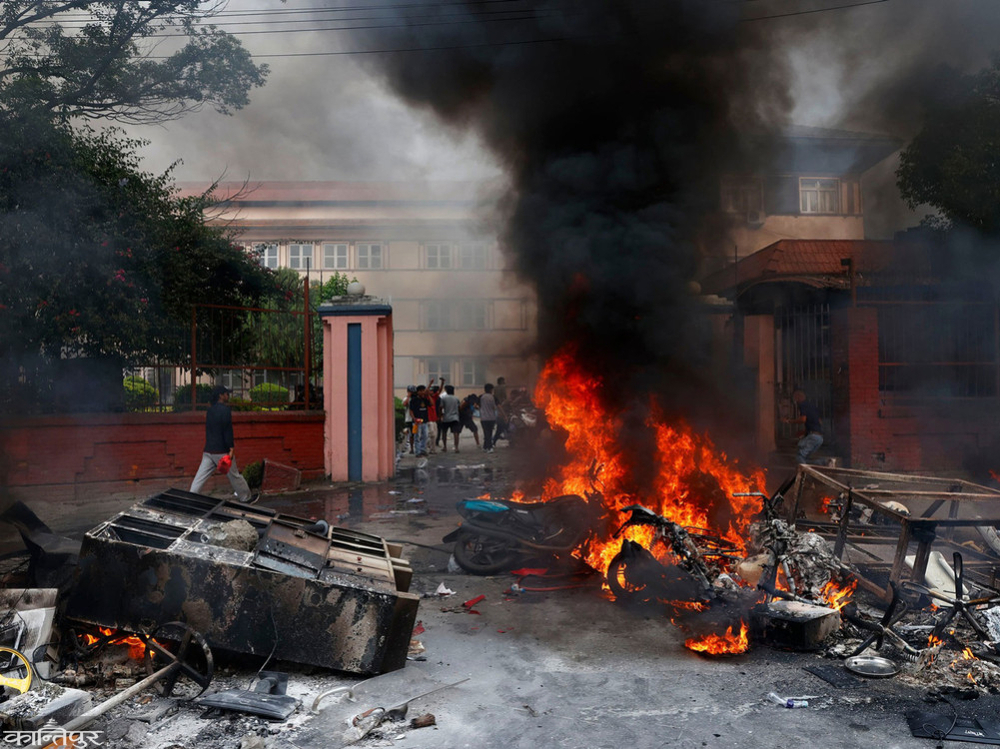
Supreme Court spokesperson Arjun Koirala informed that files of cases that have been decided and are being prepared for publication in the law journal have also been burned. According to the data of 22 Bhadra, about 200,000 cases were pending in courts across the country. Out of the 24,234 cases pending in the Supreme Court, 20,034 cases have been burned.
The Supreme Court has found only 2,509 files for writs and 1,691 for cases. 197,000 case files have been destroyed in the archives. According to Spokesperson Koirala, ongoing cases can be returned as they are also being processed elsewhere. ‘However, since the cases in the archives are processed only in the court, it is impossible to re-create the files for ongoing cases,’ he said. The Supreme Court has already started the process of creating the files for ongoing cases.
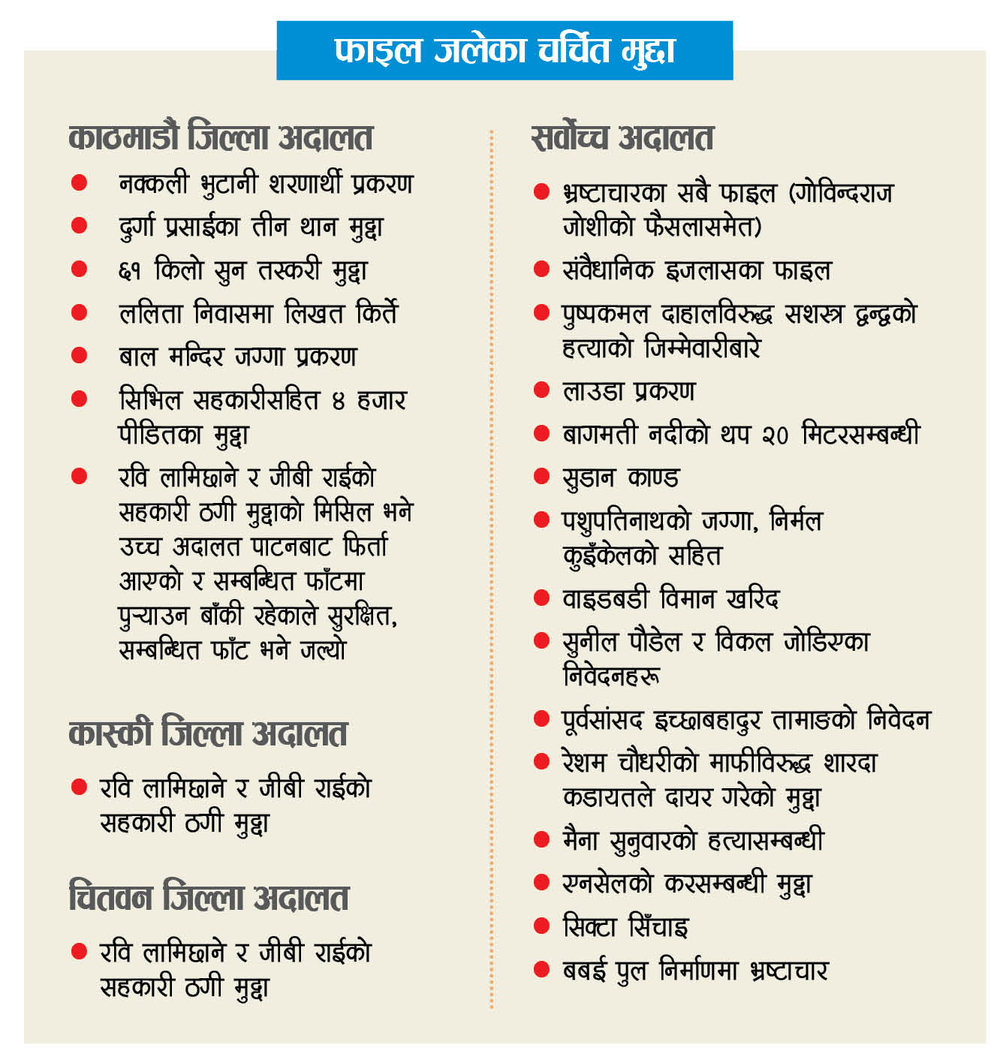
6,533 ongoing cases at the higher and district levels and 4,185 files for tehsils have been lost. 766,071 files have been destroyed in the archives. The most damage has been done in the Kathmandu District Court. 400,000 files for archives and 4,000 files for ongoing cases have been burned in the Kathmandu District Court, informed Shrestedar Tirtharaj Bhattarai.
‘All the cases since 2053 have been burned,’ he said, ‘some cases before that have been saved.’ According to him, although almost all the files have been reduced to ashes due to the fire in the main building, work is underway to verify the cases that have been saved.
The implementation of the verdicts is likely to be complicated as more than 400,000 cases decided by the Kathmandu District Court have been destroyed by the fire. ‘There is a problem in implementing the verdict in cases where there is no complete file or case,’ said Dhan Bahadur Karki, the District Court’s Judgment Enforcement Officer. ‘Such a problem seems to arise in the immediate case of about 3,000 verdicts.’ According to him, the recent verdicts are written only in the opinion book, and since the opinion book has been burned, it is also difficult to understand what the verdict was.
The fire completely burned out the 9th, 13th and 21st floors of the Kathmandu District Court. There were cases in those floors including the fake Bhutanese refugee case and 61 kg gold smuggling. In the fake Bhutanese refugee case, Congress leader Balkrishna Khand, UML leader Top Bahadur Rayamajhi and others are accused. In Field No. 13, there was a case file of forgery and fraud in the cooperative fraud and embezzlement of government land of Lalita Niwas. In the case related to gold smuggling, a charge sheet was registered in the court on 31 Bhadra 2080 with the help of the Revenue Investigation Department. Maoist leader Krishna Bahadur Mahara and others are involved in the gold smuggling case.
Chief Justice Prakash Man Singh Raut said that the judiciary has lost not only physical property but also history in the protest of 24. ‘The legacy of justice since 2018 has also been reduced to ashes in the flames,’ he said.
Ravi Lamichhane’s entire file
While the files from civil cooperatives to Gokarna cooperatives were burnt in the Kathmandu District Court, the file related to the embezzlement of money of the Swarna Lakshmi cooperative, which was linked to Rashtriya Swayamsevak Sangh (RSS) President Ravi Lamichhane, has been found intact. According to a district court employee, the file of Swarnalakshmi Cooperative was sent to the Patan High Court after a petition was filed against the district court's order seeking bail. The file was saved from being burned because it was not able to reach the relevant section after it was returned.
'The section containing the files of cooperative cases was completely reduced to ashes,' the employee said. 'Around 4,000 cooperative cases were pending,' he said. Protesters also set fire to the Kalimati police circle, where the Swarnalakshmi Cooperative was investigating the savings fraud case.
What is the situation outside Kathmandu?
Protesters targeted 10 district courts and 7 high courts on Bhadra 24. In addition to Kathmandu, the district courts of Chitwan, Kaski, Saptari, Banke, Rupandehi, Parsa, Makawanpur and Kapilvastu were attacked. The Tulsipur Butwal Bench of the High Court, Biratnagar, the temporary bench of Janakpur, Rajbiraj, Hetauda and others were also vandalized and set on fire.
Nearly 21,000 old case records of the Tulsipur Butwal Bench of the High Court have been destroyed by fire. The case file related to the Supreme Cooperative Fraud case involving Rashtriya Swayamsevak Sangh (RSS) President Rabi Lamichhane is safe. The files of some major revenue cases are also safe, informed the court's information officer Ram Bahadur Kunwar. 'The work of searching for the files of the ongoing cases is ongoing,' he said.
Although the physical structure of the Rupandehi District Court, Bhairahawa, was damaged by arson and vandalism, the case files are safe. 'No files have been burned,' said Padam Aryal, information officer of the District Court, Bhairahawa.
30,000 files have been burned in the District Court, Kailali. According to the court's clerk, Chetraj Pant, the case files kept in the archive room were burnt. 'The data on the destroyed and remaining files is being collected,' he said.
A total of 24.87 lakh rupees and 21.67 lakh Nepali rupees were stolen from the Saptari District Court after the arson and vandalism. The court's information officer, Umesh Kumar Aryal, said that the files are safe.
Nearly two-thirds of the files of the ongoing cases in the Chitwan District Court have been burnt. According to information officer, Amrit Bishwakarma, only 670 files are in good condition. 'There is an initial estimate that almost 1,400 files have been burnt,' he said, 'All files in fields 1, 2, 3 and 4 have been burnt.'
The file related to the fraud of Sahara Chitwan Multipurpose Cooperative Society, where Rashtriya Swayamsevak Sangh (RSS) President Lamichhane is a defendant, was in field 1. According to the court, files related to serious and important people were kept in boxes 1 and 2. “Those files were destroyed,” said Information Officer Bishwakarma.
2,000 files related to cooperative fraud in the ongoing case and 30,000 files related to the archived case in the Kaski District Court and the Pokhara High Court have been burned. The file related to the savings fraud of Suryadarshan Cooperative, which is related to Rashtriya Swayamsevak Sangh (RSS) President and former Home Minister Lamichhane, has also been destroyed. The file related to the fraud of Pokhara’s Image Cooperative, which is related to Dhorpatan Municipality Mayor Dev Kumar Nepali, has also been destroyed. According to Kaski Court Registrar Rajan Khanal, 2,330 files have been destroyed out of the ongoing cases. Only 120 case files have been saved. 30 percent of the 70,000 files in the archive section have been burned. How are files revived? The Full Court of the Supreme Court issued the ‘Directive on the Acquisition and Verification of Files and Documents Destroyed Due to Special Circumstances, 2082’ on 5 Asoj. According to it, five methods/measures have been adopted to retrieve the destroyed files.
The directive mentions collecting copies of documents/records related to a case before a court or agency, collecting judgments and documents uploaded on the websites of the Supreme Court and other government agencies, and collecting documents held by judges and employees in the course of court work. It also says that documents exchanged electronically between various courts, other government agencies, judges and bench officers should be collected and collected through ‘appropriate means’.
The Supreme Court has also laid down a basis for how to prepare the details of the collected files and other cases. The files will be classified based on the names, surnames, country of residence, contact numbers, nature of the case, case number, civil, criminal, writ, contempt of court, petition, report or other, and on the basis of what nature the files are and on the basis of what stage they are in, such as those in the process of action, those whose full text of the decision has been decided and is yet to be prepared, or those who are in the process of implementing the decision, or those whose implementation of the decision has been completed and are in the form of records.
In the case of an appellate court or body, the files will be classified based on which jurisdiction the files fall under, whether it is the original jurisdiction or the appellate jurisdiction, and in the case of the Supreme Court, the files will be classified based on which jurisdiction the files fall under, including appeal, writ, petition, case reviewed, retrial, petition report, review or constitutional bench. The files will also be prepared based on which bench the files will be presented in, whether it is a single, joint, full or grand full bench. Files may also be prepared on other grounds as required.
Once the details of the destroyed files are prepared, a field-wise and summary record book will be prepared. The directive states that after preparing the details of the destroyed files by courts other than the Supreme Court, a copy should be sent to the Supreme Court. It has been said that the files received in this way will be uploaded on the Supreme Court website and a copy will also be provided to the Attorney General's Office, the Government Prosecutor's Office, the Nepal Bar Association and other bodies.
Related News
Bhadra 24: Protesters entered the gate in the second attempt, and the Supreme Court was destroyed

