There is a constitutional provision that if the party participating in the government withdraws its support, the Prime Minister must take a vote of confidence within 30 days, but since the Civil Liberation Party withdrew its support on June 22, the Supreme Court raised serious constitutional questions after the government did not go through this process.
We use Google Cloud Translation Services. Google requires we provide the following disclaimer relating to use of this service:
This service may contain translations powered by Google. Google disclaims all warranties related to the translations, expressed or implied, including any warranties of accuracy, reliability, and any implied warranties of merchantability, fitness for a particular purpose, and noninfringement.
The constitutional question has been raised regarding the legal status of the government led by Prime Minister KP Sharma Oli if the party participating in the government has not received a vote of confidence even after formally informing them that they have left the government. While the information that the Civil Liberation Party has formally left the government has been given to the Parliament, the Supreme Court has taken the matter of the Oli government's non-confidence vote to judicial review.
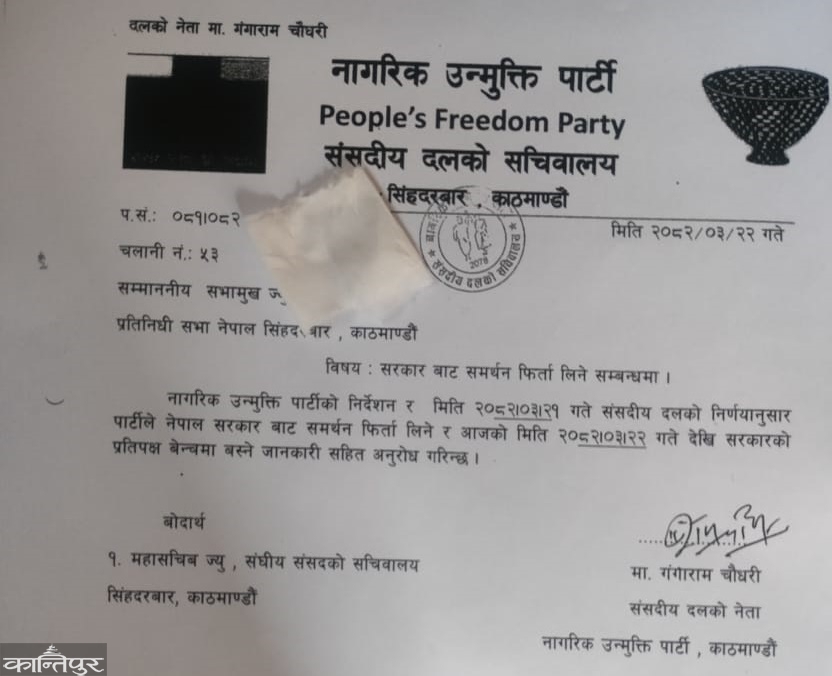
On June 22, Unmukti, one of the participants in the government, registered a letter of withdrawal of support at the Parliament Secretariat. Article 100 (2) of the Constitution states, "If the party represented by the Prime Minister splits or if the party participating in the government withdraws its support, the Prime Minister must submit a proposal to the House of Representatives for a vote of confidence within 30 days." According to this provision, if Prime Minister Oli does not receive a vote of confidence within 19 July, a writ was filed in the Supreme Court saying that the legitimacy of the government has expired.
Civil Immunity has sent a letter to the Parliament saying that after 30 days of withdrawing its support, it has given its support again. But after the expiry of 30 days, the argument has been raised that since the support is given again, it will not automatically be recognized. Advocate Birendra KC filed a writ petition in the Supreme Court saying that Prime Minister Biswas did not go to Parliament to take the vote of confidence contrary to the provisions of the Constitution. The Supreme Court has issued a show cause order after conducting preliminary hearing on the writ petition. The Supreme Court has called the petitioner along with the Prime Minister and Speaker asking for written answers to four constitutional questions. The Supreme Court did not issue an interim order on the
writ but asked the government to submit in writing the reasons for not taking the vote of confidence. According to Article 100, Clause (2) of the Constitution of Nepal, if the Civil Liberties Party, which participated in the government led by the opposition Prime Minister, withdrew its support to the government on 22 June and the Prime Minister did not receive a vote of confidence in the House of Representatives within 30 (thirty) days of that, the legitimacy of the government will be questioned. Support is about returns. "Even in the case that the Janata Samajwadi Party (JSP) Nepal, which is not participating in the government led by the Prime Minister but has supported the government, has withdrawn its support, can the interim order be issued due to the lack of compliance with the constitutional provision of Article 100 of the Constitution and the lack of compliance?" is mentioned in the second question.
In the third, the Supreme Court has withdrawn the support given to the government and raised the question whether it can be supported again or not. "The copy of the letter written to the Speaker of the House of Representatives with the request of the chairman of the Civil Liberation Party, which came into the discussion to retain the concerned party, appears to have written a letter on June 22 stating that the party would withdraw its support to the current government," the order said, "30 days after writing the letter, the letter was canceled and on the party's letterhead, according to the decision of June 30, the said letter was written against the Prime Minister in Article 100 of the Constitution. (2) The question of legality arises when the constitutional provisions of (2) are attracted or not?'
The fourth question raised by the Supreme Court that it should be explained before the interim order, it raised the question that when the matter of Parliament's arithmetic is decided, why should it be declared only when the interim order is decided. "Is the provision of sub-section (2) of Article 100 of the Constitution binding in nature or will it only be attracted based on the relative number of members of the House of Representatives of the parties participating in the government, the majority or the arithmetic of the minority?" The order said, "What is the situation in which an interim order can/cannot be issued?" Regarding these constitutional questions, it seems that a decision should be made in the next hearing regarding whether the interim order will be issued or not after listening to both parties.
The Supreme Court has set a date for the hearing of the interim order on 11 August. On that day, the court will give a decision after hearing the arguments of both the government and the writ petitioner. If the prime minister is found to have violated the constitution without taking a vote of confidence, the government will be suspended. Senior advocate Shambhu Thapa comments that the prime minister violated the provisions of the constitution by not proposing a vote of confidence in the House of Representatives despite the withdrawal of support by the parties participating in the government. He said that since the clause (2) of Article 100 of the Constitution clearly states that the party participating in the government must take a vote of confidence within 30 days of withdrawing its support, there is no exemption for this.
"Clause (2) of Article 100 of the Constitution clearly states that if a party participating in the government withdraws its support, the Prime Minister must go to Parliament within 30 days to prove that he has confidence," says Thapa, "Not taking a vote of confidence until this period lasts means that the Prime Minister does not seem to accept the Constitution." tells "If you look at the spirit of the constitution, the prime minister should have taken the vote of confidence within 30 days," Shrestha says, "If the vote of confidence is not taken within the period set by the constitution, then the act of disobeying the constitution has been committed." He recalled taking the vote. "If the constitution is to be followed, a vote of confidence should be taken," says Shrestha, "The constitution does not look at whether the government has a majority or not." But the argument of the government is that since no party has left the government, there is no need to adopt the process of taking a vote of confidence.
Government spokesperson and Minister of Communication and Information Technology Prithvisubba Gurung claims that the government has not received any formal opinion that any party has left the government. "The government does not know that anyone has officially left the government, and there has been no discussion about it in the government," says spokesperson Gurung, "that's why nothing can be said." What is the decision of the Supreme Court? According to the decision of the Supreme Court, the government will proceed by implementing it.
Legal advisor to the government, Attorney General Ramesh Badal argues that since the parties participating in the government are still in the government, the question of taking a vote of confidence does not arise. "The civil liberties minister who participated in the government is still in the government, he has not left the government, he has not resigned," says Badal. He informed that the civil emancipation earlier withdrew its support and applied to the Speaker and the Parliament Secretariat to be placed in the parliament as an opposition party, and the decision was made accordingly, but later it was supported, so now the parliamentary process is pending to retain the ruling party. "Civil Immunity has been maintained in the opposition seat till today, a letter has been received saying that the government has support, but no decision has been taken on it," says Pandey.
In a meeting chaired by the parliamentary party leader Gangaram Chaudhary in Kathmandu on June 21, the four MPs of Civil Immunity unanimously decided to withdraw their support to the government, sit on the opposition bench and recall Arun Kumar Chaudhary, who is the Minister of State for Tourism, from the party. "Civil Immunity has been supporting the government until now because it has not worked as expected from the government, so from today, it will withdraw its support from the federal and provincial government of Nepal and sit on the opposition bench," the decision of Immukti sent to the speaker said, "The decision to recall Honorable Arun Kumar Choudhary, who is the Minister of State for Tourism, Culture and Civil Aviation of the Government of Nepal, from the government was unanimously passed."
Gangaram Chaudhary, chief whip Lalveer Chaudhary, whip Arun Kumar Chaudhary and Ranjita Shrestha signed.
Meanwhile, the controversy within civil liberties reached its climax. Ranjita was removed from the party president and MP Lalveer Chaudhary was appointed as the president. However, the Election Commission decided on 28 July that Ranjita Shrestha will remain the party president. While deciding on the application for updating the party details, which said that Lalveer Chaudhary has been appointed as the president while removing Ranjita, the commission has decided that Ranjita is the president. Civil Liberties held a national meeting on July 14 and 15 and decided to dismiss Ranjita and make Lalveer its president.
Ranjitha reversed the decisions made under the leadership of Lalveer and Gangaram after the commission reinstated her as the chairman. On July 30, she wrote a letter to the Speaker regarding her vote of confidence and support for the government. "According to the decision of this Civil Liberation Party, the party has withdrawn its support from the government on June 22, 2082, canceling the letter with the statement that it has been informed in the parliament secretariat that it has full confidence and support for the current government as per the decision of the party, and now it is requested that the statement remain on the side of the government," said the letter written by Ranjita to the speaker. The
letter has also been given to the Parliament Secretariat and the Election Commission. Similarly, Ranjita also submitted a petition in the court to participate in the discussion as she is also the interested party of the writ which is questioning the legitimacy of the government.
Even though there are different opinions between the government and the parliament, constitutional law experts have argued that the essence of the constitution is to take a vote of confidence. Senior advocate Purnaman Shakya, an expert in constitutional matters, said that according to the constitution, there is a constitutional provision that the Oli government should take a vote of confidence. The constitution says that a vote of confidence must be taken. But if the majority is reached, the government may have thought that it is not necessary. This is a wrong practice," Shakya said. "There was a similar practice in the past as well. This practice is not good.
Senior advocate Madhav Basnet, an expert in constitutional law, said that Prime Minister Oli should take a vote of confidence in the current situation. It is not because the government has a majority. The article on the vote of confidence in the constitution does not assume that there is a majority, it envisages that there should be a test in the parliament," said Basnet, "If the party participating in the government splits or if the support given to the government is withdrawn, the prime minister will know whether he has a majority by testing the floor." If the vote of confidence is not taken, will the legitimacy of the government be questioned or not? Should an interim order be issued to convert such a government into a caretaker government or not?
Even in the case that JSP Nepal, which did not participate in the government but supported the government, withdrew its support, can the constitutional provision of Article 100, sub-section (2) of the constitution be attracted and an interim order be issued for lack of compliance or not?
A copy of the letter written to the Speaker of the House of Representatives with the request of the chairman of the Civil Liberation Party, which was included in the discussion. Wake up or not?
Is the provision of Article 100 (2) of the Constitution binding in nature or is the majority or minority of the members in the House of Representatives of the parties participating in the government only attracted by mathematical relativity? What are the circumstances under which an interim order can/cannot be issued?

