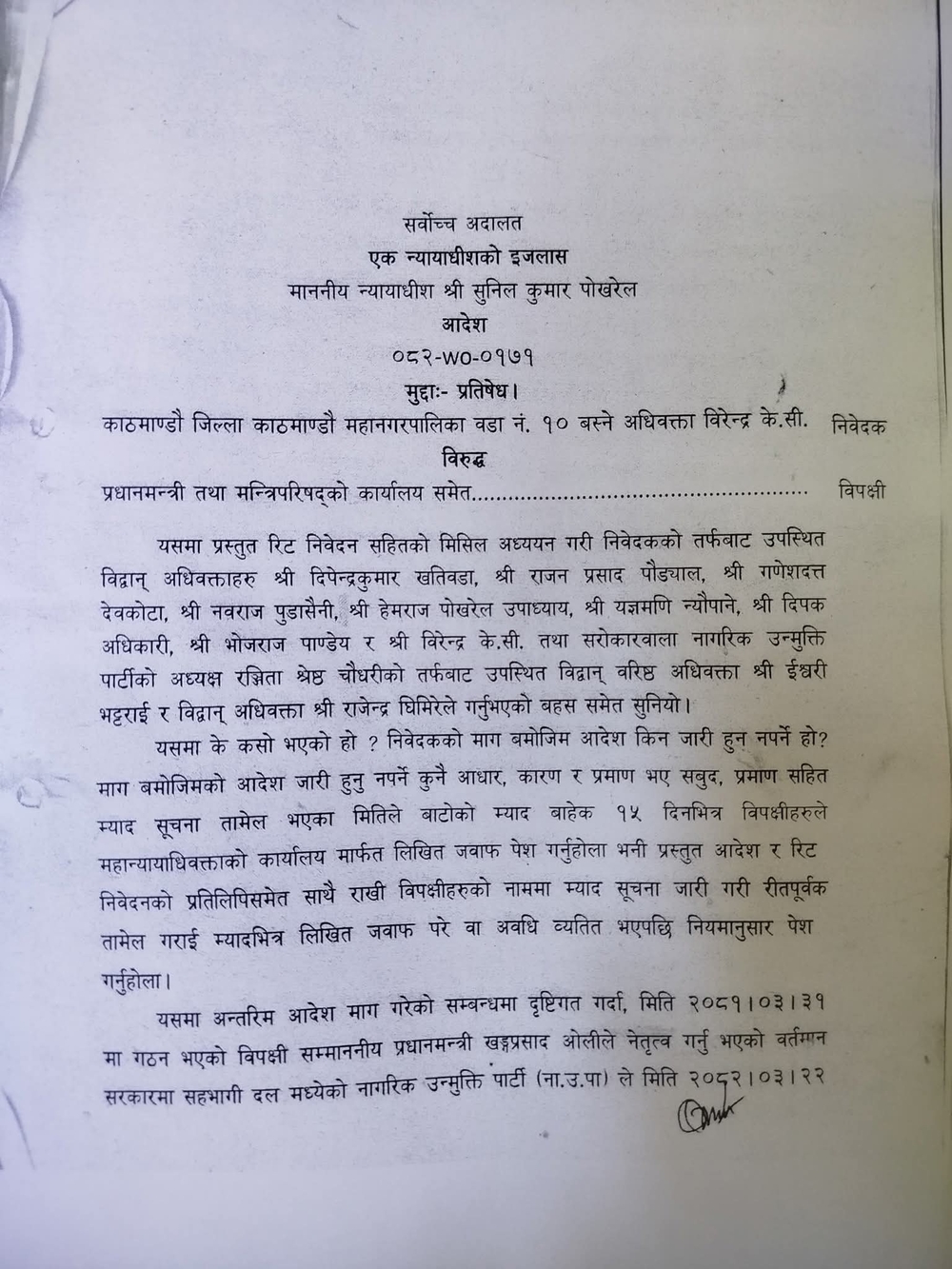
A single bench of Judge Sunil Kumar Pokharel asked such a question. In the writ filed by advocate Birendra KC, the Supreme Court has raised a question saying that a serious constitutional interpretation should be made.
We use Google Cloud Translation Services. Google requires we provide the following disclaimer relating to use of this service:
This service may contain translations powered by Google. Google disclaims all warranties related to the translations, expressed or implied, including any warranties of accuracy, reliability, and any implied warranties of merchantability, fitness for a particular purpose, and noninfringement.
The Supreme Court has raised four questions on whether or not a vote of confidence should be taken if the support given to Prime Minister KP Sharma Oli is withdrawn.
A single bench of Judge Sunil Kumar Pokharel has asked such a question. In the writ filed by advocate Birendra KC, the Supreme Court has raised a question saying that a serious constitutional interpretation should be made. A vote of confidence should be taken in the writ petition, It has been claimed that the prime minister should be relieved of his post because he has not received a vote of confidence within 30 days and that he cannot make far-reaching decisions because the government is running. In the writ petition, the Supreme Court did not issue an interim order but asked the government to submit in writing the reasons for not taking the vote of confidence.
On June 32, Jaspa announced that it had withdrawn its support to the government. Since the vote of confidence was not counted from the same day, it has been mentioned in the writ that Prime Minister Oli is acting. In Article 100 of the Constitution, there is a provision on vote of confidence and no-confidence . Article 11(2) states that if a party participating in the government withdraws its support, the Prime Minister must submit a proposal to the House of Representatives for a vote of confidence within 30 days.
In sub-section (3) of the same article, there is a provision that the Prime Minister will be relieved of his post if the proposal submitted in that way cannot be passed by the majority of the members in the House of Representatives.
The Supreme Court rejected the interim order on Friday and the full text of the order was published on Sunday.
Four questions raised by the Supreme Court
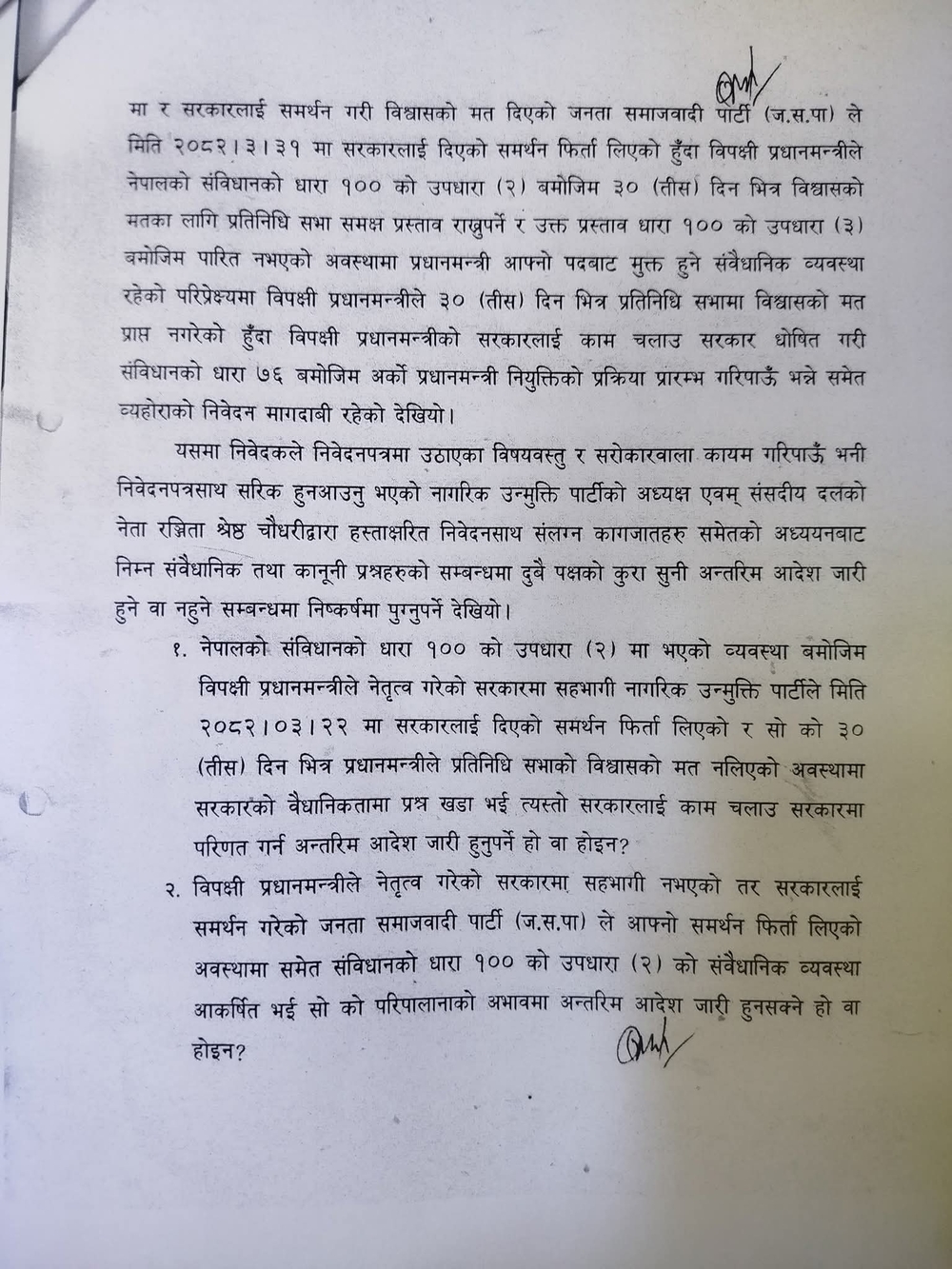
The Supreme Court has said that four questions should be answered before deciding why not to issue an interim order. Judge Pokharel's bench asked the first question about why the government should not be temporary.
According to the provisions of Article 100, Clause (2) of the Constitution of Nepal, the legitimacy of the government will be questioned if the Civil Liberties Party, which participated in the government led by the opposition Prime Minister, withdrew its support to the government on June 22 and the Prime Minister did not receive a vote of confidence from the House of Representatives within 30 days. The support taken by Jaspa is about return . What will happen in the case of supporting the government but not participating in the government?
'Even when the Janata Samajwadi Party (JSP), which has not participated in the government led by the opposition prime minister, but has withdrawn its support, can an interim order be issued due to the lack of compliance with the constitutional provisions of Article 100 of the Constitution, or not?'
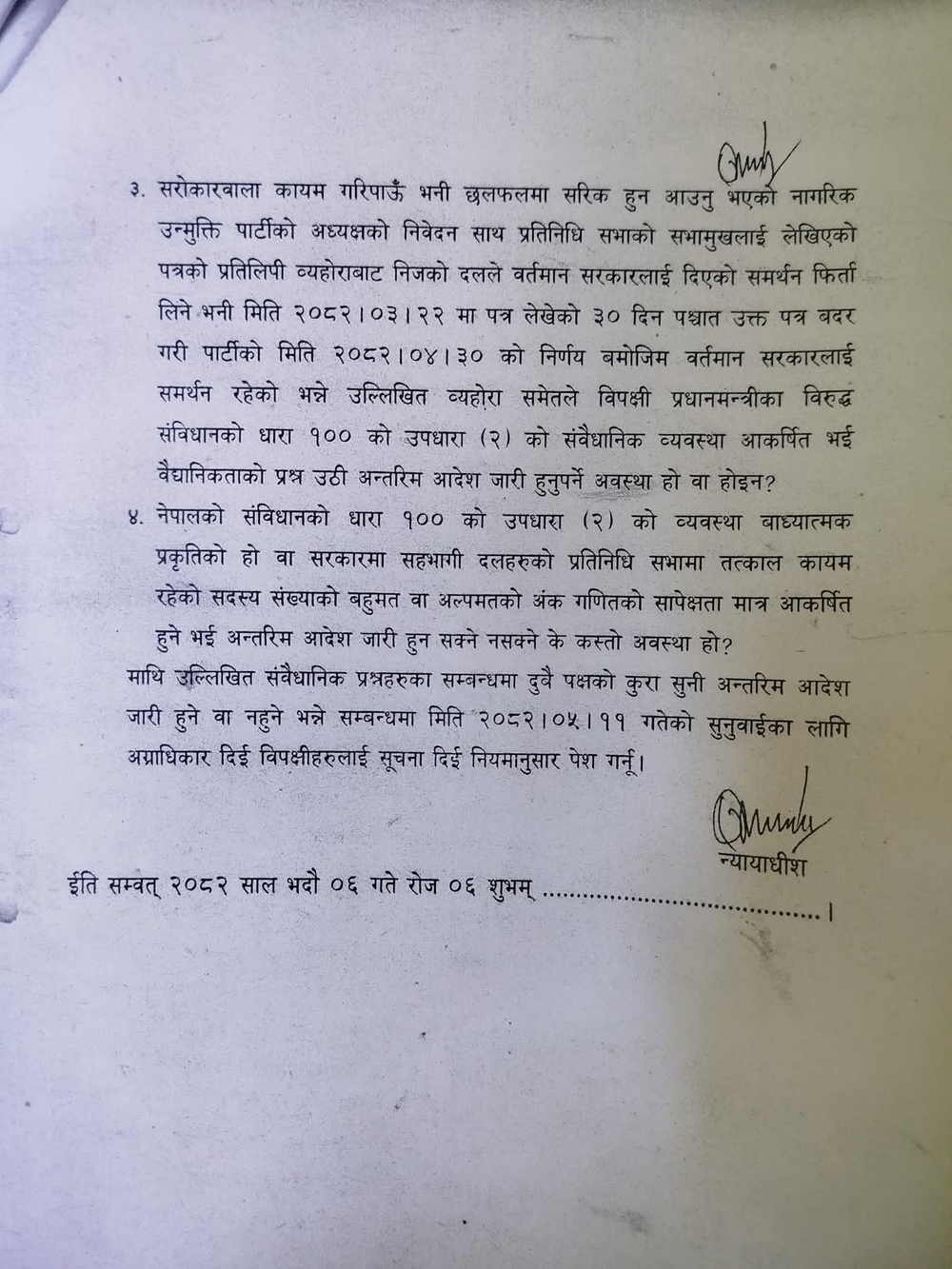
As a third question, the Supreme Court has raised the issue of whether the support given to the government can be withdrawn and whether it can be supported again.
"From the copy of the letter written to the Speaker of the House of Representatives along with the request of the chairman of the Civil Liberation Party to be retained in the discussion, it appears that the party wrote a letter on June 22 to withdraw its support to the current government," the order said, "30 days after the letter was written, the letter was revoked and on the party's letterhead that it supported the current government according to the decision of July 30. The question of legality arises or not by attracting the constitutional provisions of sub-section (2) of the Supreme Court.'
The fourth question raised by the Supreme Court is that it should be explained before the interim order.
"Is the provision of clause (2) of Article 100 of the Constitution of Nepal binding in nature or whether the majority or minority of the members in the House of Representatives of the parties participating in the government is only attracted by the relativity of mathematics," the order said, "What is the situation in which an interim order can/cannot be issued in this matter? Regarding these constitutional questions, it seems that a decision should be made in the next hearing regarding whether the interim order will be issued or not after listening to both sides.'
The Supreme Court has fixed 11 August for the hearing of the interim order. On that day, the court will give a decision after hearing the arguments of both the government and the writ petitioner. If the Supreme Court decides that a vote of confidence should be taken or if it is judged to have violated the constitution without taking a vote of confidence, the government will be suspended.