After realizing the importance of Sanskrit, foreign students are attracted to study Sanskrit and Eastern philosophy in Nepal.
We use Google Cloud Translation Services. Google requires we provide the following disclaimer relating to use of this service:
This service may contain translations powered by Google. Google disclaims all warranties related to the translations, expressed or implied, including any warranties of accuracy, reliability, and any implied warranties of merchantability, fitness for a particular purpose, and noninfringement.
Lately, not only in Nepal, but also in the whole world, the interest in Eastern philosophy is increasing. In most universities around the worldEastern philosophy is not only taught, but a department has been running for it for a long time.
The number of people from Nepal going to foreign universities to study Sanskrit is also increasing. Similarly, foreign students coming to Nepal to study Sanskrit and Nepali culture and history are also increasing.
The number of foreign students studying Sanskrit in Valmiki Vidyapeeth (campus) is also increasing. Currently, the number of foreign students is 62 in this university located on the Exhibition Road of Kathmandu. Out of which two people are doing PhD (Education) and 60 people are studying Sanskrit language . They are doing 1 year 'Sanskrit for Foreigners' course . According to
campus, in the financial year 2081/82 to study Sanskrit in Valmiki campus 62 foreign students were enrolled. According to the campus, the number of new admissions has increased compared to other Sanskrit schools in the country.
According to Valmiki Campus associate professor Prem Neupane, foreign students come to Nepal to study language, Sanskrit philosophy, Buddhist philosophy. There is a course called 'Sanskrit for Foreigners' for students coming to study in Nepal from abroad. There are 2 semesters in the subject. In which students study grammar and language subjects, Neupane said, "After passing the one-year course (language), if the student has previously graduated in any subject, then the postgraduate can also be done in other universities of Nepal. Those who do master's degree in Eastern Dharma philosophy, they can study any subject related to religion, including Sanskrit, Dharma philosophy. According to
Neupane, the number of people who come to Nepal and learn common language is more significant. Foreign students also come to the campus to learn about the Shlok, Sanskrit language and to understand the customs and traditions. Neupane said that those who come to study from different countries with interest in Nepal consider knowledge to be the most important. 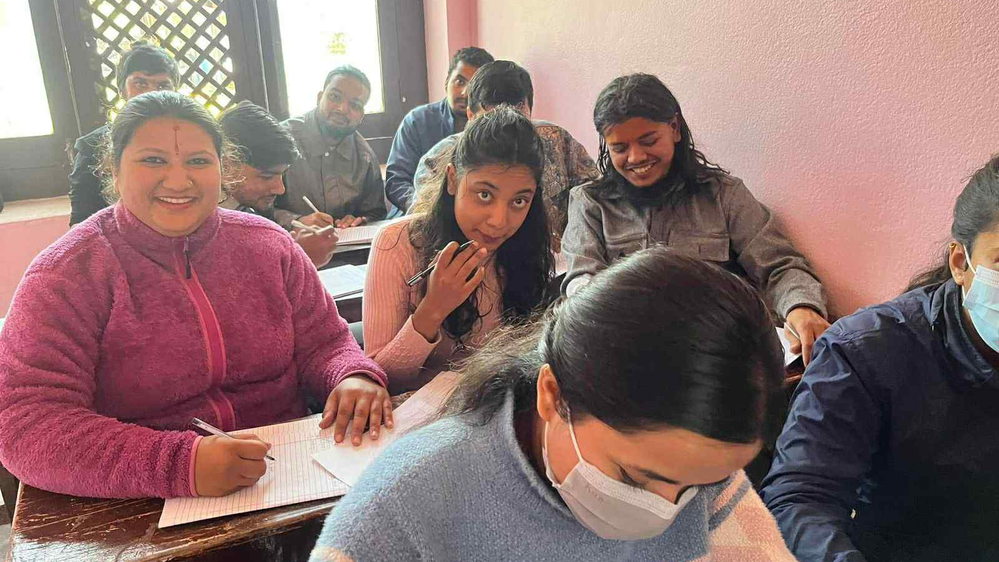
Currently Valmiki has students from America, China, Mexico, Italy, Spain, Sri Lanka, Taiwan, Austria, India etc. Sanskrit itself is becoming important. They came to Nepal to acquire knowledge knowing that Sanskrit is important. In five years, 300 foreign students have studied Sanskrit. Some of which Acharya (MA) passed and two are doing their PhD here,' said Neupane.
Recently, the number of women in Sanskrit studies is also increasing . Associate Professor Rama Bhattarai says that the number of women studying Sanskrit has increased compared to before. "Earlier when we were studying, it was not seen that more than two or three women were studying Sanskrit, but now the number has increased," says Bhattarai, "more people are attracted to it after understanding the importance of the Sanskrit language". According to
Bhattarai, Sanskrit plays an important role in bringing peace in the society, disciplining people and keeping them dignified. "Among the Nepali students studying Sanskrit, the number of retired employees working in various fields has increased," she said.
The number of students is increasing not only in Kathmandu but also in other Sanskrit universities of the country. According to Rajesh Ghimire, Vice-Professor of Shri Vinduwasini Sanskrit Vidyapeeth in Pokhara, everyone's future will be bright if Sanskrit language is taught in a way that is easy for everyone. He says, 'If gurukuls and universities in every place to study Sanskrit could be operated in such a way that Nepalis as well as foreigners would be comfortable, there would be a positive change in every person as well as the society.'
Ghimire said that since Sanskrit language itself is a scientific language, everyone's interest in this has increased at the present time. He says that one can understand the traditions and customs of the society without knowledge of Sanskrit language. Seeing the need to save it, many people have chosen the Sanskrit language at present. What is not more than what is in Sanskrit? He argues that it is necessary to question that. He says that Nepali and foreign students have recently shown interest in this subject, realizing that after studying this subject, they will know everything. He said that if the government can include Sanskrit subject in regular teaching, the interest towards Sanskrit subject will increase .
Professors say that there are various subjects within Sanskrit, but as soon as Sanskrit subjects are mentioned, people only associate them with rituals. But They say that 19-20 subjects are taught in Sanskrit, including various subjects such as grammar, literature, justice, theoretical astrology, Buddhist philosophy, Sarvadarshan, Dharmashastra, Vedanta philosophy.
Pradeep Ghimire, who is studying a master's degree in 'classical Indology' (archaeology) at Heidelberg University in Germany, says that the research field in Nepal is very low compared to foreign countries. After graduating from Valmiki Vidyapeeth and went to Germany for further studies, he says, ``Foreign students go to Nepal to understand the language and culture . But it seems that they come abroad from Nepal to do research. Because the field of research in Nepal seems to be weak compared to abroad.
is ahead in terms of study and resources, he says that if we can strengthen the research field in Nepal, we can attract not only natives but also foreign students. Heidelberg is the oldest university in Germany, founded in 1386. The University has a South Asian Studies Institute (South Asia Institute). Professor Axel Michaels, who has taught in this department for a long time, is conducting the study and research of the religious and legal documents of pre-modern Nepal and conducting the 'Documenta Nepali' project to digitize such records.
The students who are studying from Valmiki Vidyapeeth and who have completed their studies also say that the government should pay attention to strengthen Sanskrit studies . Navin Upadhyay, who has passed the fourth year examination of his graduation, says that if the university has enough resources, it can attract Nepali as well as foreign students if the library can be arranged appropriately.
He says, 'if there is a good arrangement of the library, teaching according to the academic calendar, along with the development of technology, learning of Sanskrit subjects through technology, the level of Sanskrit University could have increased and foreign students could have been attracted more. According to the campus, 1,464 students are currently studying various subjects at different levels in Valmiki, which is a branch university of Nepal Sanskrit University. In which Prak Shastri, Shastri, Acharya, Vidyavaridhi and Sanskrit for Foreigners are read .
Jung Bahadur Rana B.S. After establishing Rajarajeshwari school in 1939, the same school In the year 1942, after the Ranipokhari Pathshala was transformed, the teaching of Sanskrit language was started in Kathmandu Valley.
was transformed into Valmiki Sanskrit College in 2024 and Valmiki Vidyapeeth after 2030. It was established in 2043 as a branch university of Nepal Sanskrit University.

