There is a Supreme Court order that the government can take someone's call details only with the court's permission if it is necessary for criminal investigation, but if the National Intelligence Bill is passed, the intelligence chief will be able to monitor, monitor and tap (listen and record) any person's phone calls, messages, videos, etc.
We use Google Cloud Translation Services. Google requires we provide the following disclaimer relating to use of this service:
This service may contain translations powered by Google. Google disclaims all warranties related to the translations, expressed or implied, including any warranties of accuracy, reliability, and any implied warranties of merchantability, fitness for a particular purpose, and noninfringement.
The government is trying to bring in a law related to espionage so that the personal privacy provided by the constitution will be violated. By bringing the National Intelligence Bill, it is going to make a law with provisions to monitor, monitor and tap citizens' phone calls, messages, videos and other materials. The government is preparing to register this bill in the parliament soon. While Article 28 of the Constitution has ensured the right to privacy of individuals.
In the past, there were repeated attempts to make such arbitrary laws. The KP Sharma Oli-led government formed in the Congress-UML alliance is about to introduce a law to listen and record the personal conversations of citizens through the intelligence chief.
In the draft of the National Intelligence (Intelligence) Bill, provisions for 'interception' (tapping) of conversations, audio-visual, electronic signals and details of media, individuals and organizations are included. According to experts on the constitution and law, if the government's proposal is passed as it is, the government can record and abuse the individual rights of the citizens guaranteed in the constitution at any time. They also commented that there is a risk of being used as a 'tool for layering' those who criticize the government.
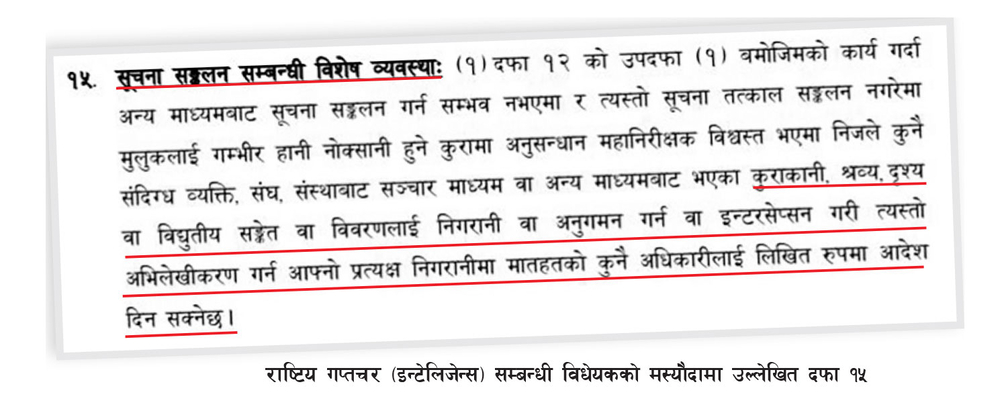
In the 15th of the proposed National Intelligence Bill, it is mentioned that the interception (tapping) will be done by including the special provisions related to information collection. It has been said, "If it is not possible to collect information through other means and if the Inspector General of Investigation is convinced that the country will be seriously harmed if such information is not collected immediately, he may give an order in writing to the officer under his direct supervision to monitor or monitor or intercept the conversations, audio-visual or electronic signals or details from any suspect, organization through the media or other means, and record such." Explaining this, the bill states, Interception should be understood as the act of monitoring or monitoring any communication network and obtaining information as needed.'
For this purpose, to 'intercept' the details of individuals and organizations, it is sought to give 'read-only' access to computer database systems in other government agencies or public bodies by connecting them to the department's computer database system.
While it is not wrong to allow the spying mechanism to tap the phones of suspects involved in activities that disrupt Nepal's independence, sovereignty, geographical integrity, national independence and national security, legal scholars have expressed concern about the risk that the government may misuse it as a 'weapon of anti-layering' within the country.
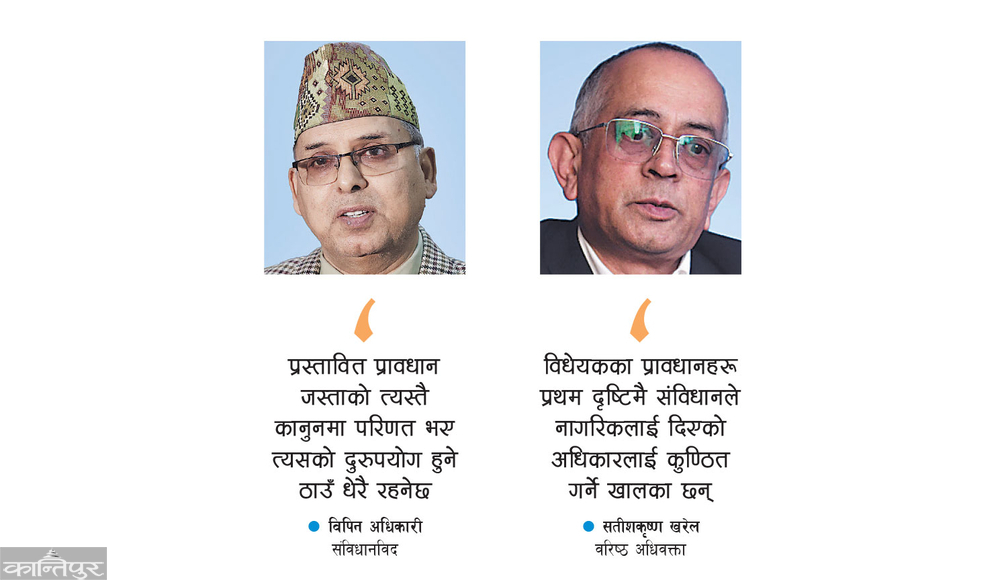
Senior advocate Satishkrishna Kharel says, "The provisions of the bill are, at first sight, such as to curtail the rights given to the citizens by the constitution." "Those who sit in the parliament should understand, those who are in power should also take care of it, when they are in the opposition, this provision can be misused on them too," he says.
According to Senior Advocate Kharel, it seems that if the Inspector General wants to investigate, he can collect the personal details of anyone. "In a country like Nepal, there is definitely a possibility of its misuse for political purposes or criminal purposes," he says, "how to balance national security and personal privacy?" One should be sensitive to it.'' In the context of
crime investigation, the police can record someone's conversation or take call details only with the permission of the court. The Supreme Court explained on 21 Jan 2072 that 'uncontrolled access to information cannot be the privilege of the executive'.
Advocate Baburam Aryal filed a writ stating that since the right to privacy is an absolute secret and natural right of an individual, the government may interfere in one's private work and activities, the then Chief Justice Kalyan Shrestha's bench ordered that if access to information is necessary for criminal investigation, it can only be obtained with the permission of the relevant district court.
Aryal, who is currently the secretary of the Bar Association, says that the government has brought a draft bill against the constitution and the Supreme Court's decision. "The provision in the bill shows that the government has control over the information of anyone and under any circumstances," he says. He thinks that
media always challenges the state, critical news and analysis are published, in that situation the media also becomes the star of the government. He said that the provision of the bill, which is intended to bring freedom of speech and expression, freedom of movement, and freedom of personal privacy to everyone, given by the constitution, will affect them. What is national security? It should be explained, if there is a situation where such a crisis is not accidental, what could be the situation? Such matters should be clearly stated in the bill now," says Aryal.
Mentioning that the government should also understand its responsibility towards the citizens while considering national security, he said that since the current provisions are in a 'balancut' state, there is a high possibility of their misuse. According to him, in the situation where access to information is not necessary for national security, the judicial process should be followed by the relevant agencies.
The government has insisted that it is going to prioritize the challenges and make legal arrangements accordingly, subject to the limits determined by the constitution for national security. It is mentioned in the draft that 'national security challenges will be prioritized and appropriate legal arrangements, organizational structures and working methods will be adopted, so it is expected that there will be a positive impact in the field of fundamental rights and human rights'. Senior advocate Kharel says that since there is a risk of abuse of rights in the
draft, it should not be passed as it is. "The situation of telephone tapping for national security and the officer who ordered it should be made responsible," he says, "Why telephone tapping?" Why collect information? The basis and reasons for this should be reported to a judicial mechanism.
The government has claimed that such an arrangement is included to make the spying system effective in a 'defensive', defensive or 'counteractive' manner. The Special Services Act Bill was submitted to the Parliament in 2076 during the time of the then Prime Minister KP Sharma Oli with this arrangement in mind. After the unification of UML and Maoist, during the time of CPN President Oli, the bill came to curtail the rights of citizens.
Although the bill was passed by the National Assembly with amendments, it did not proceed through the House of Representatives. The bill was stopped after the five-year term of the parliament was over. At that time, the main opposition parties, including the Congress, opposed the bill. Congress leaders from the parliament to the streets opposed it saying that there should not be a law that would curtail the rights of citizens. Now, when Oli is the prime minister in the government consisting of Congress and UML, a draft bill has been prepared by targeting the rights of citizens to strengthen the counter-espionage mechanism.
Article 17 of the Constitution has ensured citizens' right to freedom of thought and expression. The right to communication is guaranteed in Article 19 and the right to privacy of citizens in Article 28. In the case of privacy, it is mentioned that "the privacy of any person's life, wealth, residence, property, written data, correspondence, character-related matters shall be inviolable except in accordance with the law".
Currently, the National Investigation Department (NDI) operates under the Special Services Act, 2042. By replacing the same Act, the government is preparing to introduce an Act related to 'National Intelligence' (Intelligence). The provision to upgrade the department as head office is mentioned in the proposed bill. It is mentioned that after the promulgation of this Act, the Head of the Department is called the Chief Director of Research. Under that, the right to have a separate special mechanism in the head office for the counter-espionage mechanism and through it to allow 'interception' of citizen's information from the unit under the direct authority of the intelligence chief is sought to be ensured in the law.
If Section 15 of the proposed Bill on Espionage published by the Office of the Prime Minister and Council of Ministers for opinion/suggestions and discussion is passed, there is a risk that the government will target people, media or organizations that it does not see as "favorable".
Constitutionalist Vipin Adhikari calls the provision in the bill a risky provision. "It is seen that an administration-oriented law is being made rather than a human rights-oriented one," he says. It seems that the bill was not brought objectively.'
He says that laws should be made to protect the fundamental rights given to citizens by the constitution. Will it reach the government? That was not enough. What is the right to think so? A threat to national security? How is this matter decided? How can citizens challenge it? "Khoi such matters?," he says, "In some cases, the government may want the right to access people's information, but that is an exceptional situation. It should not be made a regular topic.'
In a situation where it is necessary to listen to someone for national security, he suggests that an impartial person or agency should be consulted. He suggested that instead of taking the bill to the parliament at once and taking a position, the government should make necessary improvements through extensive debate on it.
On 7 August 2079, in the House of Representatives, Congress MPs Dilendra Prasad Badu, Pushpa Bhusal, Sanjay Kumar Gautam and Gagan Thapa said that the provision of phone tapping should be removed. They mentioned that if the provision is not removed, there is a danger that the government will go down the path of autocracy by curtailing the rights of individuals.
Nemkipa MP Prem Suwal commented that the intelligence did not know who was the enemy and who was the friend. But UML leaders Khagraj Adhikari and Navraj Silwal said that 'interception' is also necessary to protect national security, sovereignty and integrity and counter-espionage against foreign espionage against the country. The Congress leaders who opposed it in the past are silent on the draft which has now been made public.
When the bill was registered in the National Assembly in 2076, it was mentioned that 'suspicious or surveillance persons and organizations will be intercepted'. But the National Assembly gave the right to taping only in 4 offenses by explaining the reason.
A condition was added that the head of the organization should maintain confidentiality in such information even after reinstatement or retirement. Violation of the conditions was said to bring action even after retirement. However, now, ignoring the issues that were opposed in the past and which were amended by the National Assembly, the government is trying to empower the spying mechanism so that it can be more arbitrary.
"The method of operation related to interception mentioned in the bill has raised doubts, if it is not amended, there is a danger of questioning the personal freedom of citizens," Congress MP Badu said in the House of Representatives 3 years ago about the previous bill, "If there is no judicial protection, it is against the constitution, there is a danger of curtailing personal freedom and practicing autocracy." In the 2079 House of Representatives meeting, he said that there is a risk of extreme misuse of the interception system. "Now it is heard that the phone conversation between the minister and the journalist is being tapped," he said, "What will happen after getting the legal right?" He was of the opinion that there should be a system for interception approval to be obtained from the Supreme Court or Parliament.
The Special Service Act, currently in the form of the National Research Department's Service/Conditions and Operations Act, came into force on 12 August 2042 when the then King Birendra put the red seal on the Special Service Act. At that time the Act was made powerful even in internal and external intelligence. In addition to monitoring the activities of anti-panchayat forces, the external intelligence mechanism was made powerful at that time to monitor the activities of external forces.
However, with the advent of multi-party system, the spying mechanism was weakened. Towards the end of the Panchayat, under the leadership of DIG-level intelligence officer Prabhat Shamsher Rana, the National Public Relations Head Office 'B' was set up as a counter-espionage unit within the National Investigation Department (NDI) to look into external affairs.
A few years after the creation of the Act and its regulations in 2042, Head Office 'B' was established as a 'Counter Intelligence Agency'. At that time, two separate bodies named 'A' and 'B' were formed to deal with internal and external affairs within the RAA. According to sources at the time, the counter-espionage unit was also monitoring the intelligence chief. The leader who was in favor of the multi-party was appointed as a spy.
After the political change of 2046, the interim government formed 'B' unit was abolished. After that, Rana, the head of 'B', was put on reserve in the Ministry of Home Affairs and retired. Yog Prasad Upadhyay was the Home Minister in the interim government formed on 29 Chait 2046. A former officer of the department says that the 'B' unit was abolished in his own plan.
6 Baisakh 2047 Council of Ministers abolished the unit but had to wait a year to amend the Act. The interim government, which had the main responsibility of handing over power to the elected government after elections, had dismantled the powerful intelligence mechanism.
According to a former secretary who entered the government service from the Panchayat period, India, the US and some western countries were not satisfied with the external intelligence system of the country at that time. External forces were constantly at stake to undermine it. He says that after the political change of 2046, they got an opportunity to dismantle the mechanism. Home Minister Upadhyay amended the Act to weaken the intelligence system without the formation of a people's elected government. He became Nepali ambassador to America after the general election.
After 2048, the Research Department began to develop as a political recruitment center. After the order of the Supreme Court in 2069, the intelligence recruitment center was stopped. The '10 percent irregular recruitment' to recruit relatives and friends was abolished after the order of the Supreme Court. The department was under the Ministry of Home Affairs until February 2074, after becoming the Prime Minister for the second term, KP Sharma Oli took it under the Prime Minister on 16 February 2074. Even now, the department is under the Prime Minister.
Also read:


