One and a half lakh students still ineligible for admission to higher education, up to two subjects for 'non-graded' grade enhancement exam on 28 and 29 August
We use Google Cloud Translation Services. Google requires we provide the following disclaimer relating to use of this service:
This service may contain translations powered by Google. Google disclaims all warranties related to the translations, expressed or implied, including any warranties of accuracy, reliability, and any implied warranties of merchantability, fitness for a particular purpose, and noninfringement.
This year, 61.17 percent of the students have been 'graded' (passed) in the class 12 examination. Compared to last year, this year 9.02 percent students have qualified for higher education. Last year only 52.15 percent of students were in 'grading'.
According to the results published by the National Examination Board on Monday, out of 396,347 examinees, 242,465 have been graded. 'Nongraded' 153 thousand 882 examinees will not be able to get admission in higher level immediately. Up to two subjects, for 'non-graded' students, the grade enhancement examination will be held on 28 and 29 August.
Last June, 62 percent (about 14 percent more than the previous year) students were classified as 'grading' in the public SEE results. Academicians have also been suspecting that there has been an unexpected improvement in the results of SEE. They question whether the teaching and learning of students has been improved or the examination system has been weakened. Chairman of
board, Mahashram Sharma, says that the results of class 12 have improved due to the improvement in the learning culture as the authority up to the school level has gone to the local level. In class 12, although the results have improved on a regular basis, they are not satisfactory on a partial basis. According to the
board, only 41,840 (36.49 percent) of 114,640 people took the exam partially. In this, 72,800 "non-graded" students cannot even participate in the grade increase exam. On the regular side, along with 'non-graded' students in more than two subjects, they will have to participate in the annual examination in the coming Baisakh.
Although there is an improvement in the overall results towards regularity, like last year, the results of Karnali, Madhesh, Sudurpaschim, Lumbini and Koshi are weaker than the national average. Only the results of Bagmati and Gandaki provinces, which have a large number of students, are better than the national average.
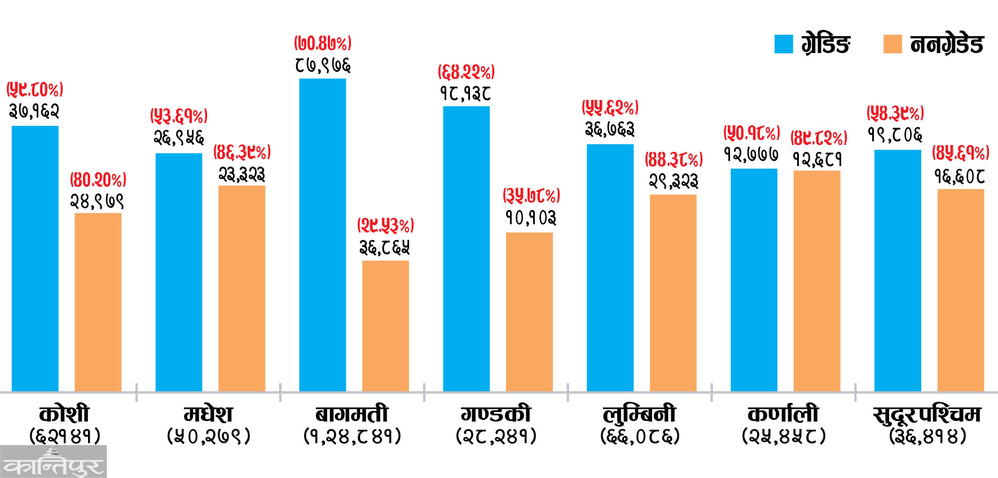
Out of 124 thousand 841 candidates from Bagmati province, 87 thousand 976 (70.47 percent) were 'graded' and 36 thousand 865 (29.52 percent) were 'non-graded'. Out of 28 thousand 241 examinees of Gandaki, 18 thousand 138 (64.22 percent) got 'graded' and 10 thousand 1 hundred 3 (35.77 percent) got 'non-graded' results.
Even though Madhesh is seen as the last in SEE, Karnali province is seen as the weakest in class 12 results. Out of 25 thousand 458 candidates from Karnali, only 12 thousand 777 (50.18 percent) have been graded. 12 thousand 681 students (49.81 percent) were ineligible for higher level admission. In SEE, 70 percent of Karnali students were in 'grading'.
Out of 50 thousand 279 examinees of Madhesh, 26 thousand 956 people (53.61 percent) will be able to study higher education. 23 thousand 323 (46.38 percent) examinees have been 'non-graded'. Out of 36 thousand 414 people who took the exam in Far West, 19 thousand 806 people (54.39 percent) were in 'grading'.
Other 16 thousand 608 (45.60 percent) will not be able to study at higher level immediately.
In Lumbini, out of 66 thousand 86 examinees, 36 thousand 763 (55.62 percent) are 'graded' and 29 thousand 323 (44.37 percent) are 'non-graded'. There were 62 thousand 141 examinees in Koshi. Among them, 37,172 (59.80 percent) were classified as 'graded' and 24,970 (40.19 percent) were classified as 'non-graded'. Last year 44 from Koshi, 46 from Madhesh, Bagmati
67 percent of students, 54 from Gandaki, 48 from Lumbini, 41 from Karnali and 39 percent of students from Far West were in 'grading'. Chairman of the
board Sharma said that most students have been 'non-graded' in English, accounting, social, Nepali, economics, business studies, mathematics and other subjects. 66 thousand in English, 41 thousand in accounting, 33 thousand 900 in social, 28 thousand 300 in Nepali, 17 thousand 700 in economics, 10 thousand in business studies and 9 and a half thousand students are 'non-graded'.
In SEE, most students are 'non-graded' in mathematics, science, English, and social sciences. In class 12, mathematics and science are not compulsory subjects, so English is
The number of 'non-graded' students is seen to be high. In SEE, only 128,215 in mathematics, 80,672 in English, 79,271 in science and technology, 53,186 in social science, 54,735 in Nepali and 42,150 in economics were 'non-graded'.
There has been a problem of teacher shortage in mathematics, science, English and other subjects in public schools for years. Since 2057, not a single permanent post has been added in public schools. There are zero permanent posts of teachers in classes 11 and 12.
The number of students who bring GPA between 3.60 and 4 in class 12 this year is 13 thousand 502. GPA below 3.60 to 3.20 has been obtained by 55 thousand 896 people. Similarly, there are 94 thousand 268 people who scored below 3.20 to 2.80. The number of students with GPA below 2.80 to 2.40 is 69 thousand 812 and below 2.40 to 2.0 is 8 thousand 964. There are 23 students with GPA below 2.0 to 1.60.
How many students in which GPA?
3.60 to 4 : 13,502
3.20 to less than 3.60 : 55,896
2.80 to less than 3.20 : 94,268
2.40 to less than 2.80 : 69,812
2.0 to less than 2.40 : 8,964
1.60 to less than 2.0 : 23

