As predicted, if the drought reduces production by 20 percent, 11 lakh 91 thousand 95 tons less rice will be produced this year. Insufficient rice for these countries is about 2.4 million tons.
We use Google Cloud Translation Services. Google requires we provide the following disclaimer relating to use of this service:
This service may contain translations powered by Google. Google disclaims all warranties related to the translations, expressed or implied, including any warranties of accuracy, reliability, and any implied warranties of merchantability, fitness for a particular purpose, and noninfringement.
Due to the drought, the government has predicted that rice production will decrease by 20 percent this year. According to the Ministry of Agriculture, it is expected to decrease because there is less planting due to lack of irrigation and the planted fields are also drying up.
Madhesh, which grows more rice, has been declared a drought-prone area by the state government and a disaster-prone area by the federal government. According to the Ministry's data, there is less planting in Jhapa, Morang, Sunsari and Gandaki provinces of Koshi. This time only a small amount of planting has been done in Madhesh. Even where it is, it has dried up due to drought. The situation in other provinces is also the same," said Ramakrishna Regmi, the senior statistics officer of the ministry. "Although it is not possible to say in numbers, the paddy production is not the same as last year."
In the last fiscal year, 500,000 tons of rice (including seeds) worth 20.35 billion were imported. Similarly, according to the data of the Customs Department, 241 thousand tons of rice (including Kanika) worth 18 billion 66 million have been imported. "Increasing imports will cause problems in earning a living for those who do not have an alternative source of income," says Regmi, "It affects the overall economy."
According to the ministry, in the last financial year 2081/82, 59 lakh 55 thousand 476 tons of rice was produced. This quantity is 231 thousand 242 tons more than the financial year 2080/81. According to the Ministry of Agriculture, 1.2 million tons of rice is insufficient for the country, despite an increase of about 200,000 tons in production. As predicted, if the drought reduces production by 20 percent, 11 lakh 91 thousand 95 tons less rice will be produced this year. Insufficient rice for these countries is about 2.4 million tons.
According to the Center for Crop Development and Agricultural Biodiversity Conservation, 78.84 percent of rice has been planted across the country as of July 11. Barkhe paddy is planted in 13 lakh 78 thousand 966 hectares, of which 1 million 87 thousand 148 hectares are planted, according to the center. Current planting is very less than last year. Till July 13 last year, 92.6 percent planting was done. This year, the drought in different areas has directly affected the planting.
Nepal has a monsoon-based farming system. Even though the monsoon is active, relatively little rain has fallen in Madhesh. Planting was not done on time due to lack of irrigation. It has also started to dry in the planted area. Madhesh Province is the most affected by drought. The main sources of irrigation in Madhesh are rivers, ponds, dams, canals, shallow tubewells and deep borings. But there is a problem of lack of resources in these systems when there is no rain for a long time. A total of 51.82 percent planting has been done in Madhesh, compared to 92 percent planting till July 13 last year.
According to the ministry, all eight districts of Madhesh are affected by drought. Although the government has declared Madhesh as a disaster, it has not brought any relief program. Although the government has announced a program to have 500 deep borings in Madhesh, it takes time to bury the borings. The situation in other provinces is also the same.
According to Economic Survey 2081/82, irrigation facilities have reached 44.4 percent of the total arable land of 35 lakh 57 thousand 764 hectares. It is mentioned that the arable land that has reached the irrigation facility has increased by 1.5 percent on average. As part of the irrigation system construction and maintenance program, 316 small irrigation systems have been constructed till February of the last financial year and additional irrigation facilities have been provided in 612 hectares. It has been claimed that irrigation facilities have been expanded to an area of 31,306 hectares by February 2081.
1 thousand 55 hectares on the surface side, 276 hectares on the lift side, 3 thousand 136 hectares on the underground side and 4 thousand 467 hectares have been irrigated, the government claims. But some canals do not have water. If there is no rain, the canal will dry up. For the same reason, planting has not been done. Irrigation is the main reason for the decrease in planting. We have received information that the seeds have dried up in many places due to lack of water," said Keshav Devkota, head of the center, "Rice seeds should not be cut for more than a month. It is not considered good if it is kept for a long time, it does not give good fruit. According to him, when the seeds are old, they cannot plant marijuana. Devkota says that without that, the production will automatically decrease. "Not a single planting has been done now. The problem was also seen in the place of planting," he said.
According to government data, the contribution of agriculture, animal husbandry and fisheries sector to the total domestic product is 24 percent. Rice contributes 12 percent to agricultural GDP. The contribution of rice to the total GDP is 3 percent. Scientists say that if rice production decreases, the contribution to GDP will also decrease.
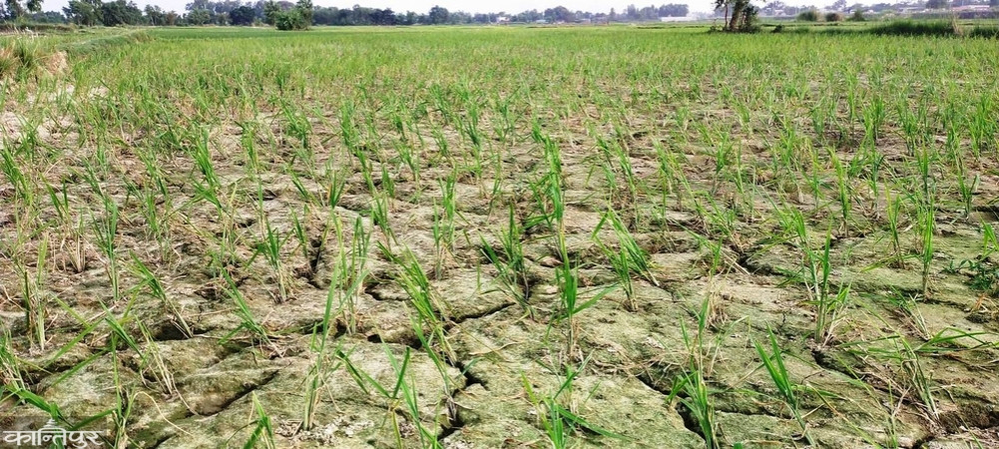
It has been raining for a couple of days. Although there is some relief for the crops that have already been planted with rice, there is a problem in the areas that have not been planted," said Sushil Subedi, a scientist of the Agricultural Research Council (NARC). If 20/25 percent of planting is not done, the production will decrease by the same amount. However, he said, there is still 10/15 days to plant rice. Planting of 110 to 115 days old rice varieties can still be done in Terai. Chait 5 and Hardinath 1 15/20 days harvest of paddy can be planted. "Planting can be done till October in Terai," said Subedi. Senior Crop Development Officer Mukund Bhusal also predicts a drop of around 20 percent in paddy production. Bhusal, who conducted a field study of paddy crops in Sirha and Saptari, said that only about 25/30 percent was planted in areas without canal water. The water level near Chure has gone down a lot. The tubewell looks dry. Farmers keep paddy paddy in May. It has been 2 months since the 20/25-day crop should be planted," Bhusal said. This reduces production. Talking about the average, it is estimated that the production will decrease by about 20 percent.'
In the report prepared by the Ministry of Agriculture and Livestock Development after studying the dry areas of Madhesh Province, it is mentioned that some of the seeds of paddy prepared for planting are burnt and some are about to dry up. According to the report, the wells and boreholes have dried up and there is also a shortage of drinking water. According to the report, due to the decrease in underground water level, less water is coming from boreholes, and irrigation from boreholes takes more time and cost. The study team concluded that due to low water flow in Kamala river, rice production will decrease due to less planting in Siraha.
demand and production
In the last fiscal year, a total of 5955 thousand tons of rice was produced, which is 231 thousand tons more than the previous year. According to the support price set by the government, the total value of rice produced by farmers at an average rate of 34 rupees per kg is 2 trillion 2 billion. However, a total of 1.2 million tons of rice was insufficient for Nepal.
imports and prices
Last fiscal year, 533 thousand tons of rice (including seeds) was imported. For this, 20 billion 35 million rupees went abroad. Similarly, 241 thousand 553 tons of rice (including Kanika) were imported and 8 billion 66 million went abroad.
This year's estimated import
This year, due to the drought, rice production will decrease by 20 percent, and around 2.4 million tons will be insufficient for Nepal. For this, based on last year's import price of 38 rupees per kg, more than 91 billion will be exported abroad.
The state of major 7 irrigation projects
Only 49 percent of the total 542 thousand hectares of arable land in Madhesh have irrigation facilities. Sunkoshi-Marin Diversion, Babai, Sikta, Rani Jamra Kularia, Mahakali, Bheri Babai Diversion and Bagmati have spent more than one hundred billion rupees.
000
Bagmati Irrigation Project
Start Year : 2049/50 year (32 years ago)
Total irrigated area: 45,600 hectares (Sarlahi-Rautahat)
condition: Although operational, services are limited due to lack of water in Bagmati during dry season
Sunkoshi-Marin Diversion
Cost: 49 billion rupees
Start year: February 2077
Deadline: According to the contract until August 2081
Progress: 10 percent progress in dam work despite construction of tunnels
Irrigation area: 1 lakh 22 thousand hectares of Bara, Rautahat, Sarlahi, Mahottari, Dhanusha
Babai Irrigation Project
Start year : 2045/46 year (38 years old)
construction period (revised) : till 2082/83, again 2 years more demand
Progress : 82.27 percent
Irrigated area: 36 thousand hectares (Bardia)
cost: initially 2.87 billion, currently 18.96 billion, already spent 15.47 billion
Sikta Irrigation Project
cost: initially 12.8 billion, currently 52.89 billion, so far spent 22 billion
Start year : 2062/63 year (21 years ago)
construction period (revised) : present 2089/90 target
Progress : 45 percent only
Irrigated Area : Target 42,766 Hectares (Banke)
Rani Jamra Kularia Irrigation Project
Start year : 2066/67 year
Construction Period : Initially 2074/75, still remaining
Progress : 74 percent
Irrigated area : 38,300 hectares (Kailali)
cost: initially 12.37 billion
Currently 27.7 billion, spent 20.58 billion
Mahakali Irrigation Project
Start year : 2063/64 year
progress: only 26 percent
irrigated area: 33,225 hectares (Kanchanpur)
cost: initially 35.02 billion, already spent 9 billion
completion target : 2086/87 year
Bheri-Babai Diversion Multipurpose Project
Start Year: 2068/69
Construction Period: First 2079/80, Now Revised 2084/85
Progress: 69 percent
Irrigation Area: 51,000 hectares (Bardia+Banke)
Cost: Initially 16.43 billion, currently 33.19 billion, now spent 18.19 billion

