We use Google Cloud Translation Services. Google requires we provide the following disclaimer relating to use of this service:
This service may contain translations powered by Google. Google disclaims all warranties related to the translations, expressed or implied, including any warranties of accuracy, reliability, and any implied warranties of merchantability, fitness for a particular purpose, and noninfringement.
The bill on the Constitutional Council has been sent back by the President. Even though both the Houses of Parliament passed the bill with the provision that only two members of the Constitutional Council can appoint the officers of the Constitutional Commission, the controversy was increasing. The President sent the bill back to the House of Representatives for reconsideration saying that it is "primarily against the essence, spirit and democratic values of the Constitution".
Article 284 of the Constitution stipulates that there will be a Constitutional Council chaired by the Prime Minister to recommend the appointment of the Chief Justice and the officers of the constitutional bodies. The Council consists of the Chief Justice, the Speaker, the Deputy Speaker, the Speaker of the National Assembly and the Leader of the Opposition.
When a bill is sent back, it must be sent to the relevant house (the House of Representatives or the National Assembly where the bill was first introduced) and the relevant house has the prerogative to reconsider the bill or not. There is a constitutional provision that the President must affix the red seal within 15 days after the House passes it or reconsiders it and sends it for the second time. However, the then President Bidya Devi Bhandari kept the Citizenship Bill unverified even after it was passed for the second time. After Bhandari's term ended, Paudel, who became the president, authenticated the bill.
On 12 February 2079, the government registered the First Amendment Bill on the Constitutional Council (functions, duties, rights and procedures) in the House of Representatives. The government proposed a bill so that a decision can be made by the consensus of two people in unfavorable times, stating that it would be difficult to hold a meeting of the Council consisting of the Prime Minister, Chief Justice, Speaker, Deputy Speaker, Speaker of the National Assembly and the leader of the opposition parties and the positions of the Constitutional Commission would be vacant if they could not make a decision.
The matter was passed by both houses without sufficient debate. In the provisions amended by the Bill, the quorum of the Constitutional Council and the decision-making process have been extensively changed. The provisions of the Act on sending notices 48 hours before the time, date and place for the meeting have also been amended. If there is no agreement in the first meeting, the chairman can call a second meeting within 48 hours and it is not mandatory to give the agenda and notice of such meeting to the members. Previously, it was a mandatory condition to send the agenda 48 hours in advance.
The Bill provides that the meeting cannot be held without the presence of the Chairman of the Council (Prime Minister) and no decision can be taken against the opinion of the Chairman. The criteria for overall quorum has been narrowed down. If the chairman and five members are present in the council, it is considered as full attendance and the decision of at least 4 people is official.
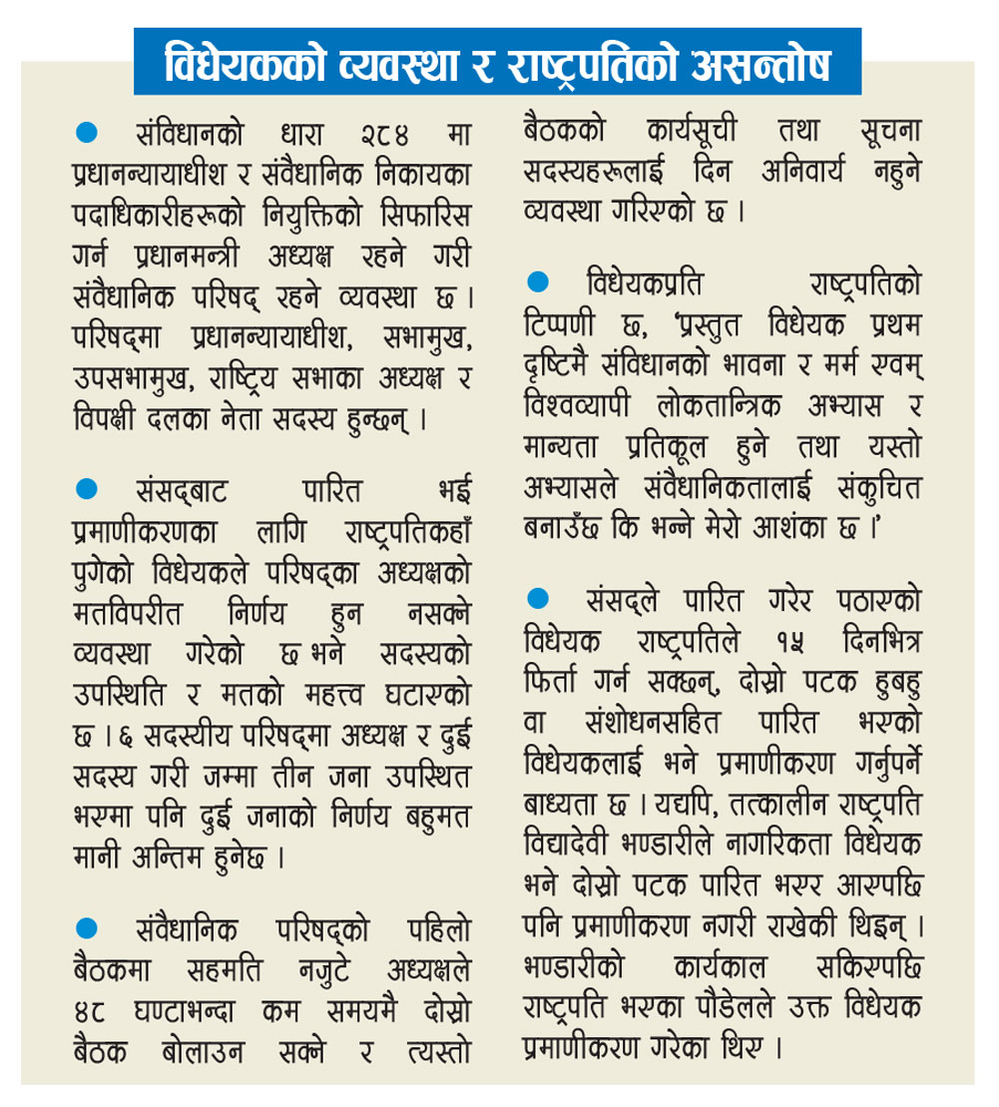
Similarly, if the chairman and four members are present, the decision of three people will be valid. Even if the chairman and three members are present, the decision of three people will be valid. However, if a total of three people including the chairman and two members are present, the decision of two people will be final. The president's comment on this is, "At first glance, the proposed amendment bill appears to be contrary to the spirit and essence of the constitution and universal democratic practice and recognition, and I suspect that such practice will limit and narrow the constitutionality." Recommendations and decisions should be made by consensus of the total number mentioned in the Constitutional Council. If there is no unanimity, the majority of the total number should not be overshadowed in any way, and the basis of the majority should be considered as the final pillar of the decision," the message of the President said.
The Constitutional Council recommends the appointment of officers of 13 commissions, including the Abuse of Authority Investigation Commission, the Election Commission, and the National Human Rights Commission. According to the principle of separation of powers and balance of power, the Constitutional Council has been envisioned with the Prime Minister, the Chief Justice, the Speaker, the Speaker of the National Assembly, the Leader of the Opposition and the Deputy Speaker. However, if one of the members agrees with the Prime Minister's proposal, a bill has been passed that allows the recommendation of the officers of the constitutional bodies.
The president drew the attention of the whole house to the fact that the president and other members of the constitutional council are permanently retained by the constitution, so that they do not remain in office or may be absent at such and such a time. "If the constitution and laws are disrespected in such a way as to show the intention to replace the constitutional and legal governance system by giving more priority to the governmental facilities and practical needs, then it will give support to arbitrariness," the president said. Kiran Pokharel, President's Press Adviser, said that it was decided to send the bill back as it was deemed necessary to reconsider the spirit and spirit of the constitution, as well as democratic values, norms and global practice. "The President has fulfilled his responsibility, Parliament will also fulfill its responsibility," he said.
After the President has decided to send back the bill, the House of Representatives should reconsider it, according to the chairman of the State Arrangements Committee, Ramhari Khatiwada. He argues that since the constitution does not have the feeling that decisions can be made even by a minority vote, the confusion should be removed. The way the structure of the Constitutional Council has been constructed, it has adopted the principle of balance of power. Khatiwada said, "It would be better to reconsider the provision where decisions can be made by the minority, leaving out the majority."
UML MP leader Surya Thapa says that since the constitutional body officials have been vacant for a long time in the past, there is a compelling situation to amend the Constitutional Council Act.
His argument is that if the provision that only two people can make a decision is kept in the law, only six members of the council will be forced to attend. As yesterday, officers were appointed in the constitutional organs by bringing an ordinance. It cannot be said that the same fate will not happen again. Instead, when they understand that the decision will be made by two people when they are not present, all the members will be forced to attend," says Thapa, "If the law is not amended, the council will not be able to work."
Five messages given by the president
1. In Article 284 of the Constitution of Nepal, there is a constitutional council with the prime minister as the chairman to recommend the appointment of the chief justice and the heads and officials of the constitutional bodies. There is no doubt or ambivalence about the matter in the Constitutional Council of Ahambhumi, which recommends the appointment of heads and officials of the constitutional bodies envisioned by the constitution with the aim of controlling arbitrariness, maintaining good governance and rule of law, and institutionalizing the separation of powers, control and balance in state operations.
2. At first glance, the Bill on the Constitutional Council is seen to be against the spirit and spirit of the Constitution and universal democratic practice and recognition. I suspect that such a practice would limit and narrow constitutionalism.
3. Article 284 (1) of the Constitution seems to keep the Chairman and other members of the Constitutional Council permanently. But my attention has also been drawn to the fact that the law should not create a serious and complicated situation when the members are not present or may be absent at a certain time.
4. Recommendations and decisions should be made by consensus of the total number of members mentioned in the Constitutional Council. In case of unanimity, the majority of the total number should not be overridden in any way and the basis of the majority should be considered as the final pillar of the decision. But in my opinion, it is necessary to reconsider the bill that has such a provision, as the decision made by the presence of at least 50 percent of the chairman and the sitting members in the bill is automatically understood as a minority.
5. It seems that the respected parliament should also consider the issue that if the constitution and laws are disrespected in order to replace the constitutional and legal governance system by giving more priority to the governmental facilities and practical needs, then it will give support to arbitrariness.

