In the last fiscal year, one trillion 19 billion was received from the export of soybean and sunflower oil, but during the same period, 1 trillion 38 billion rupees were withdrawn from the import of raw material of soybean and sunflower oil. A serious question is whether to revel in the figures exported after import and normal processing.
We use Google Cloud Translation Services. Google requires we provide the following disclaimer relating to use of this service:
This service may contain translations powered by Google. Google disclaims all warranties related to the translations, expressed or implied, including any warranties of accuracy, reliability, and any implied warranties of merchantability, fitness for a particular purpose, and noninfringement.
A new record has been set in the overall export trade of the country due to the rapid increase in the export of soybean and sunflower oil. According to the data of the Customs Department, in the financial year 081/82, the highest amount of goods worth 2.77 billion 3 crores has been exported. This is 81.80 percent more than the previous financial year.
In the financial year 080/81, the total export was equal to 1 trillion 52 billion 38 million rupees. According to the department, the export trade in 077/78 exceeded 1 trillion 41 billion. Before that, in 078/79, 2 trillion 3 crores and 1 trillion 57 billion 14 crores were exported in 079/80.
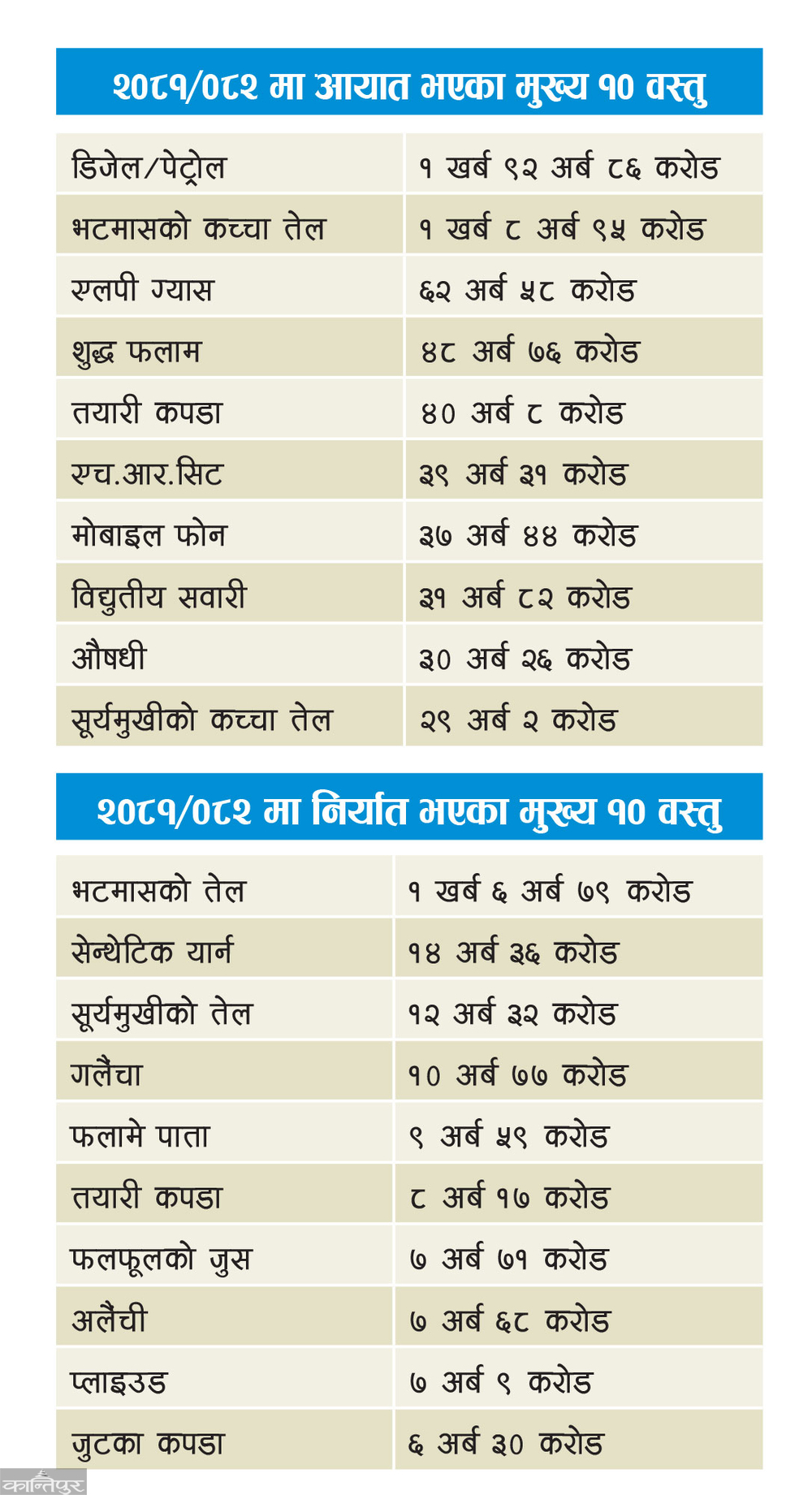
The export of edible oil seems to be the main reason for the almost doubling of exports in one year. In the financial year 081/82, soybean, sunflower and palm oil were exported worth 1 trillion 21 billion 52 crores. In the same year, there is a data of 1 trillion 44 billion 78 billion soybean, sunflower and palm raw material imported. The import of raw materials has also tripled abnormally compared to the previous year. In 080/81, crude oil worth 41.93 billion was imported.
In the financial year 081/82, the export of soybean oil alone is 1 trillion 6 billion 99 million. Whereas, only 900 million worth of soybean oil was exported last year. Soybean oil is the most exported from Nepal. Refined oil of sunflower, which is the third number, exported 12.32 billion in the last financial year. In the financial year 080/81, processed sunflower oil worth 16 crores was exported.
The import of soybean oil (crude) has reached 1 trillion 8 billion 95 million in the year 081/82. Last year only 13.51 billion worth of soybean oil raw material was imported. The import of sunflower oil (crude) was 17 billion 83 million in 080/81 and increased to 29 billion 2 million in 081/82.
The share of edible oil in total exports is about 44 percent. It seems that the export of oil has increased due to the discount on exports and the facility of advance payment to industrialists," said Ravi Sainju, a commercial expert, "but the increase in exports is not due to domestic production. It is imported from third countries and exported here only with value added. It will not benefit in the long term. He also mentioned that there is no need to be proud because it will be imported from third countries and exported to India again.
According to Sainju, crude edible oil is 8 percent of the total imported goods. According to the treaty between Nepal and India, 30 percent value addition is required, but under SAFTA (South Asian Free Trade Area), it is only 20/25 percent. India has increased the customs rate of oil imported from other countries by another 20 percentage points last August. After that, when India imports crude oil, 27 and a half percent tax will be levied,” he said.
According to Sainju, when Nepal exports agricultural goods under SAFTA, it pays only agricultural development fee (around 5 percent), while India imports from other countries and has to pay 35.75 percent including customs and agricultural development fee. In the Nepal-India trade agreement, there is a provision of 'value add' up to 30 percent, while for other countries, up to 40 percent 'value add' has to be done. Sainju said that emphasis should be placed on domestic production to increase exports to benefit the country.
According to the Ministry of Agriculture, 3.5 to 4 million tons of sunflower, mustard, and soybean oil are consumed annually in the country. Only 380,000 tons (raw material) are produced annually in the country, including soybeans, oilseeds (mustard, sunflower, etc.). Insufficient raw materials are imported by industrialists. There is a situation where raw materials have to be imported due to insufficient production in the country. Imported raw materials are processed and exported," said Vikas Dugad, president of the Nepal Vegetable Ghee/Oil Industry Association. "Comparatively, the market in India is also good."
In Nepal, crude oil is imported from America, Argentina, Ukraine, Indonesia, Malaysia and Thailand. According to businessmen, there is no lending transaction while selling in India. That is why the emphasis is on exports. Exporting imported raw materials has a cycle of about 100 days. According to the
department, synthetic yarn is the second most exported item from Nepal. Its exports also increased to 14.36 billion last year. In 2080/81, synthetic yarn worth 11.77 billion was exported. Last year, woolen carpets worth 10.77 billion, iron sheets worth 9.59 billion, ready-made fabrics worth 8.17 billion, fruit juice worth 7.71 billion were exported. Similarly, cardamom worth 7.68 billion, plywood worth 7.9 billion, jute woven fabric worth 6.30 billion have been exported.
About 82 percent of the goods exported from Nepal go to India alone. But the Indian market has not been analyzed. As only traditional products are produced and exported, Nepali products have not been able to find a good market. About 10 percent of the world market is India. The study of what kind of goods Indian consumers want to consume has not been done," said Sainju, "we could not do branding on tea, cardamom." According to the department, import trade has increased by 13.25 percent in the last financial year. In 081/82, goods worth 18 trillion 4 billion 12 crores have been imported.
Last year, the import was worth 15 billion 92 billion 98 million. Among the imported goods, petroleum products are at the forefront. According to the department, diesel worth 1 trillion 28 billion 76 crores, petrol worth 64 billion 58 crores, LP gas worth 62 billion 58 crores were imported last year.
The amount of diesel and petrol imports has decreased compared to the previous year, while the amount of LP gas has increased. In the year 080/81, petrol was imported worth 1 trillion 28 billion 6 crores, diesel worth 64 billion 10 crores and LP gas worth 55 billion 61 crores. Lately, petroleum products are seen as essential commodities.
In the financial year 081/82, there is a data of import of pure iron worth 48.76 billion, ready-made cloth worth 40.8 billion, HR seat worth 39.31 billion, mobile telephone worth 37.44 billion. With the increase in imports and exports, the trade deficit has also increased by 6 percent. According to the department, the trade deficit of the country reached 15 trillion 27 billion 9 crores in 081/82. Trade deficit in 080/81 was 14 trillion 40 billion 60 crores.


