In Nepal, 75 percent electric and only 25 percent petrol-diesel vehicles are being imported in Nepal
We use Google Cloud Translation Services. Google requires we provide the following disclaimer relating to use of this service:
This service may contain translations powered by Google. Google disclaims all warranties related to the translations, expressed or implied, including any warranties of accuracy, reliability, and any implied warranties of merchantability, fitness for a particular purpose, and noninfringement.
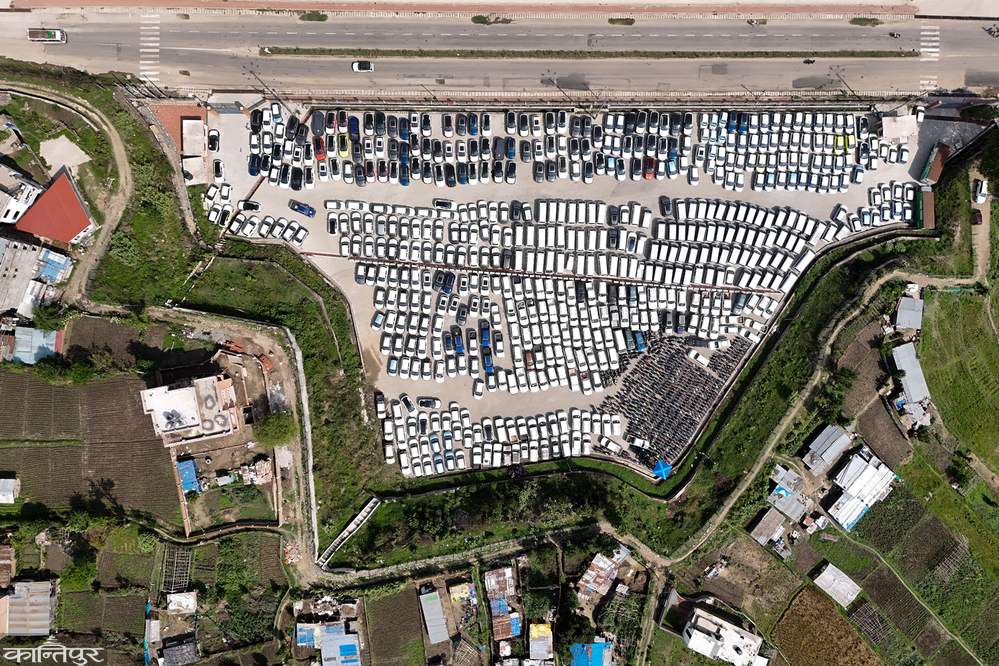
Businessmen are importing a large number of electric vehicles (EVs) in anticipation of an increase in taxes in the next financial year's budget. Only since 15 Baisakhi, 1,050 EVs have been inspected and kept at the Chobhar dry port. Similarly, more than 1000 EVs have been kept at Tatopani crossing for checking.
Vice President of NADA Automobiles Association Rajanbabu Shrestha said that the businessmen are importing vehicles saying that the tax on EVs may increase in the next financial year. According to him, businessmen are introducing EVs at the end of the financial year because they are taking risks. "Due to the tax increase on EVs, businessmen bring electric vehicles at the end of every fiscal year," he said, "Last year, more vehicles came than this." The government is bringing the budget for the next fiscal year on June 15 after a week.
The high-level economic reform suggestion commission formed by the government under the leadership of former finance secretary Rameshwar Khanal last October suggested adjusting the huge difference in the customs rates of electric vehicles and non-electric vehicles.
For this purpose, the Commission is of the opinion that the benefits obtained from the introduction of electric vehicles in the overall economy, international practice, and the policy adopted by the neighboring countries should be studied and analyzed. According to the report of the commission, it is suggested to study options such as keeping the basic customs rate the same on imported vehicles but adding a 'green tax' on carbon emitting vehicles.
In financial year 080/81, EVs up to 50 kW were subject to 15 percent customs duty. In 081/82, 5 percent excise duty was added on EVs up to 50 kW . In 080/81, 51 to 100 KW EVs were subject to 15 percent customs duty and 10 percent excise duty, but in 081/82, customs duty and excise duty were increased to 5 percent each.
Similarly, in the current fiscal year, 30 percent customs duty and 20 percent excise duty are levied on EVs from 101 to 200 kW. Last year customs and excise duty were 20 percent each. For FY 081/82, customs duty was increased by 20 percent on EVs from 201 to 300 KW while excise duty was reduced by 10 percent.
Previous year customs duty was 40 percent and excise duty was 45 percent. For EVs of more than 301 KW, customs duty and excise duty were 60 percent each in fiscal year 080/81. The government had increased the customs duty on these vehicles by 20 percent last year. Excise duty was reduced by 10 percent.
NADA's former chairman Dhruv Thapa says that EV import will increase at the end of the financial year because the tax on EVs was reduced only in one year and the tax was increased in other years. "Government's financial policy shows that taxes will increase every year, based on that trend, businessmen are importing vehicles," he said. At other times, the tax has always been increased.
Thapa estimates that although the tax on EVs has been increased by 10 to 15 percent this year, it may increase more than that. "This year the tax may increase a lot," he says, "the government looks at the revenue, now less is being received from the automobile sector."
In Nepal, 75 percent electric and only 25 percent petrol-diesel vehicles are being imported in Nepal, according to NADA. From July to May of the current financial year, 9,850 electric vehicles worth 23,993,222,000 rupees have been imported. From that, the government has collected 14 billion 247 million 78 thousand rupees in revenue. According to the data of the customs department, 1 thousand 892 electric vehicles were imported only in Baisakh of the current financial year.
According to Ashish Gajurel, executive director of Nepal Intermodal Transport Development Committee, the EVs that passed the inspection from Tatopani dry port in Rasuwa and Sindhupalchok have been kept at Chobhar dry port after paying the fare. "In Chobhar, there are facilities such as keeping business labels along with customs inspection pass, parking vehicles by paying rent, according to these facilities, businessmen have parked EVs by paying rent," he said, "The number of EVs kept in the parking lot is the highest so far." There are other diesel-petrol vehicles at the port for inspection. Therefore, Chobhar Port can now park only 350 vehicles,” he said. The parking fee at the port is 100 rupees per day for small vehicles and 125 rupees for large vehicles. According to the
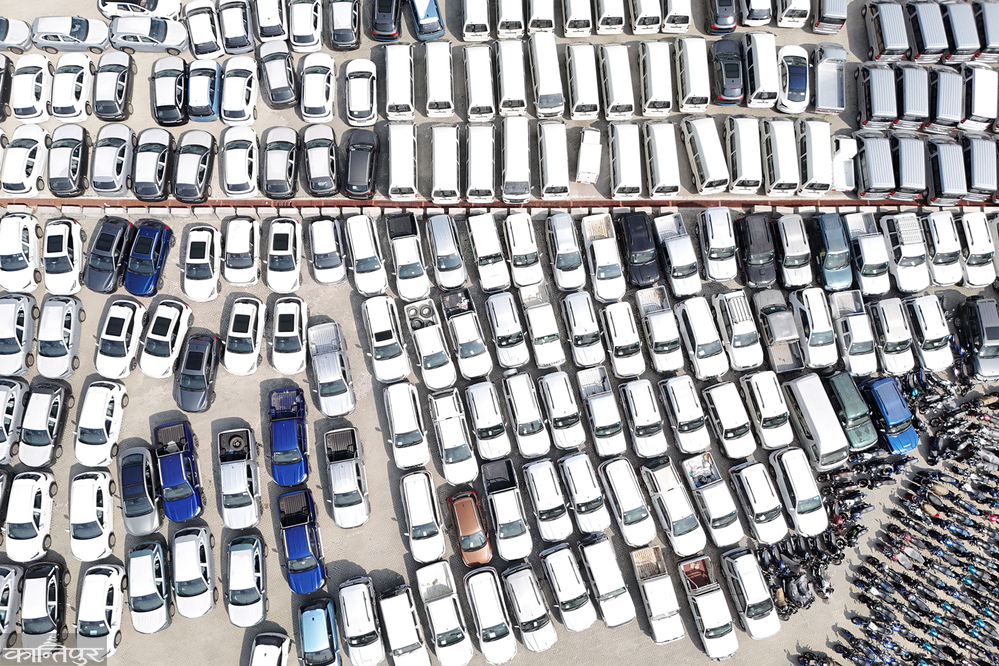
committee, there are 139 cars of SPG Automobiles Company, 5 of Pioneer Moto Corp, 293 of CG Motors, 211 of MAW Vriddhi Motors, 79 of Sangrila Motors, 123 of Jagdamba Motors and 118 of Sangrila International Freight. Similarly, NEV Nepal's 1 and Cymex Inc.'s 4 EV buses are in Chobhar. 72 EV vans of NEV Nepal and 5 EV vans of Pragyan Motors are also parked in the parking lot after paying rent.

