We use Google Cloud Translation Services. Google requires we provide the following disclaimer relating to use of this service:
This service may contain translations powered by Google. Google disclaims all warranties related to the translations, expressed or implied, including any warranties of accuracy, reliability, and any implied warranties of merchantability, fitness for a particular purpose, and noninfringement.
Monkey counting has been started across the country to determine the number of monkeys that are causing trouble to farmers. With the help of National Nature Conservation Fund, Tribhuvan University Central Department of Zoology, Kathmandu is counting the main places where monkeys are found in 6 provinces.
It is claimed that this calculation will help in making policies, plans and programs to manage the nuisance and problem of monkeys as a national problem. The coordinator of the monkey census in 4 municipalities and 15 rural villages of 13 districts, associate professor of the Central Department of Zoology, Dr. Hariprasad Sharma said. Now counting is being done in Ramechhap's Manthali, Dailekh's Dullu, Baitadi's Patan and Dhading's Dhunibesi. Counting has been completed at two local levels of Gaurishankar, Baitteshwar and Vigu village palika, Dhading in Dolakha. He said that the team will reach Ilam, Panchthar, Dhankuta and Makwanpur to count within a day or two.
He said that the monkey census being done for the first time nationally will help farmers and monkey-friendly work. The calculation started from last Chait 15 will be completed by the end of May. Now it will be counted in 6 provinces except Madhesh province. In Madhesh province, the department has already calculated. Now counting is being done in Bagmati, Sudurpaschim, Koshi and Karnali provinces . It has not started in Lumbini and Gandaki. Monkeys will be held in Palpa, Arghakhanchi, Gulmi and Pyuthan in Lumbini. A monkey found in Dhading during the 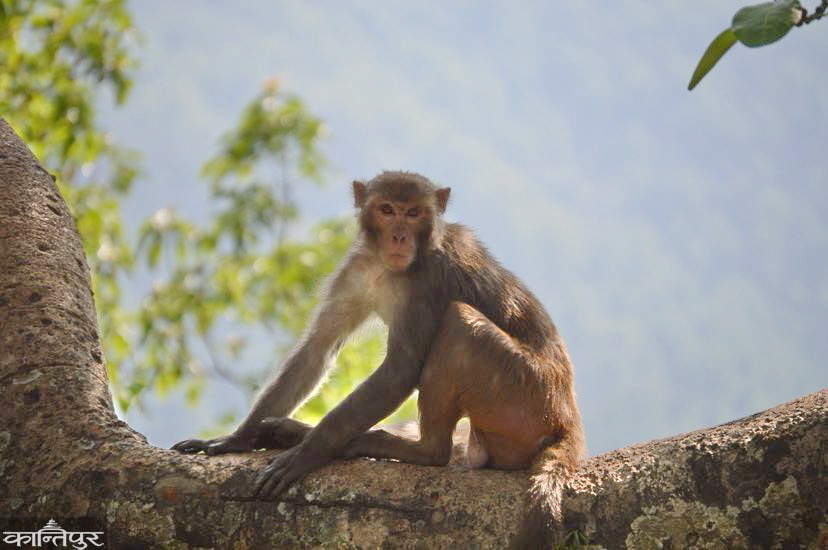 calculation. Photo Courtesy : Prakriti Baskota
In order to make a
calculation plan, all 753 local levels were contacted and asked for information about whether or not monkeys caused problems. About 230 local levels sent information. Among them, about 45 local levels had sent information mentioning the place and the ward saying that monkeys had caused problems. "We contacted the municipality that responded to the letter and confirmed it," Associate Professor of the Central Department of Zoology, Dr. Bishnuprasad Bhattarai said, 'After that, we studied the news/articles in the newspapers about the problem of monkeys.'
Similarly, based on the complaints received about the problem of monkeys in the Agriculture, Cooperative and Natural Resources Committee of the House of Representatives, he said that monkeys will be counted in 40 to 45 local levels where there are more problems. A team of 18 people, including professors teaching zoology, wildlife researchers and students studying zoology, is engaged in the enumeration. The team is being led by one person and is being counted in coordination with the respective ward president, member, chief/deputy chief of the local level selected for the count. Bhattarai said that the counting was made comprehensive and official by mobilizing local volunteers.
In Nepal, monkeys are found from 63 meters to 4 thousand meters altitude. In Nepal, there are 4 species of monkeys, including red, brown and two species of langur, associate professor of the department. Hariprasad Sharma said. There are two species of Langur, Nepal and Terai. Although there are three species of langurs in Nepal, there has been no research on this," he said. All the participants have been trained to do the calculations scientifically. Experts have said that the data will be given official status after counting up to 5 times so as not to be missed or repeated. 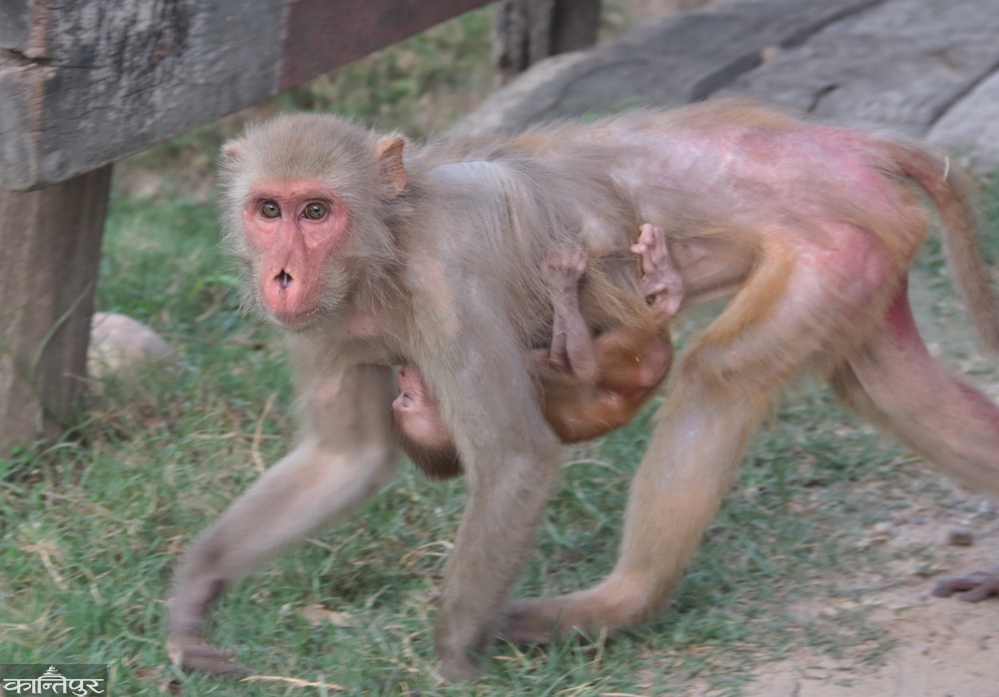 A monkey strolling with its baby in Bardia National Park. Photo: Manoj Paudel/Kantipur
Monkeys and wild boars are damaging crops and die when they are chased away. This arrangement has been on trial for one year since November last year to provide relief to farmers when monkeys cause excessive damage.
Since monkeys are also connected with religion and faith, suggestions are taken from the locals during the calculation on how to manage them. "When someone says they should kill and someone says they should manage by neutering, the opinion of the locals will also be important," associate professor Dr. Sharma said. After counting the number of monkeys in places with many problems, it is possible to work by projecting the estimated possible number of monkeys in the country, Associate Professor Dr. Sharma said. If the initial number can be found, after 5/6 years it can be recalculated to find out the decrease. This will help the state to make short-term and long-term policies and programs for monkey management, he said.
When monkeys come to farms and houses and cause suffering by eating food and grain crops, it is heard that people chase, chase, injure and even kill them as revenge . Many people fall down and get injured while chasing monkeys and there have also been cases of death. Wildlife expert Dr. Monkey plays an important role in the ecological balance. Hemsagar Baral said. He said that monkeys are contributing to seed conservation by eating the fruits of different species of forest plants and taking them from their feces to another place.
In Schedule 1 of the National Parks and Wildlife Protection Act, the guard monkey is listed as a protected animal, while the two species of langur monkeys found in Nepal are listed in Schedule 1 of the CITES Convention and the guard and red monkeys are placed in Schedule 2 . In the IUCN Red List, the guard monkey and Terai langur are endangered and the red monkey and the Nepali langur are in the category of least concern .

