Retirement age of employees increased from 58 to 60 years
We use Google Cloud Translation Services. Google requires we provide the following disclaimer relating to use of this service:
This service may contain translations powered by Google. Google disclaims all warranties related to the translations, expressed or implied, including any warranties of accuracy, reliability, and any implied warranties of merchantability, fitness for a particular purpose, and noninfringement.
The Federal Civil Service Bill was passed by the House of Representatives' Public Order and Good Governance Committee on Friday. A year after reaching the committee for quarterly discussion, the bill was finalized with amendments.
In the bill passed by the parliamentary committee, a provision of 'cooling period' has been put in place so that employees cannot take public appointments for two years after retirement. A 'cooling period' has been put in place to stop the tendency to get appointed to constitutional, political, diplomatic and other positions after retirement from civil service. The retirement age of employees has been increased from 58 to 60 years. There is also provision for an additional secretary in the civil service. At the meeting of the
committee on Friday, Home Minister Ramesh Lakhtar announced the government's decision to consider a 'cooling period' for two years. Law Ministry Secretary Udayraj Sapkota expressed his displeasure with the committee's decision to keep the 'cooling period' for two years. He argued that there should be a provision for a 'cooling period' in the law related to the Constitutional Council.
"There is no cooling period for security agencies and university professors, only civil servants were tried to be stopped," he said. The parliamentarians had argued that the provision of a 'cooling period' in the law related to the Constitutional Council would only apply to the posts recommended by the Constitutional Council, so it should be kept in the law related to civil service.
In the implementation method of the decision to increase the retirement age of employees by 2 years, the committee is under the pressure of the chief secretary, secretary and joint secretary who are going to compulsory retirement in the next financial year. The Public Service Commission gave a written suggestion to arrange that 'from the date of commencement of this Act, the mandatory retirement age of civil servants will be 58 years until the current financial year, 58 years and 6 months for the first 6 months thereafter, 59 years for the second 1 year thereafter and 60 years for all employees after 1 year.'
High-ranking employees have been pressuring the committee through various political power centers to extend their tenure by at least 1 year. Congress MPs Sarita Prasain, Ishwari Neupane and Ambika Basnet demanded that the retirement age should be implemented as suggested by the public service. They said that if the government does not accept the recommendations of the Public Service Commission, it will send a wrong message.
However, according to the pressure of the employees, after the promulgation of the law, provision has been made in the bill to extend the service period by one more year for the employees who are going to retire within one year and for the employees who will retire in the next one year. The system of trade union in the civil service has been kept as is.
RPP MP Chanda Karki, RPP MP Budhishan Tamang, JSP MP Ashok Kumar Rai and others demanded that the trade union should be abolished or it should be limited only to Naib Subba. But after Congress, UML and Maoist MPs showed no interest in it, the bill was passed keeping the current arrangement regarding trade unions.
Due to the pressure of the organization of the political parties of the employees, there is no provision in the bill to organize the trade union by law. The members of the committee said that they do not have the guts to introduce a law that would abolish or weaken trade unions. United Samajwadi MP Rajendra Pandey said in the committee meeting that he cut his leg to remove the trade union. "We were all on the same page to have only one official trade union, but we did not dare, we lost our footing," he said.
Jaspa MP Rai said that the employees in the political party trade union do not work but abuse their power. "I have seen a shopkeeper going from house to house of the leaders to make the joint secretary a secretary," he said, "therefore only one official trade union should be kept."
In the amendment of the bill made by the State Administration Committee, it has been arranged that the chief administrative officers of the local level will be under the provincial government for the implementation of federalism. A provision has also been made that the secretaries of the ministries of the state government should belong to the state civil service. But until that post is filled by the state public service, it is arranged that it will be sent from the federal civil service.
Provision has also been made in the bill that a person will get the facility of reservation only twice in the civil service. That facility will be available only once in the Rajpatra and Rajpatra posts. The age of entry into civil service has been reduced by one year for women while keeping it the same for men. Previously, men were allowed to take the entrance exam until they were 35 years old and women were 40 years old.
The post for entry into the civil services has also been reduced. If this bill is passed by the House as it is, there will be no open competition for Naib Subba. Only upto Under Secretary Civil Service will be admitted through open competition. In the bill that provides for an additional secretary, the tenure of the chief secretary and secretary has been reduced.
In the Bill, which does not set the additional secretary's tenure limit, it is arranged that the tenure of the chief secretary will be reduced from 1 year to 2 years and that of the secretary will be reduced from 5 years to 4 years. There is also a provision in the bill that such a provision is not applicable to those who are currently in office.
Provision has also been made in the bill for employees who are working in one state public service to be transferred to another state public service post. In the beginning, there is a provision that at least 10 years must have been worked under a provincial service, but there is a provision that it must have been served for a maximum of 10 years. The argument was raised in the committee that the law allowing a person employed in the public service of one province to be transferred under the public service of another province is anti-federalism.
The government registered the Federal Civil Service Bill in the House of Representatives on 21 February 2080 with the aim of making the country's administrative system streamlined, functional and result-oriented in accordance with the system of governance. It was sent by the House of Representatives to the State Affairs Committee on 5th May 2081 for quarterly discussion.
Chairman of the committee Ramhari Khatiwada announced that the bill was unanimously passed with amendments in the meeting on Friday. RPPA MP Wise Tamang submitted a written dissenting opinion on the bill to Chairman Khatiwada. According to the secretariat of the committee, he expressed a different opinion saying that the civil servants who are called permanent government should not have trade unions related to political parties. The bill passed by the
committee will be submitted to the House of Representatives along with the report. After approval from there, it will be sent to the National Assembly. It will be returned to the House of Representatives after it is passed by the National Assembly after discussion. The Speaker will then send the Bill to the President's Office for verification. It will come into effect as an Act after the confirmation by the President.
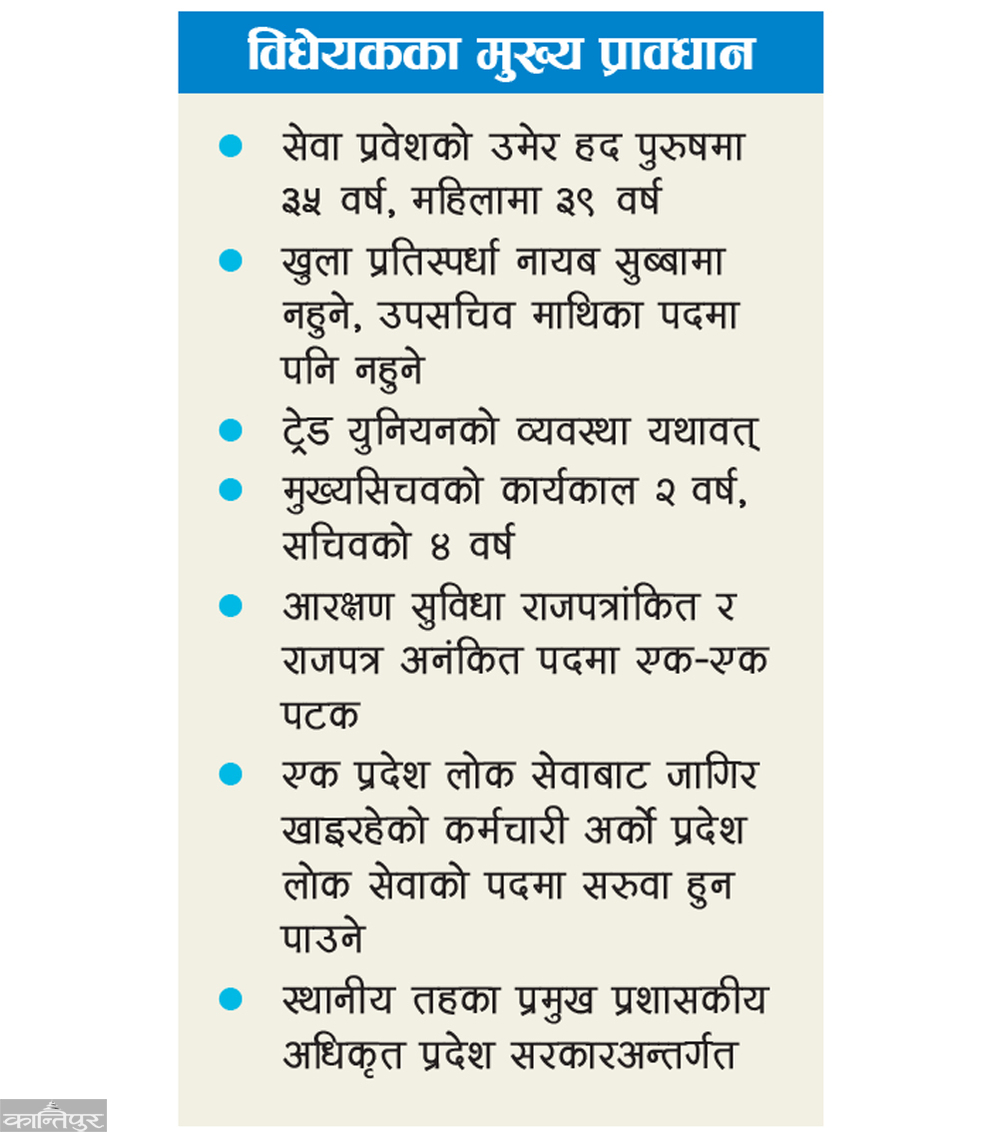
The main provisions of the bill
- the age limit for entering service is 35 years for men, 39 years for women
- there will be no open competition in Naib Subba, not even in the positions above deputy secretary
Trade union provisions as they are
- the tenure of the chief secretary is 2 years, the secretary's 4 years
- reservation facility one time in gazetted and non-gazetted posts
– An employee who is employed by one state public service can be transferred to another state public service post
- Chief administrative officer of the local level

