We use Google Cloud Translation Services. Google requires we provide the following disclaimer relating to use of this service:
This service may contain translations powered by Google. Google disclaims all warranties related to the translations, expressed or implied, including any warranties of accuracy, reliability, and any implied warranties of merchantability, fitness for a particular purpose, and noninfringement.
Civil society and community-level activists from various countries have expressed their commitment to give priority to the voices of the poor, workers, women, farmers, and other communities most affected by climate change in the international debate, to build a common vision for a just transition, and to strengthen resistance against systemic inequality.
On the eve of the 'Sagarmata Dialogue' to be organized by the Nepalese government from Friday, the speakers expressed this view at the 'Sagarmata People's Assembly: Voices from the Global South' program jointly organized by the Asian People's Movement on Debt and Development, Rural Reconstruction Nepal, The Coalition for Gender Responsive Climate Policy, South Asia Alliance for Poverty Eradication and LDC Watch in Kathmandu on Thursday. kept Representatives of communities, civil society, and social movements from the Global South participated in the event. In the
program, former ambassador and executive chairman of RRN, Arjun Karki, pointed out the need to include grassroots voices in national and international policy making.
Climate Action Network International Executive Director Tasneem Esop said that the 'Just Transition' concept, which originated from the labor movement, is now playing an important role in protecting the vulnerable.
Dereje Alemayehu, executive director of the Global Alliance for Climate Justice, demanded tax justice and structural reforms, claiming that "the Global South is feeding the Global North through illicit financial flows".
Stefano Plato, coordinator of the United Nations Financing for Development Mechanism, said that the multilateral system should be reimagined.
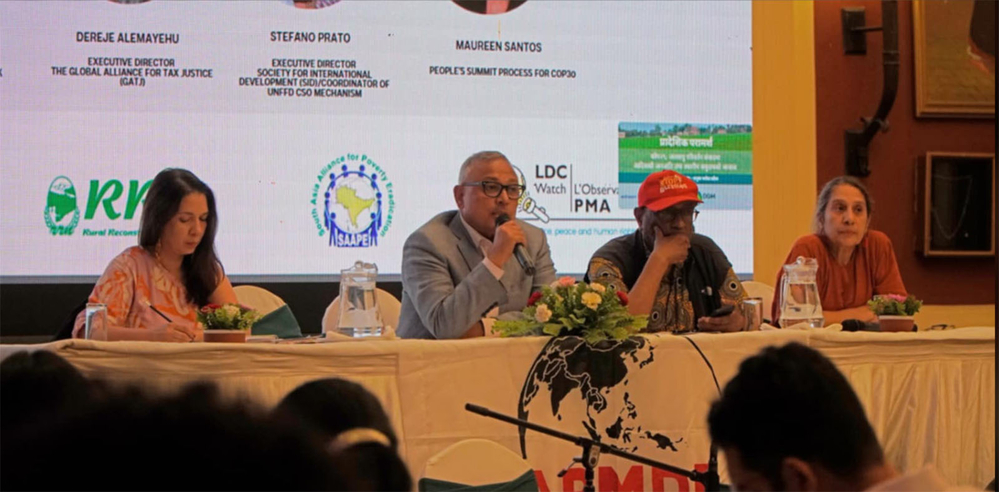
Maureen Santos of the People's Summit for Cop 30 opined that community-based solutions should be prioritized. Sindu Dhungana, a member of the Green Climate Fund, expressed concern about the imbalance, saying that mitigation is given more priority than adaptation in climate finance.
Thailand's Wanun Permpibul and Bangladesh's Amanullah Parag said climate policies that ignore the rights of farmers and fishermen are taking a new form of imperialism.
Similarly, Armayanti Sanusi, a participant from Indonesia, presented an example of how a geothermal project operated with foreign investment caused oppression and displacement.
Sharmila Karki of South Asia Alliance for Poverty Eradication mentioned that climate justice is not possible without gender justice.
Prem Dangal of the All Nepal Farmers' Federation called carbon trade and other market-oriented policies false solutions and emphasized the need to build a movement from the grassroots level against them. In the
program, there was a voice that minority groups should also participate in the inclusive 'Just Transition' debate.

