30 billion 12 crore 51 lakhs due from employees/officials
We use Google Cloud Translation Services. Google requires we provide the following disclaimer relating to use of this service:
This service may contain translations powered by Google. Google disclaims all warranties related to the translations, expressed or implied, including any warranties of accuracy, reliability, and any implied warranties of merchantability, fitness for a particular purpose, and noninfringement.
Due to financial chaos in the government and public expenditure, the state of the country has become dire. According to the 62nd annual audit report released by the Auditor General's Office on Wednesday, the total revenue of the state has reached 7 trillion 33 billion 199 million rupees. In the financial year 2080/81, it is only 91 billion 59 billion 79 million rupees.
During the audit of 5 thousand 759 agencies and offices by the Auditor General's Office, the amount of 94 trillion 62 billion 36 crore rupees for the financial year 2080/81 was found to be about one trillion. 47 billion 74 billion 30 million was found during the audit of 31 trillion 6 billion 16 billion of 31 trillion 6 billion 16 billion by the General Accounts of 3 thousand 93 offices towards federal ministries and subordinate agencies.
The audit of 1,165 offices under the state government is 4.2 billion 4 billion and the audit of 761 offices under the local level is 25.32 billion 42 million.
Similarly, 695 public institutions/development committees worth Rs 522.13 billion and 43 organizations with 44 billion 7.4 billion rupees were audited. Beruju is.
According to the General Account, the amount to be recovered from the relevant employees and officials for one financial year is 30 billion 12 million rupees. The amount to be regularized is 56.12 billion rupees and the amount to be exempted is 5.34 billion rupees.
It is mentioned in the report of the General Account that the sum of 6 trillion 69 billion 863 million beruju up to the year 2079/80 was 28 billion 284 million beruza and the remaining 6 trillion 41 billion 593 million beruzu has been transferred to the next financial year. Adding the transferred amount, the total balance till the end of June of the year 2080/81 has exceeded 7 billion. According to the
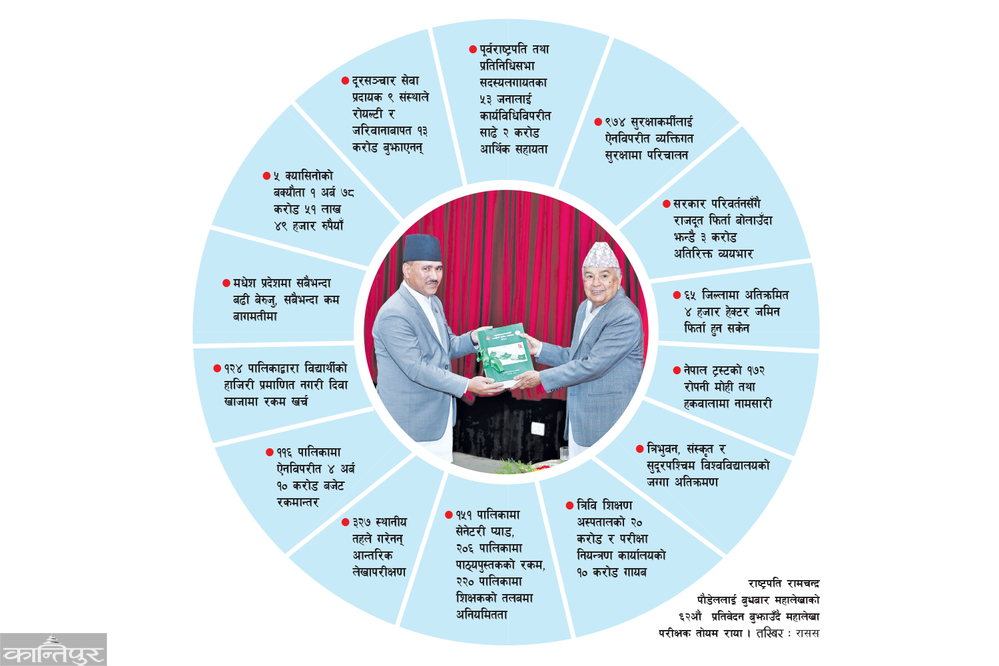
report, the government, organized organizations and committees at all three levels need to take action, besides audit arrears, revenue arrears, foreign grants and loans to be taken, the amount that needs to be taken on time is 5 trillion 51 billion 178 million rupees.
The audit arrears of the union and state up to 2080/81 have been seen as only 8.71 billion 3.4 million. It has been found that the government has yet to collect 4 trillion 72 billion 493 million revenue arrears. It is mentioned in the report that 6 billion 25 million 11 million foreign grants are pending for research admissions, 14 billion 33 million 3 million foreign loans are pending for research admissions and 49 billion 37 million 37 million in excess interest on loans given as guarantees.
Finance, Physical Infrastructure and Transport, Defence, Land Management, Cooperative and Poverty Alleviation, Foreign Affairs, Energy, Water Resources and Irrigation, Urban Development, Communication and Information Technology, Industry, Commerce and Supply and Health and Population are ahead of the ministries that are more affected by the amount. Artha's share in Beruju alone is 70.61 percent. After that, the share of physical infrastructure is 13.48 percent. In the audit of 3 thousand 93 federal offices, only 35.73 percent of 1 thousand 1 hundred 5 offices were found to be ineffective, it is mentioned in the report of the General Account.
Auditor General Toyam Raya submitted the 62nd report to President Ramchandra Paudel on Wednesday. The General Accountant has also submitted the report of their respective provinces to all seven provincial heads on Wednesday. In the fiscal year 2080/81 audited by the Accounts General, Maoist Chairman Pushpa Kamal Dahal was the Prime Minister while Congress, UML and some other parties were in government by turns.
According to Auditor General Raya, it has been found that the trend of spending from government and public funds without justifying it is still there. Arbitrarily distributing subsidies, not confirming the justification of subsidies given to loans, haphazard development work by the consumer committee and its weak monitoring are seen as major problems, he said, "Laws have not been formulated according to the governing system." Auditor General Raya's analysis of Beruju's situation is due to reasons such as the prolonged process of public procurement, arbitrary spending at the end of the year and the trend of money transfer not being controlled. Mentioning that if the recommendations and instructions pointed out in the report are not followed literally, the distortion and disorder will continue next year, he emphasized that the government and parliament should be sensitive to this.
According to Section 39 of the Financial Procedures and Financial Responsibility Act 2076, the first responsibility and liability of the concerned person and the official involved in the financial transaction will be the first responsibility and liability of the financial transaction. It has been said that if there is no proper clearance, the relevant accounting responsible officer should get clearance.
The report concludes that the financial situation has increased when the budget is not spent as per the allocation. Section 10 (3) of the Financial Procedures and Financial Accountability Act states that budget allocation should be based on ability to spend. 17 trillion 51 billion 31 billion 21 million was allocated for the last fiscal year, but only 13 trillion 93 billion 16 billion was spent. The Accountant General has raised questions saying that the budget was not made in a realistic and spendable manner.
The General Account has also pointed out that the union, state and local levels spend money in an uncontrollable manner. The General Account has suggested to the government to emphasize the creation of legal structures and the implementation of existing laws to avoid risks from corruption, tax evasion, financial crimes, drug trafficking, criminal benefits, kidnapping and hostage taking, international terrorism and other areas. The General Account has also suggested to control the misuse of concessional loans given to various sectors.
By June 2081, the arrears of concessional loans have reached 1 trillion 268 million, and instructions have been given to recover them. The General Account has raised questions that the government is not working effectively in commercial agriculture and livestock loan abuse.
According to the report, 1 trillion 11 billion 25 million 59 million loans of 46 thousand 336 borrowers were approved under commercial agriculture and livestock loans till the end of June 2081, and 86 billion 89 million 87 million rupees were inflowed. It has been directed to assess the returns on its returns and benefits to the state. The report has also suggested to be ruthless about stalling development works by killing contracts. In the
report, it is also mentioned that the government has not collected 3.4 billion rupees from the private telecommunication service provider companies under the unified license fee. Similarly, 137 million will have to be recovered from nine telecommunication service providers. According to the decision of the Council of Ministers on August 26, 2064, the details of the transfer of 172 ropani 15 annas land to Mohi and his rightful owners are also included in the report.
Arbitrary amount transfer
The government has also pointed out that the government has increased uncontrolled expenditure by transferring arbitrary amount. According to the report, only 79.56 percent of the allocated budget was spent last year, and by selecting arbitrary purchases and schemes, it was transferred to the amount of 2 trillion 56 billion 413 million rupees.
This is 14.64 percent of the total budget. Out of that, 29,900,340,000 in June 2081 alone, and 15,983,000,000 in the last week of June alone, has further reduced the allocated initial budget.
In the end of June of 2079/80, 23 billion 10 million 65 million rupees were transferred and out of this, 13 billion 81 million 91 million rupees were transferred in the last week of June. It is mentioned in the report that about 6 billion more money was transferred in the last financial year than the money transfer situation should be improved.
In Rule 32 of Financial Procedures and Financial Accountability Regulations 2077, there is a provision that 'money cannot be transferred until the end of the first quarter period. But in the first three months of 2080/81, 11 billion 647 million rupees have been transferred. The Accountant General has commented that the government has not followed the laws made by itself.
The trend of arbitrary transfer of money has also been seen at the provincial and local levels. In the report, it is mentioned in the report that the initial budget of the seven provincial governments was 2 trillion 80 billion 195 million 24 million and 33 billion 88 million 24 million more and 33 billion 75 million 51 million.
According to the Mahalekha, 91 crore 936 thousand in Koshi, 10 crore 2 lakh 53 thousand in Madhesh, 94 crore 89 lakh 15 thousand in Gandaki, 1 billion 15 crore 1 lakh 54 thousand in Lumbini and 4 crore 48 lakh 97 thousand rupees were transferred in Asar. It is mentioned in the report of the General Account that 116 local levels transferred 4 billion 1074 million 72 thousand rupees in violation of the Local Government Operation Act 2074. Auditor General Raya said that there is a need to control the tendency to transfer arbitrary amounts at the end of the year.
Former Secretary Sharda Prasad Trital said that the size of Beruzu is increasing every year because politicians and administrators are not following the law. He commented that even the Public Accounts Committee of the Parliament, which should play a role in reducing corruption, has become a shadow of power.
'Accounting committee has become paralyzed and unable to work. It is human nature that no matter what one does, it will remain only in the book, and there is no punishment for anyone. There is also the problem of keeping projects and programs without ensuring resources on the basis of fees, of not studying them and of spending the allocated budget indiscriminately," says Trital. "The Ministry of Finance cannot collect revenue arrears. The eye of the politician is where there is a lot of budget. Officials also change frequently, they follow the leaders and ministers and spend indiscriminately.'
According to Trital, the most responsible official for controlling beruju is the secretary of the ministry. "There is a tendency for secretaries to be transferred after the change of government and ministers, even the secretaries don't think that what they have to do now, they don't have to do it," he says. "Whatever the General Accountant has shown to be wrong, it should not go any further." However, every year the same beruju has come. This showed that there is a need for transformative training in the administration,” he said.
Bhandari also says that in some cases, the size appears to be large when the General Account is not included. For example: The Ministry of Finance's biggest problem is not spending, but tax arrears. Tax arrears go to revision, may come later. may increase. Therefore, the auditor general should also review the issue of what to write in the beruju and what not to write in it," he says, "there is also a problem of double beruju. If an organization's audit reveals a discrepancy in payments, it may be counted on both sides. Therefore, there should be a change in the reporting style of the General Account. According to
Bhandari, financial indiscipline increases when the Accounts Officer himself is not sensitive to corruption. He will not be prosecuted for not having a license. Instead, an arrangement was made to recover the money from the one who has done wrong,'' he says. Even the fight between the Parliament and the Accountant General on the issue of audit and spending of beruju did not make progress in the collection of many beruju.'