The Government's appeal to the Nepalis in India and Pakistan to stay safe
We use Google Cloud Translation Services. Google requires we provide the following disclaimer relating to use of this service:
This service may contain translations powered by Google. Google disclaims all warranties related to the translations, expressed or implied, including any warranties of accuracy, reliability, and any implied warranties of merchantability, fitness for a particular purpose, and noninfringement.
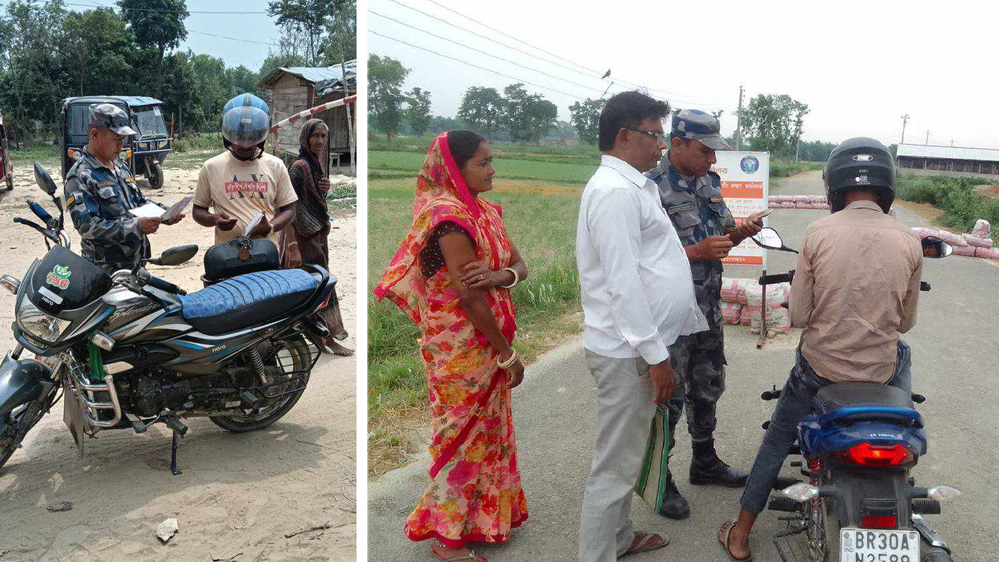
The government has issued a circular to allow only passengers carrying identity cards to travel between Nepal and India. In view of the situation created after the India-Pakistan war erupted with the terrorist attack in Pahalgam that killed 26 tourists including one Nepali, the Ministry of Home Affairs has made identity cards mandatory for travelers traveling through the southern border crossings.
The Ministry of Home Affairs has instructed the Nepal Police, Armed Police, National Investigation Department, Immigration Department and district administration offices along the southern border to increase special surveillance in the international border areas towards India. After the Home Circular, Nepal Police and Armed Forces have increased security patrols and checks at border crossings.
Two and a half hundred armed personnel have been deployed for border security through the Border Out Post (BOP). More than 60 police personnel are deployed in the prevention and control of cross-border crime through the border area units. Apart from this, after the latest developments, both organizations have increased patrolling in the border area from other units. A few days ago, Prime Minister KP Sharma Oli was briefed by the officials of all the four security agencies about the growing India-Pakistan tension and its impact on Nepal. Before that, the Central Security Committee meeting also reviewed the developments.
After a briefing to the Prime Minister and a security meeting with the Minister of Home Affairs, Ramesh Akhtar, the Ministry of Home Affairs issued a circular to the district administration offices connected to the border with India and asked them to make the identity card mandatory when traveling through the border and keep a record of the destination of the passengers. A security officer said that along with the circular of the house, the details from which place the passenger came from, the destination, and the purpose are included in the record.
After analyzing the latest developments, the related agencies have been instructed to take necessary security precautions in the border area, said Ramchandra Tiwari, spokesperson of the Ministry of Home Affairs. "Taking into account the developments, we have given necessary instructions to take security precautions," he said.
A review meeting was held between the security officers at the military headquarters on Friday regarding the India-Pakistan tension. According to the source, it was concluded that all the agencies should effectively perform their assigned responsibilities in the meeting. Director General of Immigration Department Govind Rizal said that the subordinate mechanism has been instructed to carry out the responsibility taking into account the risk of entering the border area without permission.
On the 9th of Baisakh, 26 people, including a Nepali, were killed in an attack by a terrorist group on tourists in Pahalgam, Jammu-Kashmir, India. Pahalgam is about 90 km from Srinagar, India. The Resistance Front (TRF) led by Hafiz Saeed, the founder of Lashkar-e-Toiba, has claimed responsibility for the killing by armed terrorist groups in Pahalgam, a popular destination for tourists. Since then, the tension between India and Pakistan has now entered into attack-retaliation.
As the conflict between the two countries escalates, assessing the risk of infiltration in Nepal, the government has taken precautions in both air and land movement through the international border area. India has an international border with Nepal for a length of about 1,880 km. Due to open borders with India, the immigration management and record system is disorganized .
Since China has a border of about 1,414 km in length, there is no challenge in the management of movement like India, as only people with visas can travel. Management of traffic from India, especially through large, medium and small checkpoints where there is no presence of the state, is a challenge.
After the army took control of Burma, some groups of Rohingya who were chased from there came to Nepal in 2012 through India. After that, it was revealed that the gang took a group of Rohingyas who were chased from Manbar and brought them from Bangladesh to Nepal via India. Security officials say that the number of Rohingyas who have infiltrated into Nepal due to lack of security measures in the border area has reached more than 500.
A security officer said that the homeless and unemployed groups can be misused by individuals and groups involved in terrorist activities, so there is a need to keep a special watch on them. After the insurgent Taliban seized power in Afghanistan in July 2078, a large number of displaced Afghan citizens were trying to enter Nepal through India.
In the beginning, a small group made fake Aadhaar cards in India and easily entered Nepal under the guise of Indian citizens. After some people of the said group were arrested from various places in Kathmandu, ID cards were made mandatory for passengers traveling through the border towards India. For about 3 months, the process of entering the group by infiltrating the group was stopped after the ID card of the travelers who traveled like this was started to be recorded.
In the first week of last November, some Afghan citizens were arrested from various places in Kathmandu. After it was found that they had infiltrated through illegal infiltration, at that time the security agencies conducted a special operation in the border area and other places including Kathmandu. At the same time, infiltration was stopped after Nepal made identity cards mandatory for citizens of both countries to travel between Nepal and India. Now, with the increase in India-Pakistan tension, ID cards have been made mandatory for travelers to prevent illegal infiltration through the border.
'Travel advisory' to Nepalis in India and Pakistan
After the uneasy situation between India and Pakistan with the Pahalgam incident and the start of clashes between the two countries with drones and warplanes at the military level, the government of Nepal has issued a travel advisory (travel advisory) to the Nepalis in those countries to stay in a safe place . The government has also requested the Nepalese who are there to contact them immediately if there is any problem.
The Nepali Embassy in Delhi has issued a notice on Friday afternoon asking the Nepalis in India to be alert and safe. The embassy has also asked to follow the security instructions issued by the official bodies of the Indian government.
"In view of the developments after the terrorist attack in Pahalgam, Jammu and Kashmir state of India, the Nepali Embassy requests the Nepalis in India to be aware and safe and to identify the nearest places where safe and emergency services can be obtained in case of crisis and to follow the security guidelines issued by the official body of the Government of India," the urgent notice issued by the Nepali Embassy in Delhi states, All stakeholders are informed to contact the Consulate General.
The Ministry of Foreign Affairs has requested the Nepalis in Pakistan to stay safe and contact the Nepali Embassy in Islamabad if they need any assistance. The Ministry of Foreign Affairs has also stated that it is in constant contact with students and all Nepalis in Pakistan.
"In the context of the recent developments, the Nepali government is fully aware of ensuring the safety and welfare of Nepali students and other Nepalis studying in Pakistan, the Nepali Embassy in Pakistan is working in constant contact with all the Nepalis there," the statement issued by the Ministry of Foreign Affairs on Friday said, "If any assistance is urgently needed in this regard, Nepali students and parents, relatives and Nepalis staying there can contact the number of the Nepali Embassy in Islamabad at any time."

