Counting at 25 places in 13 districts under the 59-day 'Big Butterfly' campaign conducted by Butterfly Watchers Nepal
We use Google Cloud Translation Services. Google requires we provide the following disclaimer relating to use of this service:
This service may contain translations powered by Google. Google disclaims all warranties related to the translations, expressed or implied, including any warranties of accuracy, reliability, and any implied warranties of merchantability, fitness for a particular purpose, and noninfringement.
335 butterflies of 129 species have been found in Nepal. The 'Big Butterfly' counting campaign, conducted with the aim of getting information about the variety and number of butterflies, has identified the number and type of butterfly species found in Nepal.
The 59-day 'Big Butterfly' campaign started by Butterfly Watchers Nepal, Bhaktapur from March 3 ended on April 30. Butterflies were counted at 25 places in Khotang, Kaski, Sunsari, Lamjung, Kathmandu, Lalitpur, Bhaktapur, Makwanpur, Surkhet, Kapilvastu, Dhading, Jhapa and Kanchanpur districts. 32 count were involved in volunteering and conservation work in the
campaign. They counted 335 butterflies of 129 species in 25 places of the country. Undergraduate and postgraduate students of the Faculty of Science, Zoology and Management participated in the calculation. Doll-loving photographers and photojournalists also participated in the count.
Butterfly Watchers Nepal's founder and butterfly expert Sanej Prasad Suwal said that the counting campaign was launched with the aim of taking photographs of the species, areas, and numbers of butterflies found in Nepal. "This is the third campaign," he said, "Its theme is Butterfly Marathon." He said that the campaign was named "Butterfly Marathon" so that those participating in the counting should count as many butterflies as possible. In the
campaign, there is a prize for those who take the most pictures of dolls. Siddharth Sapkota, a graduate student in Environmental Science at Amrit Science Campus, Kathmandu, bagged the first prize for taking the most photographs.
He photographed 68 butterflies of 63 species in Pokhara and Kathmandu Valley. Similarly, freelance naturalist Anjukumari Dhakal won the second prize. She photographed 23 butterflies of 18 species. The butterfly count also counted the Cytis-listed common wordwing and the rarely seen endangered Sirin butterfly.
Butterflies Watchers Nepal is a social science based social media platform. It has been doing butterfly study research, conservation, awareness and educational work. According to Watchers Nepal, it is now calculated to gather more information by running a campaign during the time when butterflies are more visible in terms of weather. Butterflies and rare butterflies are more visible in forest areas during March, April, June and July.
There is a record of the highest number of 692 species of butterflies found in Nepal. In the previous second butterfly count, more than 250 species of butterflies were identified. There is a record of finding butterflies from Terai to 7 thousand meters of Himal.
According to scientists, butterflies belonging to 5 families of butterflies found in the world, Hespiridae, Papilinoidae, Pyridae, Lycinidae, Rionidae and Nymphalidae are found in Nepal. Some butterflies have been 'recorded' only in Nepal. World's rarest Greek Hawkstick Sealer, Kesari Hind Butterfly, Nepal Wall, Nepal Skipper, Nepal Meadow Blue and Manang Meadow Blue butterflies are found only in Nepal. The Greek Hawkstick Cellar, Kesari Hind Putli, is found only in the Godavari of Nepal and the Manang Meadow Blue in Manang.
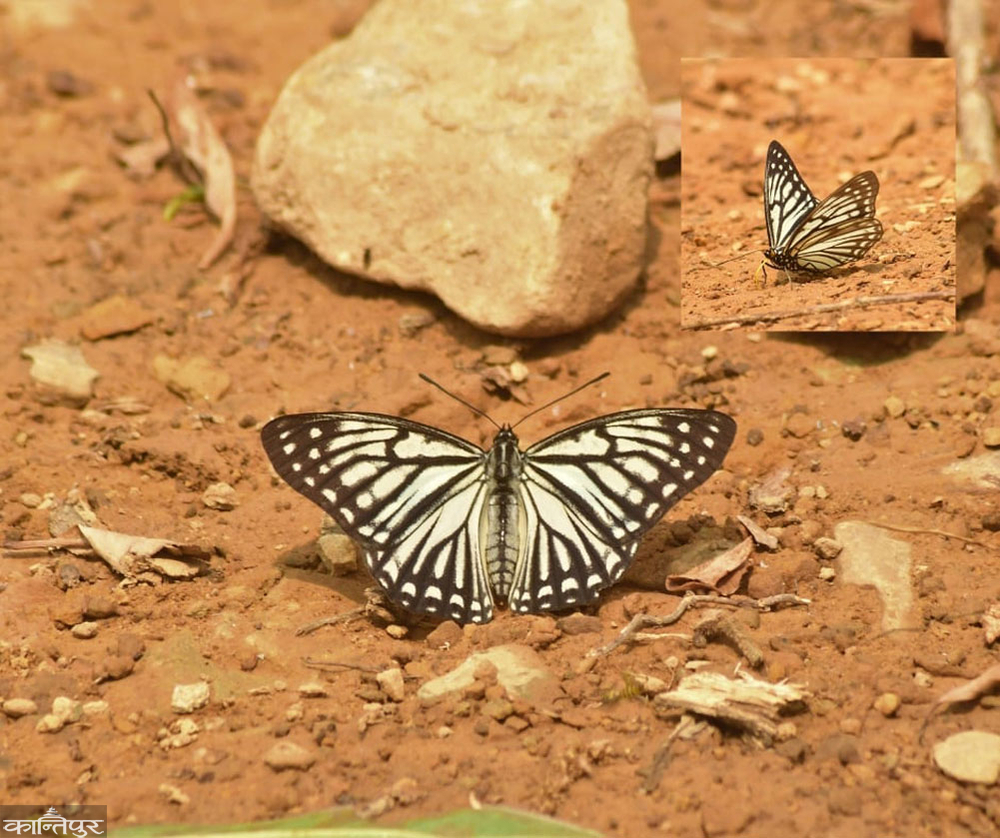
The largest butterfly found in Nepal is the Golden Wordwing. Its length ranges from 150 mm to 194 mm. It is also listed on the site. The smallest butterfly found here is the Small Grass Jewel. Its length ranges from 15 mm to 22 mm. Most butterflies in Nepal have been identified in the Annapurna Conservation Area. Godavari in Kathmandu Valley and Chitwan in the Terai are also counted among the areas where butterflies are found.
Dolls that make the environment charming also do social work. It indirectly helps to increase agricultural production. It plays an important role in pollination of cereals, oilseeds and fruits. By sipping the juice of the flower, male and female pollinate between the flowers and contribute well to the production. Butterflies also act as indicators of climate change.
butterfly sightings are also an indicator of a healthy forest. Wildlife expert Dr. who plays a role for tourism with an attractive butterfly. Hemsagar Baral said. After bees, butterflies are the most pollinators. "Pollination is necessary to produce 80 percent of the world's food," he said, "otherwise there will be no production." Starvation happens. It affects people's lives. The butterfly that makes the environment attractive also does social work.'


