Increasing pollution affects the elderly, children, and patients with chronic diseases
We use Google Cloud Translation Services. Google requires we provide the following disclaimer relating to use of this service:
This service may contain translations powered by Google. Google disclaims all warranties related to the translations, expressed or implied, including any warranties of accuracy, reliability, and any implied warranties of merchantability, fitness for a particular purpose, and noninfringement.
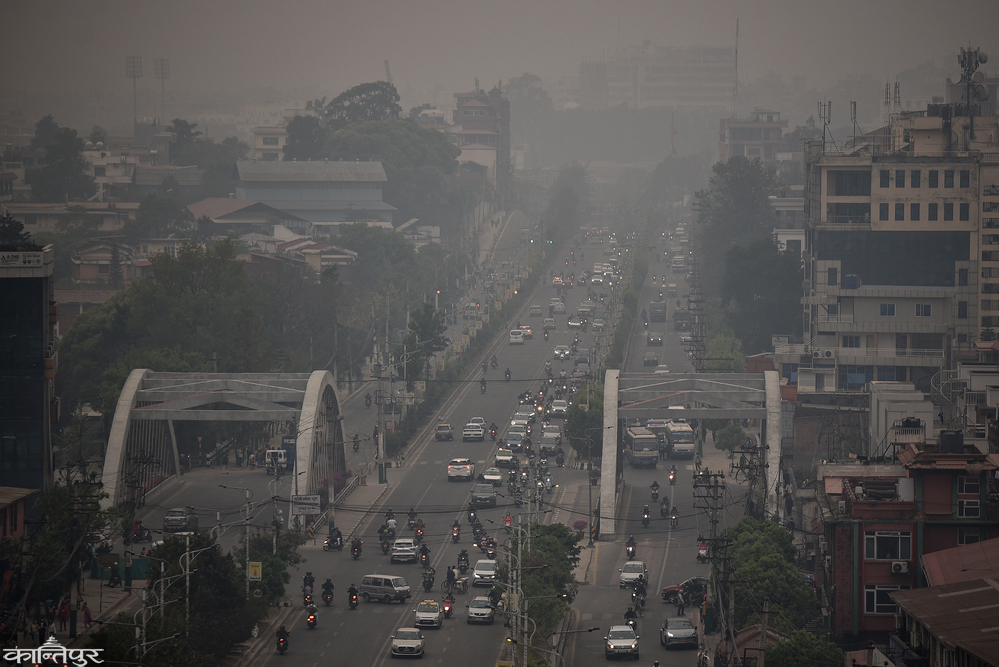
Kathmandu's air quality has again reached unhealthy levels. According to the Air Quality Index (AQI), the air quality of Kathmandu reached 262 AQI at 6 pm on Monday. This is the 'dangerous level' of air quality.
Kathmandu's air has become polluted for two weeks. Likewise, Kathmandu city is on the first list of the most polluted cities in the world on Monday. Environmentalists have stated that the air of Kathmandu has become polluted especially due to the fires that have been spreading in various districts lately. Four days ago, Kathmandu's wind had crossed the 'dangerous' level. On Chait 21 (Thursday), Kathmandu's air quality reached 384 AQI.
As the air in Kathmandu continues to be polluted, there is no plan on the part of the government to reduce it . Even though the air in Kathmandu has crossed the dangerous level and is continuously rising to the top of the polluted city, the government has not been able to take any concrete decision on this .
Director General of Environment Department Gyanraj Subedi has said that he is requesting and instructing to reduce pollution. He also said that only government agencies cannot reduce pollution and citizens should also be equally responsible.
'Currently, pollution is increasing due to burning of fire, vehicles, industry and agricultural residues,' he said, 'We have appealed and requested with these agencies to advance coordination, make suggestions and reduce pollution.'
 Doctors say that increasing pollution will cause more problems to the elderly, children, and patients with chronic diseases. Similarly, the number of chest and eye patients in Kathmandu hospitals has increased by 15 to 20 percent, said Dr. Prakash Budhathoki, spokesperson of the Ministry of Health and Population. He says that the government has not taken any decision even though the patients are increasing.
"As soon as the air quality in Kathmandu crossed the danger level, we issued a notice and asked the government along with experts to take some decision on it," he said, "but nothing has happened." What we can do is increase the number of patients in our hospitals. Be prepared. We have worked on it.'
In this context, the Environment Press Group has organized an interactive program on Monday with various associations/organizations and experts related to the environment called "Air Pollution: Who is Responsible?". Experts have suggested the government to take measures to reduce pollution immediately. Air quality expert Dr. in the
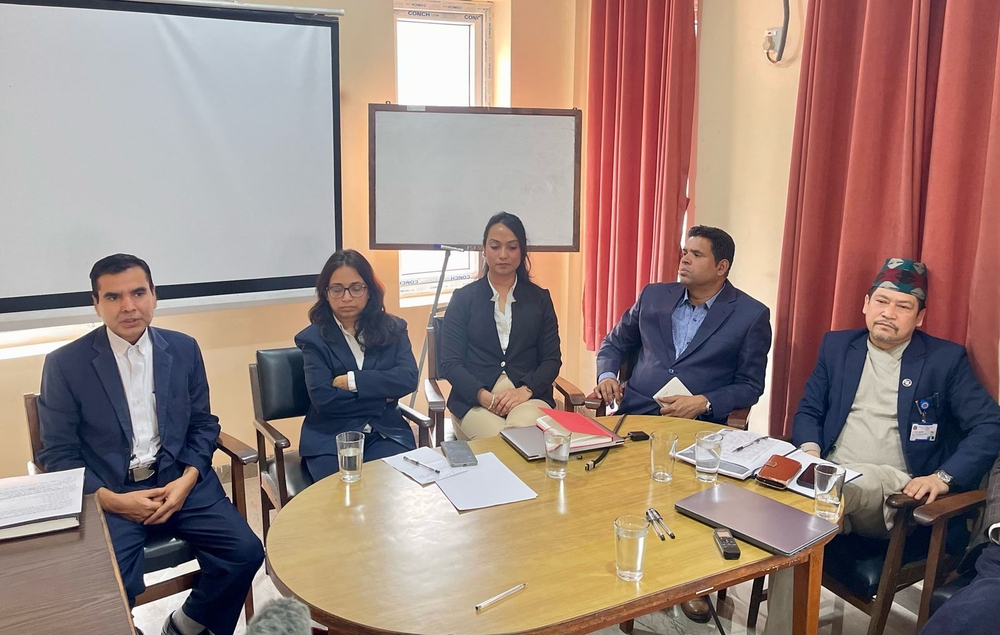
program. Bhupendra Das said that although there are facts and evidences that the problem of pollution increases during the dry season of every year due to fires and other reasons, it is practical to find solutions to the problem only after it becomes complicated. "We are breathing in bad air," he said, "Nepal, India, Bangladesh, Pakistan are at risk of pollution every year, we should not delay in finding solutions." Nepal's role in burning agricultural residues in the open in the world is 2 percent. He said that the smoke emitted by vehicles of Euro-1 and Euro-3 standards, which are supposed to be replaced, and the pollution coming out from industrial factories are becoming a regular cause of problems.
Likewise, according to the International Center for Integrated Mountain Development (ISIMOD), the pollution in Kathmandu and other parts of Nepal is continuously decreasing every day since last 8th Chait (last 21st March). Every year in Nepal pollution increases from January to April. Dr. Khushbu Sharma, air quality expert of Imimod said that there is also an international reason for this.
 The air quality index 'Air Quality Index' (AQI) in all the three districts of the valley has reached a dangerous level from the point of view of human health. When the AQI reaches above 200, it is considered very dangerous from the point of view of human health . On this 23 Chait, AQI in Bhaktapur reached 365. The officials of the Ministry of Health and Population say that the number of patients with respiratory and other health problems is increasing across the country after the amount of toxic particles in the air is high for 24 hours and every hour.
Dr. Budhathoki says that 19 percent of the total deaths of Nepalese every year are related to breathing (pollution) and the average life expectancy of Nepalese is decreasing by 4.8 percent due to pollution. He said that the problem has become complicated due to the lack of implementation of policies and action plans made earlier to reduce the pollution problem, and lack of coordination between agencies.
Water and Meteorology Department Spokesperson Vibhuti Pokharel said that the pollution increased when there was no rain for 6 months when the western wind was not active. "Earlier, we said that the winter rains will decrease," she said, "but now there are signs of rain." Let's hope it happens soon.'

