Ministry buildings of the same design are being built in one wave, the statement of the project implementation unit is that ancient architecture is connected with modern technology in the construction.
We use Google Cloud Translation Services. Google requires we provide the following disclaimer relating to use of this service:
This service may contain translations powered by Google. Google disclaims all warranties related to the translations, expressed or implied, including any warranties of accuracy, reliability, and any implied warranties of merchantability, fitness for a particular purpose, and noninfringement.
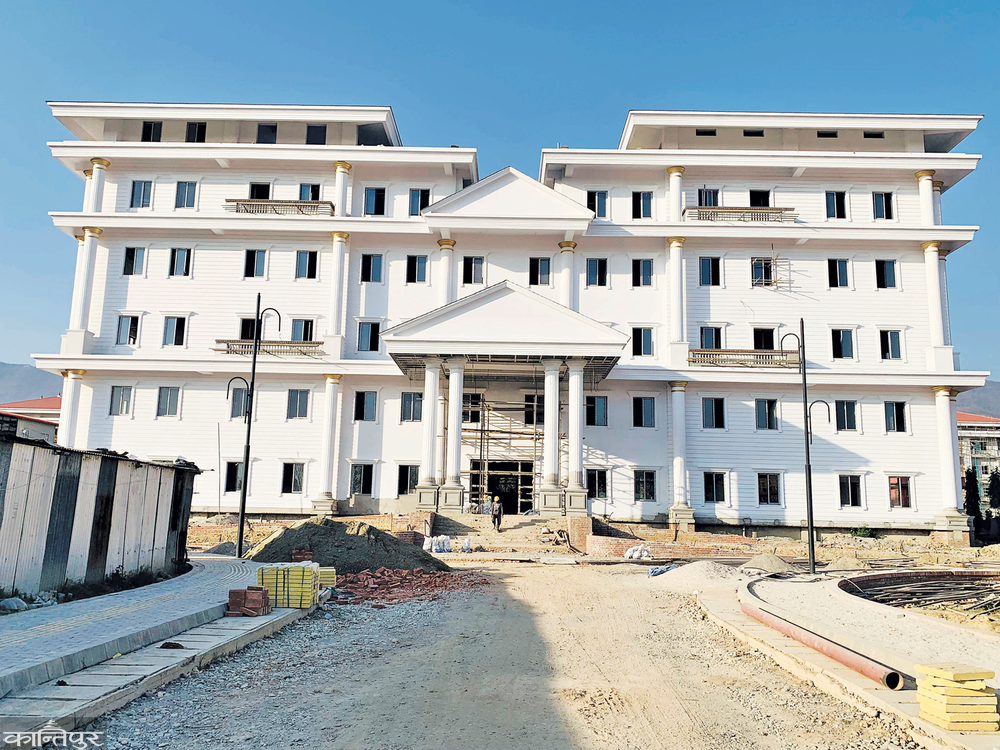
Structures are being built in Rapti Valley (Deukhuri), the capital of Lumbini Province, to give a glimpse of the Lion Palace of Kathmandu. The construction of 10 buildings including the office of the Chief Minister and Council of Ministers and nine other ministries is in the final stage. Those buildings are of the same design in the same wave.
A 6-storey building for the Chief Minister's office and a 5-storey building for other ministries are being constructed. 96 rooms are being built in the Chief Minister's office and 54 rooms for other ministries. Underground parking and one lift are being provided in each building. There are two elevators in the Chief Minister's office. Ground floor is handicap friendly. The building has modern meeting hall, administrative room.
Pradeep Bhattarai, Engineer of the State Capital Building Project Implementation Unit, said that the construction of the building has reached its final stage and beautification work is underway. According to him, Deukhuri has the first model structure among the seven provinces. "Other provinces can learn from this," he said. According to him, the wires are not visible because they are laid underground.
Engineer Bhattarai said that the building was constructed in a new way by combining ancient architecture with modern technology. As far as possible, antique materials and designs have been assimilated. Modern technology has also been adopted," he said. "A mixture of traditional and new technology can be seen in the structure of the building. This has added to the beauty of the capital.
Bhattarai said that the structure was built in consultation with people with disabilities. Safety signs have also been placed in the building from the ramp. There is an elevator to go to the upper floor, and there is a disabled-friendly ramp to go from one room to another,' he said. Out of the estimated cost of 4.21 billion, Kathmandu's Sharma Sagun JV started work with an agreement of 3.9 billion excluding VAT. Construction started in December 2079, but the contract is to be completed in December 2082. Ishwarraj Joshi, Head of the Project Implementation Unit said that the structure is being prepared before the specified time.
He informed that 70 percent physical progress and 50 percent financial progress have been made so far. In the new building, all the offices including the ministry and the directorate will be kept in one place, Joshi said. "Now all the offices operate in one area," he said, "this will make it easier to get all the services in one place after entering the capital."
Joshi said that after the completion of the building work, the work of the entrance and the wall will remain. He says that if the budget is arranged for this, the work will be completed soon. On 20 October 2077, the province was named Lumbini and the permanent capital Rapti Valley was named Deukhuri. After that, the old building of Rapti Technical School was repaired and the office of the capital was started. There were 52 small educational buildings. The educational institution was transferred to Garhwa rural municipality-3, Vidyanagar and the office of the ministry was established.
Provincial Ministry building being constructed in Deukhuri, Rapti Valley, the capital of Lumbini Province. Photo: Durgalal KC/Kantipur
 The state assembly building in Deukhuri has also reached the final stage of construction. The state assembly and secretariat buildings have been built. Parliamentary building is under construction. The Chief Executive Officer of the Provincial Infrastructure Development Authority Chhabiraj Pokhrel said that the first phase of the 20-year master plan of the provincial capital is underway.
Lumbini Chief Minister Chetnarayan Acharya says that he is working to make the state a model. He said that after the construction of the buildings, there will be ease in service delivery. Until recently, they had to serve the state by staying in old buildings and rented houses. The offices are scattered in different places," he said. "From now on, all ministries, directorates, and other offices will be in one place. This will make the capital look orderly. There will be consistency in service delivery.'

