Nepalese security forces have been deployed since 2011 to maintain peace in South Sudan, 1,966 peacekeepers of Nepal are deployed along with more than 20 countries.
We use Google Cloud Translation Services. Google requires we provide the following disclaimer relating to use of this service:
This service may contain translations powered by Google. Google disclaims all warranties related to the translations, expressed or implied, including any warranties of accuracy, reliability, and any implied warranties of merchantability, fitness for a particular purpose, and noninfringement.
Chief soldier (Colonel) Maheshwar Silwal of the Nepal Army, who is in charge of the Aridman Gana FRB (Force Reserve Battalion) at the UN House in Juba, the capital of South Sudan, is returning to Nepal next Friday after completing a 14-month stay.
He reached Juba as a commander on 080 Mansir 21 under the United Nations Mission in South Sudan (UNMISS). Manoj Karki, the chief soldier of Chandi Prasad Gana, has already reached there to take responsibility in his place.
There are 850 Nepalese peacekeepers in the FRB at the UN House. There is another special detachment of 150 Nepalese peacekeepers in Juba, which is led by Major General (Colonel) Santosh Chand. This Ishwari Box Gulm is a duffa of HRC (High Readiness Company).
This force has been deployed in Juba since 2017. At a distance of 350 km from Juba, Srinath Gana's Daffa is stationed under the leadership of Rumbekman Colonel Suresh Devkota. There are 700 peacekeepers including 66 women.
The UN has been deploying peacekeepers by establishing UNMISS since 2011, the same year that the new country South Sudan was established after the African country was separated from Sudan. Under the UN, Nepal is number one in deploying troops to establish peace in various conflict-affected countries. The presence of the Nepalese army in South Sudan is the third largest in terms of numbers. There are 18,134 soldiers, police and non-military personnel from more than 20 countries currently working in the South Sudan mission.
A decade and a half after the establishment of the new country, South Sudan is still turbulent and unstable. Internal political strife and armed activities of ethnic groups are on the rise, and the grip of the state apparatus is also weak. The country has been gripped by conflict between the Dinka and the Nuer, ethnic groups backed by President Salva Kiir and Vice President Riek Machar, respectively. The state machinery is divided by the clash between the President and the Vice President. Among the 180 countries included in the Corruption Perceptions Index recently published by Transparency International, South Sudan is at the bottom.
'Unmiss' is taking initiatives to bring the turbulent situation of South Sudan under control and bring political stability in the country. Nepalese peacekeepers have been deployed in South Sudan since the beginning under 'Unmiss'. The duration of the mission from Nepal is usually one year. Depending on the situation, the time may be reduced. Peacekeepers have been working closely with the community.
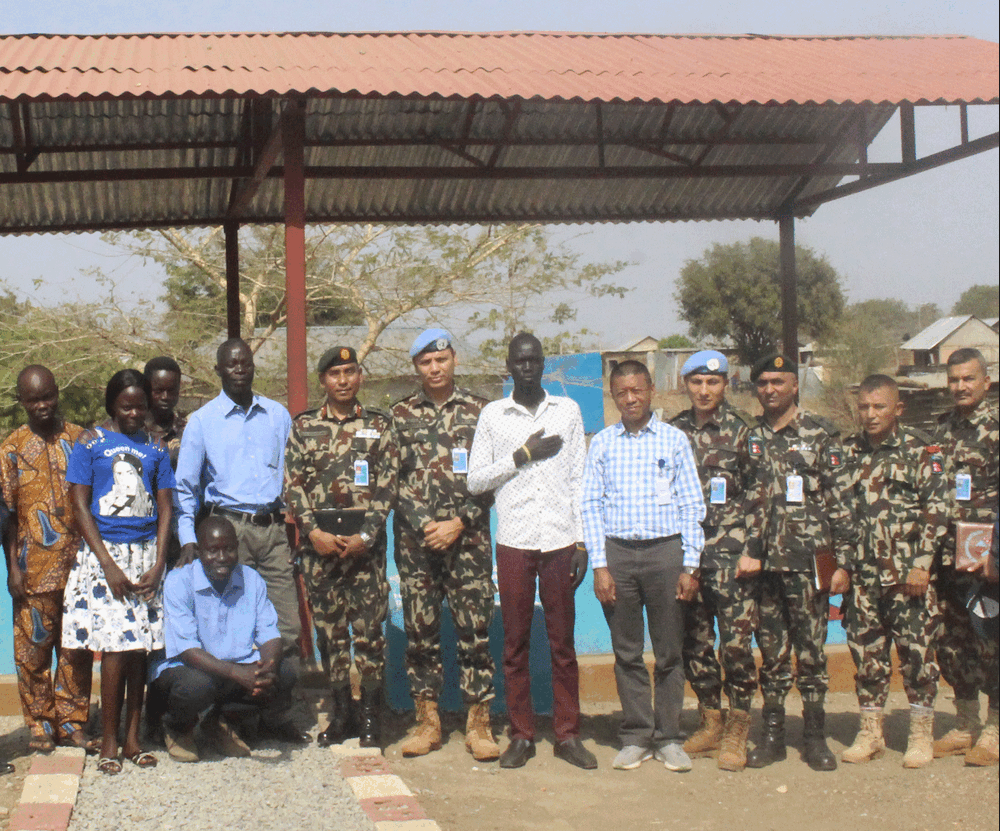
Soldier (Major) Sharad Marasini, who returned to Nepal after working as a SIMC and engineer officer under Aridman Gana, informed that the community has been supported from drinking water to stationery. "While staying here, we helped the local community with sports, stationery, sanitary items, orphanage repair, furniture, water arrangements," he said, "this acts as a bridge to connect the peacekeepers and the locals."
Francis Okumu, the principal of the local JCC High Nagil Primary School, said that he was happy that the Nepali Army worked closely with the community. "The work of the peacekeepers is commendable, our school and the community in this area have received good support," he said.
Colonel Silwal said that they have successfully delivered food to Jonglei State under the World Food Program (WFP). In the past, the food taken in this way was looted. Our forces were also fired upon by an unknown armed group, after which we had to retaliate,' he said, 'We delivered food to the affected areas, which was appreciated by the force and sector headquarters.'
Colonel Devkota said that communal and ethnic violence in the southern region, feelings of revenge and four-legged theft are the main challenges for the peacekeepers. "We have been carrying out various activities to maintain peace and security within the responsibilities we have received," he said, "Despite the problem of damage to most of the roads during the rainy season and the limitation of air vehicles, the Nepali Army is determined to fulfill the responsibilities given by us."
Captain Dr. recently returned home. Jasmin Gurung said that she had the opportunity to learn and understand many subjects while working in the different environment of South Sudan. "There is a high risk of diseases such as malaria and monkeypox in South Sudan," she said, "We worked with health precautions. We taught the local community some of the things we know.'
Amaldar Anjana Yakkha working in Srinath Gana Rumbek told that they are also working in the peace mission like male peace soldiers. She came to Rumbek six months ago as a peacekeeper from Barakh Gana, Rajviraj. Now she will stay in Rumbek for 6 months and work as a peacekeeper. "There are more challenges here than in Nepal, that's how we do our duty," she said.
While staying in the mission for a year, officers and doctors train and encourage the peacekeepers from time to time on stress management so that they don't get stressed. Nepali peace soldiers also celebrate Nepali festival here. Bhajan-Kirtan is held every evening in every Gana, Gulm. Special forces led by Colonel Chand have been conducting special operations in various places in South Sudan. "Being a special force, we work according to what comes our way," Colonel Chand said, "There are many challenges. We do briefings every day about where and what is happening, so we stay in a state of readiness.'
In September 2022, after an unknown armed group prevented a ship carrying Unmiss relief supplies from moving forward in the Nile River, a group of Daffa disembarked from a helicopter and removed the obstacle. In June 2018, when 18 people of the Dinka tribe were taken hostage by the Siluk tribe in the Malakal refugee camp, special operations forces were mobilized after they could not be rescued by peacekeepers from other countries. The army rescued the hostage safely.
Colonel Chand said that HRC conducts special operations in sensitive areas when high-ranking people visit South Sudan. In South Sudan, HRC's capability is Unmiss's capability, said Lt. Gen. Mohan Suvramaniam, Force Commander of Unmiss. "The work of the Nepali army here is commendable, it is also easy to work with the Nepali army," he said.
The North Sector of South Sudan is being commanded by Nakul Rayamazhi, the commander of the Nepali Army. He said that the presence of the Nepalese army as peacekeepers is in the main locations of South Sudan. "We have been working with the understanding of the local people," he said.
There are 1,966 peacekeepers working in South Sudan from the Nepali Army and Armed Police. According to Military Spokesman and Assistant Rathi Gaurav Kumar KC, 5,912 peacekeepers are currently deployed in different countries. There are 5,269 men and 643 women in it. So far, 154 thousand 274 people, including 2 thousand 883 women, have participated as peacekeepers in 44 missions. Now there are Nepalese peacekeepers in 11 missions.
According to the army, for the first time in 1958, a team of 5 people was deployed as military observers in the United Nations Observation Group in Lebanon as peacekeepers. Then in 1974, the old Gorakh Gana was deployed in Egypt as a contingent.
73 people have lost their lives while serving as peacekeepers. "All the Nepalese peacekeepers who are working in the mission, their efficiency has been praised by the United Nations and various leaders of the mission," Assistant Rathi KC said, "Nepalese peacekeepers have achieved good success in establishing peace in conflict-ridden areas."

