18 trillion 60 billion budget has been allocated, now 16 trillion 92 billion will be brought to the Hachuva budget at the beginning and the tendency to reduce it through half-yearly review
We use Google Cloud Translation Services. Google requires we provide the following disclaimer relating to use of this service:
This service may contain translations powered by Google. Google disclaims all warranties related to the translations, expressed or implied, including any warranties of accuracy, reliability, and any implied warranties of merchantability, fitness for a particular purpose, and noninfringement.
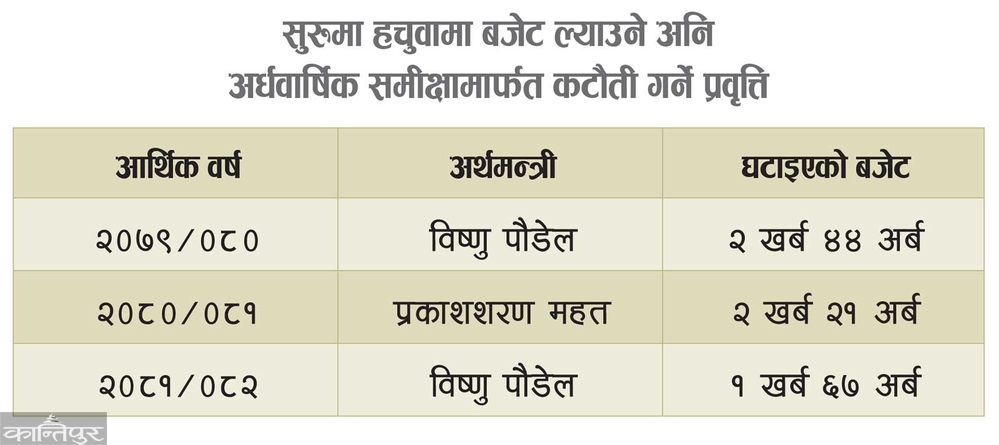
After it was determined that the income and expenditure targets would not be met, the government reduced the budget for the current fiscal year by 1 trillion 67 billion. 18 trillion 60 billion budget has been allocated, 16 trillion 92 billion has been maintained after the half-yearly review.
Finance Minister Bishnu Paudel has revised the budget by showing reasons such as the budget presented by the then Finance Minister Varshman Pune, many programs were included for which resources were not guaranteed, projects were selected across Hachuwa, thousands of projects were also kept at the center. The current budget is only 90.99 percent of the total amount allocated at the beginning.
Looking at the work and expenditure trend of the government, economists estimate that the reduced budget will not be spent. According to Finance Minister Paudel, the estimates for the remaining 6 months have been revised by adopting the policy of studying the expenses of the first 6 months, cutting unnecessary expenses and re-prioritizing the budget.
'There is a plan to emphasize on maintaining financial discipline, make necessary legal reforms for project implementation to increase capital expenditure, prioritize projects, control unproductive expenditure, select quality projects, and select projects in a coordinated manner so that there is no duplication in projects,' he said, 'It is also necessary to improve the budget system by adopting measures such as making the resource limits of the coming financial year realistic.'
With the reduction in size, the current expenditure is now 10 trillion 29 billion 30 million (90.24 percent of the initial allocation) and the capital expenditure is 2 trillion 99 billion 50 million 9 million (85 percent of the initial allocation). Last May, the previous government allocated current expenditure of 11 trillion 40 billion 664 million and capital expenditure of 3 trillion 52 billion 364 million.
"In the first 6 months, 4 trillion 52 billion 55 million has already been spent and based on the analysis of the revised estimate of current expenditure, it is estimated that 5 trillion 77 billion 29445 million will be added during the rest of the financial year to address the additional demands of various ministries/organizations," Finance Minister Poudel said, "In terms of capital expenditure, 56 billion 938 million has been spent in the first 6 months of the current financial year and based on the estimate of capital expenditure in the remaining period, an additional 2 trillion will be required." It is estimated that 42 billion 56 million 25 million will be capital expenditure.'
The revised estimate is that by the end of the current year, the income from government sources will be 14 trillion 75 billion 268 million. It is estimated that 36 billion 62 billion 86 million will be spent on foreign grants and 1 billion 80 billion 83 billion 67 million will be spent on foreign loans.
Finance Minister Poudel asserted that the target revenue collection will be due to acceleration of construction development and increase in capital expenditure, cancellation of the list of value-added tax and excise duty exemptions made by the Economic Act, and taxes imposed on new areas.
The government estimated that among the sources of expenditure proposed in the budget of the current financial year, 15 trillion 90 billion 30 million 3 million will be from revenue and internal debt, 52 billion 32 million 65 million from foreign grants and 2 trillion 17 billion 67 million 35 million from foreign loans.
In terms of financial management, the budget has been reduced to 3 trillion 63 billion 93 billion 26 million. This is 99.09 percent of the initial allocation. Last May, the government allocated a budget of 3 trillion 67 billion 28445 million rupees for financial management. "In the first six months, 1 trillion 58 billion 663.9 million has been spent on financial arrangements," Minister Paudel said, "It is estimated that 2.5 billion 268.7 million more will be spent in the rest of the period, based on loans and interest payments, as well as other expenses."
It would have been acceptable if a Congress minister had done this, because at that time he was an opposition party. But not implementing the budget that was passed by UML's Prime Minister and Finance Minister yesterday is a political revenge," he said. "Through budget cuts, it seems that this government is trying to stop specific projects and projects and finally transfer the funds to spend on their own interests." There is also the accusation that this government is showing a tendency to take the good work that is being done regularly and blame the old government where it has not done well.
Meen Bahadur Shrestha, the former vice chairman of the National Planning Commission, has alleged that this government has reduced the initial allocated budget to hide its weakness because it could not collect revenue as per the budget objective of the current financial year.
'More and more revenue should be raised according to the country's needs, possibilities and expectations. Due to these reasons, this year's budget has indicated a lot of ways to increase the revenue," he said. "In this year's budget, a program was announced to take a leap in the construction of production, employment and service delivery infrastructure for the people. For that, revenue growth was given priority while managing resources. However, this government could not collect revenue according to the purpose and purpose of the budget, it proceeded in a traditional manner, so the revenue could not increase as expected. The size of the budget has been reduced to hide this shortcoming since the revenue could not be collected as per the target.
The new government's failure to prioritize large and multi-year projects and construction of various corridors, which are mentioned in the budget, is another reason for reducing the budget, he said. "The size of the budget has been reduced based on the wrong intention and political bias that the previous government will get the programs in the budget if it is to be implemented," he added, "now the government has gone the wrong way by raising a lot of revenue and spending a large amount to keep the economy running." There is a need to increase government spending while there is a decrease in effective demand and a slowdown in the economy.
Current expenditure area has expanded and revenue collection is not in line with the target, so there is a lack of resources to carry out more economic revival programs,' he said, 'Even in this situation, resource management has become more challenging as there is still pressure from the ministries of the federal government and the provincial and local levels to provide more services and increase long-term liabilities.'
Finance Minister Poudel admitted that the current expenditure could not be reduced as expected due to the increase of mandatory expenses like social security, financial transfer, loan interest payment.
In the last few years, the trend of bringing arbitrary budgets at the beginning and making heavy cuts through half-yearly reviews is continuing. According to which the then finance minister Prakashsharan Mahat reduced the budget by 2 trillion 21 billion rupees through a review in the last financial year. Similarly, in the financial year 079/80, the then Finance Minister Bishnu Paudel also reduced the initially allocated budget by 14 percent (2 trillion 44 billion) through a review.
Economists say that the trend of budget cuts through review every year is not good. Economist Dilliraj Khanal said that due to the government's great weakness in allocating the budget arbitrarily but not being able to increase the revenue collection and spending capacity, there has been a tendency to reduce the size of the budget continuously in recent years.
"Now that the parliament is running, at least there is a job of giving information, in the past years there are many examples of amending the size of the budget without giving information even in the parliament," he said, "This trend is that the government is badly missing the need and need to develop the budget as a reliable document based on reality." The size of the budget has been reduced as a result of creating a large-sized budget as propaganda, allocating arbitrary amounts to projects, and pouring the budget into the areas of influential leaders without paying attention to regional balance.''

