We use Google Cloud Translation Services. Google requires we provide the following disclaimer relating to use of this service:
This service may contain translations powered by Google. Google disclaims all warranties related to the translations, expressed or implied, including any warranties of accuracy, reliability, and any implied warranties of merchantability, fitness for a particular purpose, and noninfringement.
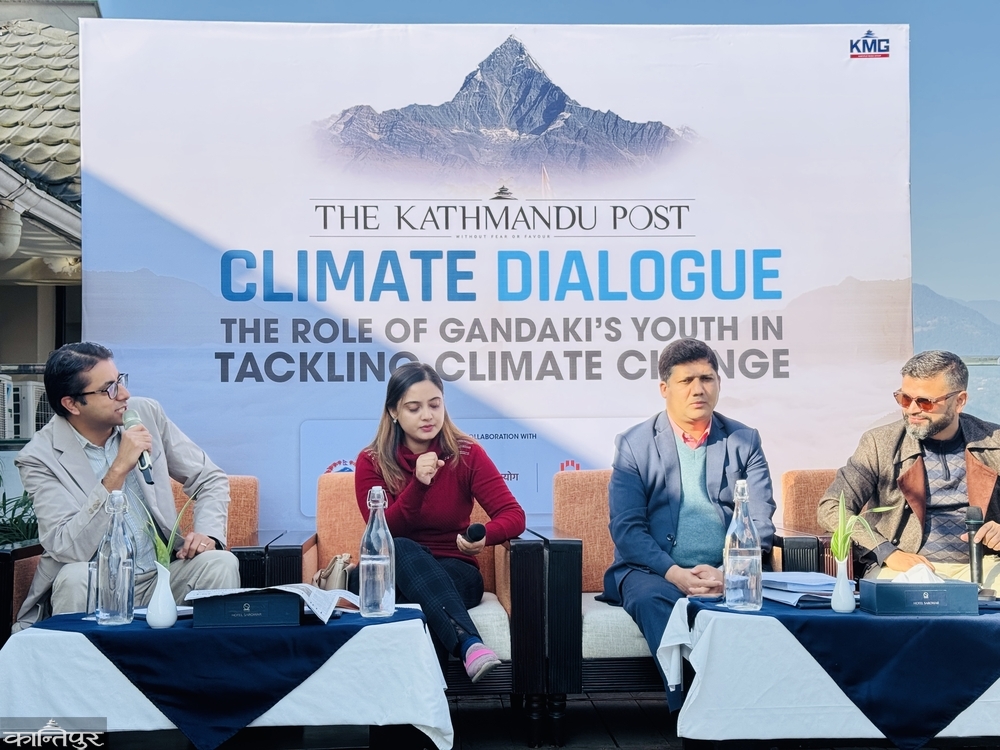
In order to deal with the effects of climate change, it has been emphasized that a climate policy should be made at the local level to include the youth and that the government should allocate sufficient budget for research. The speaker of the Climate Dialogue on 'Role of Gandaki Youth in Dealing with Climate Change' organized by Kantipur Publications' English daily The Kathmandu Post on Thursday in Pokhara emphasized on the effective implementation of climate policies at the government level.
In a dialogue held in collaboration with the Gandaki Province Policy and Planning Commission and Purak Asia, Kathmandu Post editor Biswas Baral, Vice President of the Commission Krishnachandra Devkota, young entrepreneur Tikaram Paudel Santosh and climate researcher Orchid Rosie Puri discussed the state of youth participation.
Tikaram Paudel, a young entrepreneur working in waste management, said that although various climate policies, strategies and plans have been made at the national level, the implementation aspect is weak. He emphasized that policies and plans should be made at the local level to increase the involvement of the youth. "Because of the lack of climate policy at the local level, the youth have not been able to implement their ideas," he said. Young people have the passion to deal with climate change, but the government's policy is not able to tell them to move forward openly.
Youth participation in climate-friendly entrepreneurship is a sustainable solution to the problem, he said. Stating that there is potential in climate enterprise, he mentioned that data related to climate should also be searched. "The provincial youth council should be the government mechanism to bring the youth together on the issue of climate change at the provincial level, and it should be formed as soon as possible," he said.
Climate researcher Orchid Rosie Puri said that the government spends very little on scientific research. He said that because the government did not release enough budget for climate research, the participation of the youth was also reduced. She said that despite the establishment of science and technology institute in Gandaki province, it is unable to work due to lack of budget.
She said that the government should include climate change in the curriculum from the school level and the youth should also adopt climate-friendly behavior. 'We can reduce carbon emissions through our habits,' she said, 'using public vehicles instead of private vehicles, getting into the habit of walking short distances, heating the sun instead of sitting in the room can be adopted.' Krishnachandra Devkota, vice president of the Planning Commission, admitted that even though there are plenty of policies and plans suitable for the current climate at the national level, their effective implementation is challenging. He said that the Gandaki state government is preparing to bring a climate strategy within this month to deal with climate change. "The climate policy made by the government is not of a type that excludes the youth," he said, "if it can be made effective, youth involvement will increase." Admitting that the government sector is lagging behind in climate-related studies and research, he agreed that investment should be increased.
 He says that Nepal has not been able to put its words firmly on the international stage for the necessary resources to deal with the effects of climate change. 'We have not been able to raise the issue at the same level as we are affected,' he said, 'if we can make our presence strong, we can benefit.' Mentioned . Climate activist Amrit Paudel, speaking on behalf of the audience participating in the
dialogue, told that the impact of the consumption by the wealthy has to be felt by the poor in the form of climate change. Presenting the data that Pokhara hotels emit 400 kilos of carbon annually per bed, he pointed out the weaknesses in the implementation of the government's policy on sustainable development. 'There is a lot of difference between the fishtail we saw when we were young and the fishtail of today,' he said, 'the young generation needs to be serious about it.' . Lakshmi Gurung, a tourism businessperson and climate campaigner from Mustang, narrated the devastation of the flood in Kagbeni in 2023. "The rain in the central hills has now moved to the Himalayas," she said. Mustang was known as the city of mud. But now those houses are being destroyed due to rain.' She said that by participating in the COP-28 held in Dubai in 2023, countries like Nepal raised the issue of getting compensation from the Damage Fund. She said, 'We don't need loans or investment, we want compensation,' she said, 'This is our right.'
A young student of Mustang, Aditya Rasaili, said that the state government has delayed making a climate policy. He stressed that adaptation plans should be implemented effectively to deal with the effects of climate change. Biswas Baral, editor of Kathmandu Post, said that in accordance with the plan to have climate dialogue at the provincial level, it started from Gandaki for the first time. He said that after the climate dialogue in all seven provinces, there is a plan to prepare a document and start a public debate and take this debate to the international level. Jalway Samvad was also supported by Nepali Youth Entrepreneurs Forum, Pokhara Chapter.

