”There was a lot of trouble at first. If the landlord found out, he would come to beat him. I don't even want to look at the farm now. I go to the toilet slowly.
We use Google Cloud Translation Services. Google requires we provide the following disclaimer relating to use of this service:
This service may contain translations powered by Google. Google disclaims all warranties related to the translations, expressed or implied, including any warranties of accuracy, reliability, and any implied warranties of merchantability, fitness for a particular purpose, and noninfringement.
Saraswati Paswan was born without both legs. Saraswati, who grew up in Saday (Musahar) slum of Lahan-11 Pararia, was struggling with her daily routine as she had no legs, she felt as if she was fighting a war when defecating. There were no toilets in the houses. To defecate, one had to go to the nearest field or bamboo grove. We had to crawl by hand to reach the nearest field or bamboo grove.
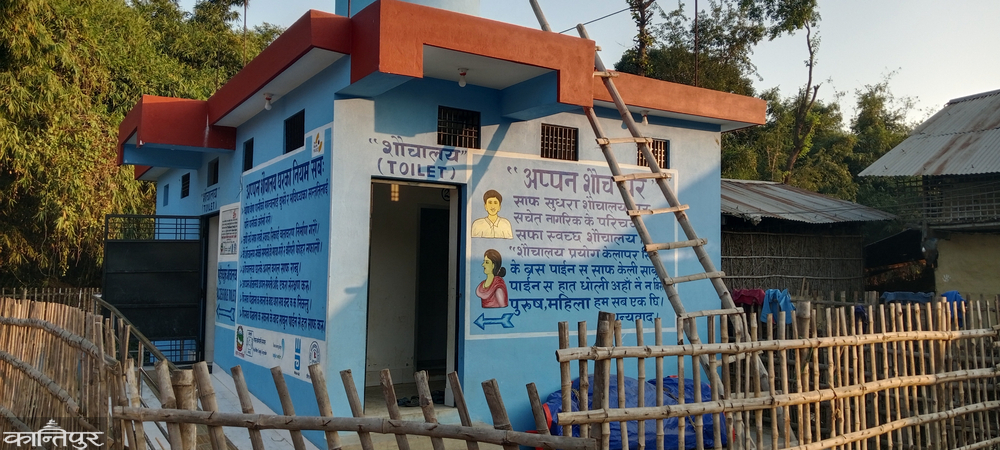
Saraswati is now 13 years old. She reaches the toilet sitting in a wheelchair. After defecation and urine, she opens the faucet and washes her hands. The community toilet of Saday Basti in Lahan is also disabled friendly.
Saraswati is the only disabled person to reach the community toilet of Pararia, which is being used by 250 families from 30 houses of poor Paswan and Musahar communities User is . Saraswati, who is studying in Class 4 at the nearby Gyanjyoti School, said, "It used to be very difficult before, but now it has become much easier." I love the toilet more than the house.'
A few years ago, when the open defecation-free zone was announced, pans and seats were distributed here too. The landless Paswan and Musahar communities were forced to cook and sleep in the same room. Kitchen and toilet became inseparable. Due to this, the source of drinking water became polluted. As a result, cases of skin, diarrhea and waterborne diseases increased.
Lahan-22 Jahdi Basti's 58-year-old Kaganiya Saday also asked for toilet Pan and Seat Pin . His family of 8 could barely survive in a small bush built on Ailani land. In one corner of the bush was the kitchen . He built a toilet in the place where he kept firewood near the kitchen. ``The toilet made him sick,'' said Kunjaniya Devi, ``eldest son got diarrhea.'' I was surprised by ringworm . After going to the health post, it was found out that the contaminated water made the patient ill.
According to the social manager Elina Ingmang, while announcing the open defecation-free zone, the problem did not arise even though sit-pans were provided in poor and poor slums. "Due to lack of space, they started keeping kitchen utensils and firewood in the toilet," she said, "It was seen that only pans and seats were placed in the houses of many people to declare an open defecation-free zone." Not in use . Health problems were observed in the houses in use.'
According to the Health Branch of Lahan Municipality, about 400 people were treated for skin diseases in Pararia last year. In Lahan-11, more than 500 people fell ill due to impure drinking water. In Lahan-22 last year alone, more than four hundred skin diseases were seen. About 800 people fell ill due to the use of contaminated drinking water in this ward. "Most of the patients had problems with typhoid, diarrhea and lice," said Ramanand Chaudhary, head of the health department of Lahan municipality Patients of waterborne diseases have increased.
In the poor and poor slums of Lahan municipality, after the increase in the number of illnesses due to open defecation, contaminated drinking water and lack of sanitation, under the Wikan project, Lahan Municipality, Nepal Drinking Water Institute, Water Aid, Alien Water and Dalit Janaklyan Yuva Club in collaboration with community toilets, contaminated drinking water and sanitation. Work has started for. Vinod Kumar Bisunke, president of Dalit Jan Kalyan Club Lahan, a partner of the project, said, "Despite the declaration of an open defecation-free zone, the problem continued in the poor and landless slums." Community toilet, contaminated drinking water and cleanliness campaign have brought many changes.' Photo: Ajit Tiwari/Kantipur
 In the first phase, community toilets have been completed and put into use in Pararia (Saday Basti) of Ward No. 11 and Jahdi of Ward No. 22 of Lahan Municipality. The head of Lahan municipality, Mahesh Prasad Chaudhary, said that community toilets have been constructed in two wards targeting Musahar, Paswan and Dom settlements and pipelines are being installed in those settlements for contaminated drinking water. According to the project manager of
Water Aid, Rajesh Lohani, the goal is to build community toilets and provide pure drinking water in all 24 wards of Lahan Municipality. Lohani said, "Community toilets and contaminated drinking water have controlled disease." Awareness has also increased than before.'
46-year-old Somnidevi Paswan is the president of Salesh-Dinabhadri Community Toilet Operation and Management Committee built in Pararia of Lahan-11. The community toilet under his supervision has a toilet with 10 seats . One is disability friendly. Toilets have been allotted to 250 people from 30 houses. 100 rupees per month is taken from every house and spent on toilet cleaning and paying electricity bills . President Paswan said, "There were many problems with the disease earlier." Now it has improved a lot.'
There are two ponds on both sides of Saday Basti of Pararia. There are farms attached to the pond. And, the flute too . Rajkumar was always found lounging in the pond. He doesn't know his age . He said, "That farm and bamboo grove is our first toilet. And, this pool is a place to wash hands . I have been chased several times while defecating in the fields. When I was caught, I was beaten up.' Sada now feels like those sad days are gone. "There was a lot of trouble at first." If the landlord found out, he would come to beat him . I don't even want to look at the farm now. Sanle go to the toilet - I come.'
There is also a community toilet in Jahdi-Saday village of Lahan municipality-22. The toilet, which has been in use since 17th of Chait, is supervised by Lutni Devi Saday. About 200 people from 22 houses in Jahdi Basti use community toilets. Lutni Devi said, "This is not only a toilet, it has also become a house to get rid of diseases for us."
What is a community toilet?
Community toilets are new in Nepal. When there is no situation to build a toilet at home, community toilets are built on government land for the slums. At the same time, the construction of community toilets has been started in Lahan municipality under Wikan project. poor Lahan municipality is working on clean drinking water and sanitation along with community toilets to control diseases that spread due to faeces and contaminated drinking water.
Community toilets are maintained by the community. The management committee formed by the community has arranged the maintenance of toilets, sanitation and electricity-lights. 100 rupees is collected monthly from every house that uses community toilets. That money is spent on cleaning community toilets, cleaning safety tanks and electricity bills.

