The government did not implement the mandate given by the Supreme Court to prioritize the allocation of budget and resources for the quick removal of garbage and dead bodies in the mountains.
We use Google Cloud Translation Services. Google requires we provide the following disclaimer relating to use of this service:
This service may contain translations powered by Google. Google disclaims all warranties related to the translations, expressed or implied, including any warranties of accuracy, reliability, and any implied warranties of merchantability, fitness for a particular purpose, and noninfringement.
Dangur, which is surrounded by the attraction of Setamme snow, which can be seen from a distance, is increasing its height. Advocate Deepak Bam Mishra's Sherpa friends used to tell the bitter truth that dirt grows faster than snow in the mountains.
And after hearing the experience of that friend that even dozens of dead bodies of foreign climbers who died while climbing were seen scattered in the mountains, Mishra further inquired about it.
He filed a writ in the Supreme Court on August 10, 2076 after realizing that due to the increase in temperature, the melting mountains are melting more and more garbage and dead bodies are being mixed everywhere. The main demand of the writ was - 'To remove the garbage in the mountains during mountain climbing and to punish those who litter.'
According to the investigation of advocate Mishra, although there is a provision in the Tourism Act that mountaineers must deposit a deposit before going to climb and show that they have brought back all the belongings they took while climbing the mountain, this money is not being followed. After seeing the increase in garbage due to the non-implementation of the provision in the Act, he also made another demand in the writ that the said provision should be implemented.
5 years after the writ was filed, the Supreme Court issued an order in the name of the government, 'to implement the law to keep the mountains clean and remove all the garbage in the mountains.' In the issued orders, there have been more than a dozen orders in the name of the government to protect 'nature as nature and mountains as mountains'.
The government has given permission to climb 414 mountains and the garbage left by thousands of mountain climbers has not only made the beauty of the mountains ugly, but its very existence is in jeopardy. The government has been asked to make a concerted effort.
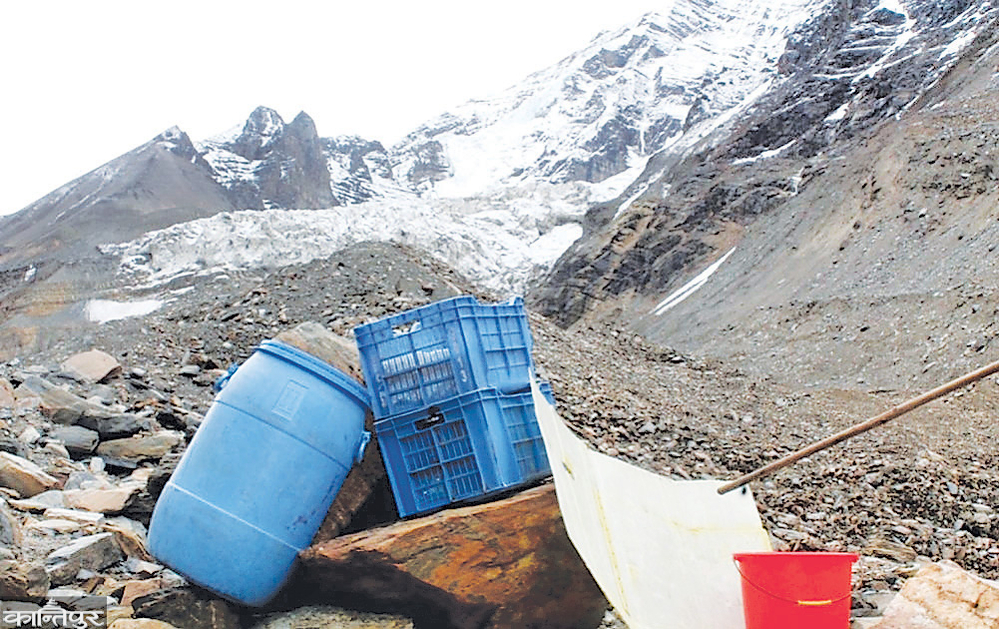
Although the full text of the mandate is yet to be released, the 12-page summary order states that 'garbage and dead bodies piled up in the mountains are putting the mountains at risk.' is My chest is heaving with steps beyond my strength. Mountaineer litter and mountaineer corpses have shattered my soul. I am in an unbearable situation. I am turning into a black stone because of the rapid melting.' The 13 mandates that the Supreme Court has given the government to do immediately have basically two purposes. First, prompt removal of ongoing garbage and dead bodies. Allocation of necessary budget and resources should be prioritized for that. Second, to prevent the mountains from becoming more dirty, the mountaineers should monitor and return the deposit only if everything is in order. In order to fulfill both these objectives, it is sufficient to follow the 13 mandates given by the Supreme Court and some provisions in the laws and regulations related to environmental protection.
Section 9 of the Environment Protection Act, 2053, subsections 1, 2 and 3 states that it shall be the duty of the concerned body to protect the heritage. Since this requires an integrated effort from the local government to the federal government, the Supreme Court has ordered that sufficient budget should be allocated from those levels and necessary coordination should be done.
Similarly, in subsection 1 and 2 of Section 30 of the Tourism Act, 2035, it is mentioned that the mountaineer team must follow the conditions specified in order not to pollute the environment while climbing the mountain. However, the writ petitioner advocate Mishra claims that there is no mechanism to see what they did or did not do while climbing the mountain, so garbage has increased in the mountains.
Similarly, rule 15 (g) of the Nepal Tourism Board Act, 2053, Mountaineering Regulations, 2059 states that when climbing a mountain, climbers must carry the waste above the base camp to the base camp. But it has not been implemented. The Supreme Court had ordered on various dates in the petition filed that even if the
ing laws are not sufficiently enforced and some laws need to be made, even if mountain climbing is stopped for some time, some initiative must be taken to maintain its cleanliness. .
9 days after the case was filed in the Supreme Court, on August 19, 2076, the single bench of Sushmalata Mathema issued an order in the name of the opposition including the Council of Ministers, the Ministry of Tourism, the Ministry of Forests and Environment, and the Everest Environment Control Committee to submit the reason why the writ could not be issued.
Soon after that, the government started the 'Sagarmatha Cleanliness Campaign' and gave the responsibility of collecting waste from Everest and Lhotse mountains to Khumbu Rural Municipality. In the year 2076, when the municipality took responsibility for the sanitation campaign, it collected 2800 kg of perishable and 8000 kg of non-perishable waste.
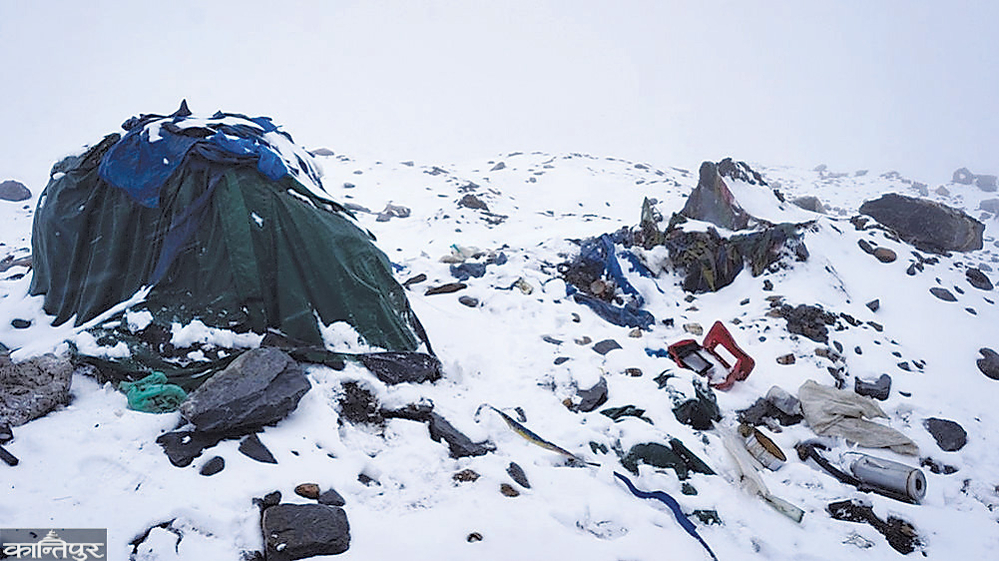
When it was seen that it would be difficult to clean up the garbage with the sole efforts of the municipality, the government handed over its responsibility to the Army's 'National Parks and Wildlife Reservation Directorate' in 2077. A budget of 10 crores was also allocated for that. Under the program of the Planning and Monitoring Division of the Ministry of Forests and Environment, the said directorate of the army has been providing security in wildlife and reservations across the country. According to Badriraj Dhungana, the head of the
division, the army conducted the 'Safa Himal Abhiyan' after the directorate of the army was given the responsibility of cleaning the mountains. According to which, in the first year, the army collected 2,505 and 25,166 kilograms of biodegradable and non-biodegradable waste from 6 mountains namely Everest, Lhotse, Pumari, Makalu, Dhaulagiri and Amadablam.
After the army took responsibility, it was seen that garbage collection has increased almost three times, the government has given this responsibility to the directorate for the next year as well and 80.3 million has been allocated for it, Pandey said.
In the second year, the army collected 7 thousand 157 kg of biodegradable and 26 thousand 720 kg of non-biodegradable waste from 4 mountains namely Everest, Lhotse, Manaslu and Kanchenjunga. For the next two years, the government continued the Safa Himal campaign by allocating a budget of 83 million rupees to the army. In five years, 21 thousand 875 kg of perishable and 97 thousand 181 kg of non-perishable waste have been collected.
The army manages the decaying waste in the local municipality and the non-decomposing waste is brought to Kathmandu in cooperation with the processing company. "There has been a situation where there is more garbage than snow in the mountains," is the experience of an army officer who is leading the garbage collection campaign Cleaning is coming. It is the experience of the army that the task of bringing garbage from the mountains is very expensive and risky. "It is costing about 3200 to collect the garbage from the hill to the highway," says the official, "The need to collect enough equipment to deal with the adverse weather and to stay in the mountains makes the garbage collection work very expensive." He said that it costs more.
'It costs at least 3 lakhs to bring a dead body to Kathmandu,' says the officer, 'and it is equally troublesome to find a place to bring it and keep it in Kathmandu.' . Rakesh Gurung, head of mountaineering branch of Tourism Board, said that the process of identification of two dead bodies has continued and the rest have not been identified. "One body has been found to be that of a Czech citizen and the other is that of an American citizen. We have informed the family for identification," Gurung said Ever since Norgay first climbed Mount Everest, people from all over the world have been coming to Nepal for mountain climbing and it seems that they have lost their lives every year. Although there are no definite figures, it is estimated by the mountaineering branch that at least 300 dead bodies are stranded in the mountains.
A month after the Supreme Court issued a mandate to proceed with the removal of dead bodies and garbage at a faster pace in the coming years, the government released the budget last May, which does not include the amount received from the previous year for Safa Himal this year.
After seeing that the army is cleaning more than the target every year, the Supreme Court has also praised it in a brief order and has also asked to continue this work with more precision and make the mountains completely clean. However, one month after the Supreme Court decree, the budget allocated for mountain cleaning was cut.
'Since the government did not give the budget, we also could not give the army cleaning work,' says Badri Dhungana, joint secretary of the Ministry of Forests and Environment, 'The army was doing a good job by picking up more garbage than the target in the Clean Himal campaign, but this year there was no budget for it, which is sad. According to Dhungana, the government has reduced the ceiling of the budget this year, so no money has been collected for mountain cleaning.
The army has been urging the division to allocate funds to continue the Safa Himal campaign. Dhungana said that they had received a letter from the army some time ago and added, "But what to do?" The Ministry of Finance did not give any money for cleaning the mountains, the Ministry is not in a position to give it from its own resources.' Writ Petitioner Advocate Mishra adds, 'This is contempt of court, I will file another case against the government.' Mishra said to go to court.
The mandate given by the Supreme Court to the government
Our rights are not only over nature, but also nature itself. Nature's self-respect remains, its power is limited. In order to protect, promote and promote nature as nature, mountains as mountains, we will adopt necessary prevention measures according to the precautionary principle. Dilaunu
In the Himalayan area, when managing waste in the waste pit, due to the extremely low temperature, the waste will not rot, but there is a possibility that it will be seen again after the snow melts. To manage/enable with special programs even in the existing old bodies management, as well as to manage/enable the management of bodies with insurance
Effective implementation of the existing laws related to mountain climbing
Do not use helicopters from the camp to the top of Himchuli, except for emergency rescues related to mountain climbing
Effectiveness of Nepal Army Everest Pollution Control Committee, Annapurna Conservation Area Project and related local bodies in mountain cleaning work was found to have a role. Let it continue. To coordinate with the government agencies and organizations and also between the intergovernmental agencies in the waste management and waste management in the mountains, to form a monitoring team (ranger) of people experienced in mountain climbing and to arrange for proper remuneration, accident insurance and proper compensation for the people involved in the cleaning campaign. will make
Although some budget has been allocated to the Nepali Army under the Safa Himal campaign, the budget is not sufficient for the waste management and waste management. Manage/ensure adequate budget
The local government, the state government and the central government should allocate a separate and sufficient budget for the sake of the Safa Himal campaign. Surviving and ensuring the goods to enter the arrival of goods to be rented and will bring back the goods to get back to the balati to get back to the bail Make arrangements to give back. Underworming the modern equipment of the relations in the process of time, performing the modern tools of the body of the body and the modern equipment required for the safety of the body and mountains of mountains, such as the exposure to the risk of radiated floods, avalanches etc. Arrangements make up the provision of potential human and material damage and protected and protected and biodiversity of biodiversity Coordinating / correlations need to be needed to develop an integrated information system to secure the mountaineering. Due to climate change from the climate from the international bodies, to take the necessary initiative to claim for the fulfillment of the damage in Nepal and NBSP;.

