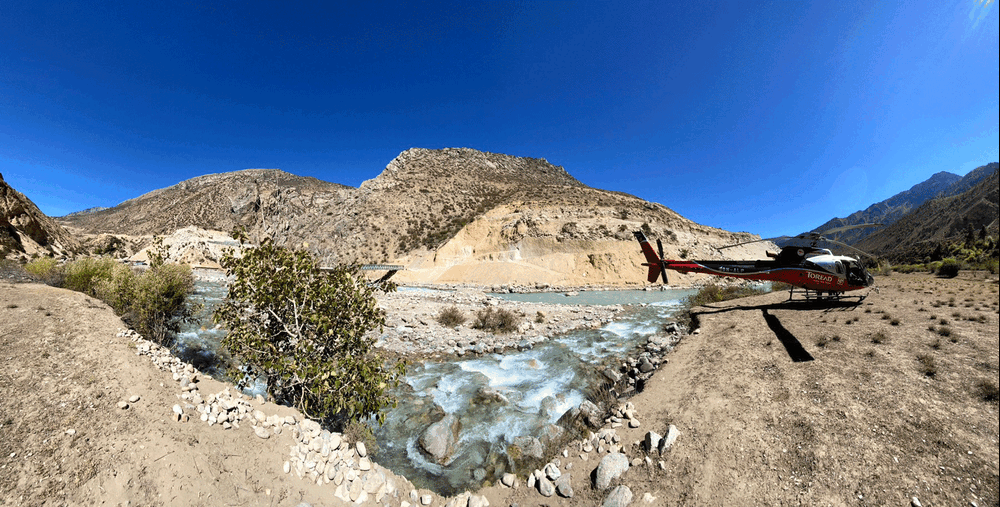
The pilot's lifeline is the river. The river itself shows him the way. They look at the mountains and fly along the river, looking for a safe way in harmony.
We use Google Cloud Translation Services. Google requires we provide the following disclaimer relating to use of this service:
This service may contain translations powered by Google. Google disclaims all warranties related to the translations, expressed or implied, including any warranties of accuracy, reliability, and any implied warranties of merchantability, fitness for a particular purpose, and noninfringement.
A single-engine Cessna Caravan aircraft of Makalu Air, which was carrying cargo from Surkhet to Humla, was returning empty. After the Simkot airport tower gave permission as 'clear to take-off', co-pilot Prashant Shah flew the empty plane to Surkhet. Captain Sange Lama was by his side. It was 4:50 in the afternoon. The weather in Simkot was clear. Since the Cessna Caravan was empty from the runway at 9,500 feet, both pilots did not have the 'extra stress' of carrying cargo or passengers.
Both pilots are in their 30s. The sky and the clouds are like their home. It was the fourth flight for the day . It was just four-five minutes after the flight started. The ship was climbing 11,500 feet to the south, 18 kilometers from Simkot Airport. Suddenly the engine failed . Only one wing (single engine) of the rotating ship became stable . The ship will not go up anymore, it started to go down .
Captain Sange quickly took command of the ship. Co-pilot asked Prashant to look out and help, saving life became the first responsibility . 'Where to go?', he started calculating without panic, 'the flight could not be continued till Surkhet . It was possible to return to the Simkot Airport with the speed before the engine shut down, but even after returning, the plane began to descend below 9,500 feet, so it was not possible to land on the runway. Now the only option left is to make a force landing in the Karnali river.
The ship was going down. After the attempt to return to Simkot Airport was impossible, they decided to make a force landing at Karnali, protecting the engineless ship from rocks, ravines, mountains and tall trees. Due to a malfunction in the engine's oil system, the glass of the cockpit was dirty with oil splashes from the front.
Taking the river as a lifeline, the Cessna Caravan flew northward under Simkot Airport. However, the pilots could not see well ahead through the dirty cockpit glass. Captain Sange, who took over the control of the ship, kept saying to Prashant. Within a few seconds, the captain tried to launch the ship in the empty stream of the Karnali river, which had no stones of Bademan, but could not. After the first attempt failed, the captain said, "I will try again," and touched the water with the back of the ship a little higher in the second attempt. The force opposite to the water's velocity and the ship's power acted as a brake . After a few moments, the ship splashed on the water and sank while landing.
Before landing there, both of them had already pulled the lock so that the door would open as the ship floated in the water. The door opened as water poured in from the front of the ship . Prashant jumped first, then Sange . 12 million ship sank in the water . After sinking the ship in Karnali, both the pilots managed to survive.
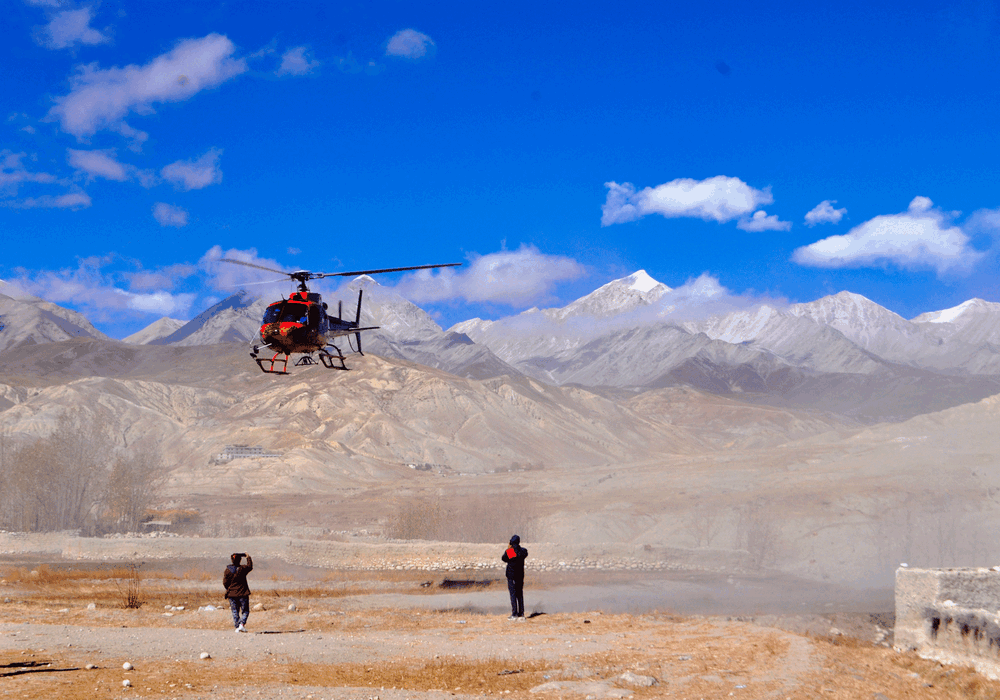
2072, this incident on Chait 26 was Nepal's first incident of force landing on the river. The incident made headlines across the country – the river saved the pilot. The incident was also compared to the US Airways crash in New York's Hudson River in 2009. All 155 passengers and crew members managed to survive in that incident.
At this time, the narrow body aircraft of Nepal Air Service Corporation is preparing to fly - Prashant . According to him, Captain Song is currently flying a Boeing-767 cargo plane in America.
At that time, what would happen if the river was not nearby? Perhaps sad news! Because a month and a half before that accident (February 14, 2072), the pilot Dinesh Neupane and Santosh Rana lost their lives when the single engine plane of 'Air Kastamandap' flying from Nepalgunj to Jumla with 9 passengers made a force landing due to engine problem at Chilakhaya in Kalikot. According to the pilot involved in the investigation of that accident, the captain and co-pilot could have been saved from this accident if the front part of the ship had not hit the bari deal or had made a 'force landing' in the river .
There are 55 airports in Nepal, 52 domestic and three international. Of these, 13 are unpaved runways and 28 are tarmac. However, not all airports are active, 9 are closed. Places like Tikapur, Kangeldanda, Meghauli and Kamal Bazar have runways but the ships do not fly. Rabindra Sherchan, a recently retired pilot of Nepal Air Service Corporation after flying for 37 years, says, "Apart from Tarai, 90 percent of our airports in mountainous and remote areas are located on the riverside. We fly along the river, overlooking the river and the mountains . We will coordinate and find a safe route.'
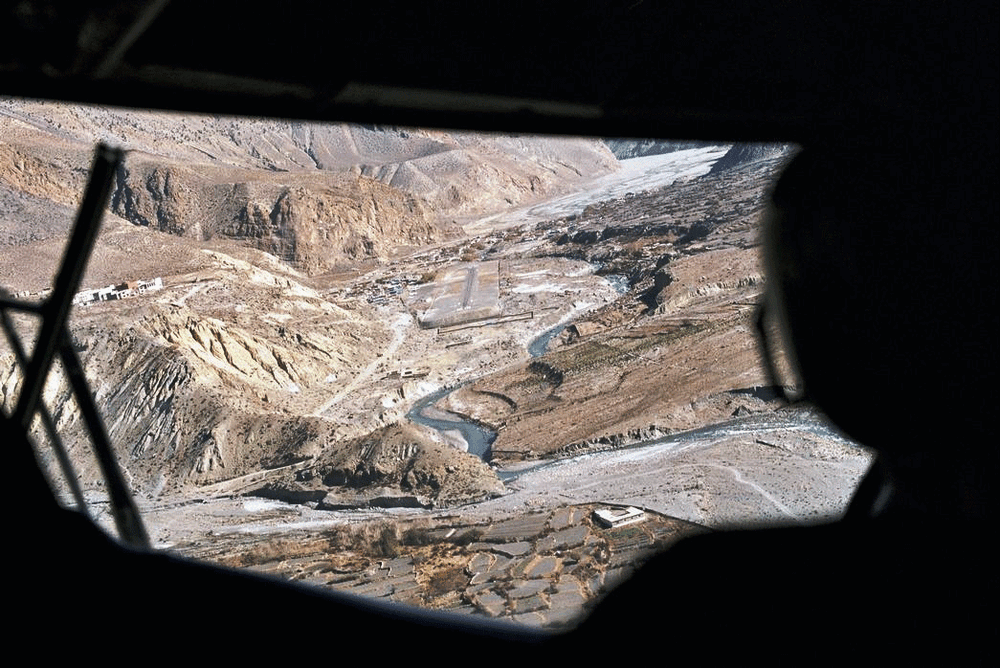
Deputy Manager (ATC) of Nepal Civil Aviation Authority Gyanendra Bhul says, 'It is scary for passengers, if there is a ship and a pilot, the flight will take place . However, for a safe flight, the basic system, communication, navigation, weather information, security all elements must be combined . Mountain flight pilots have been flying for years through rugged mountains within river plateaus, without communicating with air traffic, without guidance. No modern equipment . For years, small ships, helicopters have been relying on the natural landmarks of rivers, mountains, ponds and forests to reach/return from one point to another.' It is impossible to reach Darchula, Mustang, Taplejung without the river as the road is closed due to storm, snow, rain. We all know the mood and flow of the river. The river shows us the way . We follow that .'
81-year-old Captain BM Amatya of Kathmandu Kuleshwar (who started his career as a pilot in the year 2023 by flying the Royal Nepal Air Service Corporation's Dakota aircraft) remembers, 'Earlier, when the ship was taken to the grassland, there was neither an airport nor a tower . Even ATC was not enough . Not even an anemometer. There was no communication between the plane and the ATC.'
In that case, Rivers helped the ship to adjust its position, altitude, speed. The river played a major role in transporting ships to villages that had no infrastructure. The situation is the same today. While flying in the mountains, the pilots have to fly over the Karnali, Tila, Seti, Mahakali, Dudhkoshi, Sunkoshi, Arun, Tamor rivers . Without these rivers, small ships and helicopters would be impossible to travel across the remote skies . The river is our guide and lifeline,' adds Amatya.
Because small planes and helicopters are not pressurized, they cannot fly above 12,500 feet, there is no oxygen. Therefore, ships find it easier to follow the rivers than to fly over the high mountains and mountains of Nepal. Pilots cross rivers, cut hills and enter valleys . They named those hills according to their own language and experience . Like "Virgin Pass" in Humla, "Lamjura Pass" in Lukla, "Simra Pass" between the mountains on both sides of the Bagmati River in Simra, "Whiskey Pass" on the way to Sindhuli and Janakpur to the east and Jumla and Dhorpatan, "Dhorpatan Pass"! All these have become the lifeline of pilots .
'Pilots in flight look at the river . They make plans eye-by-eye to see which direction the river flows, which hill they can cross,'' says senior Captain Fijunath Nepali, who has spent 22,000 hours in the sky. Reached the corner, made hundreds of flights . However, while going to the west, it is remembered that the Karnali and Seti rivers sometimes diverted him . Seti flowing from Doti and Budhiganga flowing from Bajura simultaneously merge into Karnali. I've been to the point of having to go to sleep a few times. I have to go to Doti, I have got out of bed.'