Imroz loved Amrita since then, when he and Sahir Ludhian were also at the height of their platonic love.
We use Google Cloud Translation Services. Google requires we provide the following disclaimer relating to use of this service:
This service may contain translations powered by Google. Google disclaims all warranties related to the translations, expressed or implied, including any warranties of accuracy, reliability, and any implied warranties of merchantability, fitness for a particular purpose, and noninfringement.
It happened around 1930. Romanian writer and philosopher Mircea Eliade was in Calcutta, India – as a disciple in the private residence of the great philosopher Surendranath Dasgupta. Dasgupta's teenage daughter Maiteyi Devi and Eliade slowly grew in love. After receiving its needle, Dasgupta threw Eliade out of the house.
He wrote 'Bengal Nights' by molding this short relationship and the society/culture of Calcutta as understood by Eliade into a narrative. Maitreyi Devi objected to the narrow understanding of the relationship. His dissent remained at the supremacy of carnal love as portrayed by Eliade. Eliade's response to Indian culture and background is given from the novel by Maitreyi Devi through 'Na Hannayate' (meaning it never dies). These two narratives, which are included in the broad spectrum of
, remain well-discussed as a memorable expression of feelings and ideas. Also, the exchange of letters between active creative couples at different times in the past has also become a topic of discussion every now and then.
Indian painter Imroz, who passed away at the end of 2023, has presented a high standard of love and relationship. Imroz loved and cared for Amrita since then, when Amrita and poet/lyricist Sahir Ludhian were also at the height of their platonic romance. Amrita's memoir 'Rashidi Tiktok' has become a document revealing her intimacy with Sahir. The entire picture of the second chapter of Amrita's love can be seen in 'Khatonka Safarnama'. In her letters, Amrita addresses Imroz as Ima, Emu, Imwa, Jiti, etc. in addition to this name. And Imroz also calls Amrita by nicknames such as Maja, Aimee, Jorvi, Ashi etc.
The sadness and emptiness of being away from Ekarka became a new dose of expression for them. In a letter, Amrita writes, 'I received your flower-like letter. Wafaki Khushbu Ai Aur Maine Iss Khushbu Ke Kinty Hi Lambe Ghunt Bhare.' In the same quick expression, Imroz's pen goes like this, 'Ghar Akar Tumse Baatin Karne Laga, Kabhi Apne Kamare Mein Sitkar, Kabhi Tumhe Kamare Mein Khade Hoker.'
In another letter, Amrita writes, 'Akelapan aur gadha ho gaya hai, vilkul Roman Empire ki tarah. H. G. Wells writes – The Roman Empire grew like Alfred Nowell and collapsed in one fell swoop. This statement of Imroz included in the book seems to be written in response to it: 'Tu Meri Samaj, Aur Me Tera Samaj. No more society than this.'
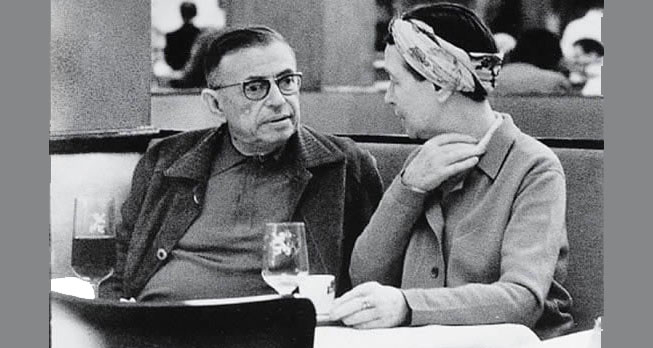
French philosophers Simone du Beauvais and Jean-Paul Sartre continued their creative collaboration decades ago in the Living Together relationship. In this way, Ajiv, who fulfills biological needs, but does not marry and does not even bear children, stayed together in agreement. They were even comfortable and generous in their proximity and relationship with other friends of their choice. Correspondence between them is not serial. A letter written by Vuvva to Sartre reads, 'I love you and have a strong desire to meet you. How much I need you! If it wasn't for you, I would be a very vain person. My dear Pudke man, you are very good! I kiss you with all my heart.'
In another letter, Vuvva writes, 'I am happy when I go somewhere and meet someone . Soon after, despair covers me because only you can give me the joy of that encounter. My love, without you I would be a child You are the only person in the whole world whom I value more.' But, I won't repeat it because I have a crush on the word. But, my beloved flower! Accept you–a gentle kiss from me on your little cheeks.'
Sartre was obsessed with carnal love. He admitted that an ugly girl, no matter how intelligent she is, is not his priority. This is the meaning of this letter as well, 'I am still committed to you. I feel you near me.....I love you with all my might. Many times throughout the day I am filled with noble desires - to be by your side and to kiss your soft cheeks. I love you even more.' Again, Sartre's hypocrisy is reflected in the second, thus, 'We have an essential love but it would be a good idea to experience other possible external love relationships.' Through vulva, Sartre used to get close to new girls and pass the time. It is evident in Vuvva's reply, "As long as we were steadfast, our love relationship continued." But, when we started meeting with outsiders, the relationship did not remain the same.'
Vuvva was also in a same-sex relationship at some point. Later fell in love with American novelist Nelson Algren. Love letters were the only way to bridge the physical distance between Paris and Chicago. Part of a letter Wuvva wrote to Algren, 'You are the only thing I know. Nelson, I have only you in my heart. You are you in the breath you take every minute. I have no other purpose nor desire. There is no hope or desire except you.'
The relationship between Vuvva and Algren lasted only a few years. Suffering from many of Sartre's extramarital affairs, Vuvva seems to have expressed a deep love for Algren. Wuvva always wore the ring Algren had given her. She was buried next to Sartre's grave with that ring. Thus ends the chapter of this strange love.
is a Russian resistance women's group - 'Pussy Riot'. A member of this group, Nadya joined the resistance movement against Vladimir Putin's repressive policies. Soon she was caught and jailed. Slavoj Žižek is a famous Slovenian philosopher. 'Comradely Greetings' is a collection of correspondence between them when their girlfriend Nadya was jailed.
Žižek tries his best to boost Nadya's morale and keep her connected to the resistance. In addition, it is also a joint resistance against the autocracy of that time. Most of these dialogues focus on capitalism, prison life, liberal democracy and philosophy. In this collection, Žižek's gentleness and tender love for Nadya are expressed in this collection. In this, Žižek appears to be a sensitive human being rather than a philosopher.
Žižek writes in the letter, 'I know very well that we are weak human beings in the face of oppressive forces. That's why I am sad and angry at the moment.' At the end of this letter, he adds, 'I am an atheist, but I pray for you. I wish you get some time to read and think in a quiet environment in prison.' Nadya writes in reply, 'You/we are being made to believe that unbridled creativity, unbridled economic growth and diversity are the gifts of modern capitalism. Today's capitalism is hiding the fact that millions of people are becoming slaves of the dominant.' But you stop worrying about me by adding theoretical pomp.' After being released from prison, she wrote, 'While in prison, I was able to think about expanding the subject in a very meaningful way.'
The love affair between Mexican painter couple Frida Kahlo and Diego Rivera is also remembered at this time. Frida also used the grammar of color and painting to express love in letters. Let's look at this letter, 'I want to draw your picture but I don't have any color. There are many colors but no color that expresses the clear form of my dark love.' Another letter reads, 'Your eyes are the green sword inside my muscles. In the dark or in the light, your voice resonates. You are an axochrome that contains color in yourself and I am a chromophore that gives color to others.'
Frida's love was not confined to the body and lust. That's why the philosophical sentiments are found in his letter, 'Where is love, tenderness or affection and our relationship? This is the whole life. ....There is one world between us. And one mountain can understand the inner part of another mountain.'
Frida had a great love for Rivera, but Rivera could not appreciate it as long as he was alive. There was no reply to the letter. However, after Frida's death, he regretted a lot and was distressed. In his autobiography, he admits, 'It was too late. Just realizing - the most important part of my life is my love for her. If I had another chance, I would have treated him very differently. Not every man is a product of the environment in which he grew up. I could not maintain any morals. Wherever I found physical pleasure, I went there. I was wrong. I used to try to destroy the one whom I loved for no reason. Mary Frida became the most persecuted by this terrible defect of mine.' It is a collection of lengthy correspondence between lyricist/writer Bhavesh Bhumri and his girlfriend (later wife) Pranita Chamling. This correspondence between Bhavesh, who was struggling in song/poetry writing in Kathmandu at that time, and Pranita, a resident of Darjeeling, clearly explains the social and political environment of the past along with mutual love and feelings. Bhavesh's letters reflect the literary and musical environment of that time. On the other hand, Pranitha's letters have become a means of teasing Darjeeling at that time. In his letters, Bhavesh is trying to escape from home. However, due to Pranita's gentleness, the subject and behavior of the letters are turned into poetic and social aspects.
The intimate correspondence of the above-mentioned creative couples, who grew up in different corners of the geography and in diverse environments, have brought to the surface many aspects of life, their own patterns of expressing desires, many angles of thinking, social norms and their violation and rebellion. In the words of Vietnamese monk and peace activist Tik Nat Hanh, "letters full of insight, understanding and compassion are considered true love letters." What level were these raivars? It's time for the readers!

