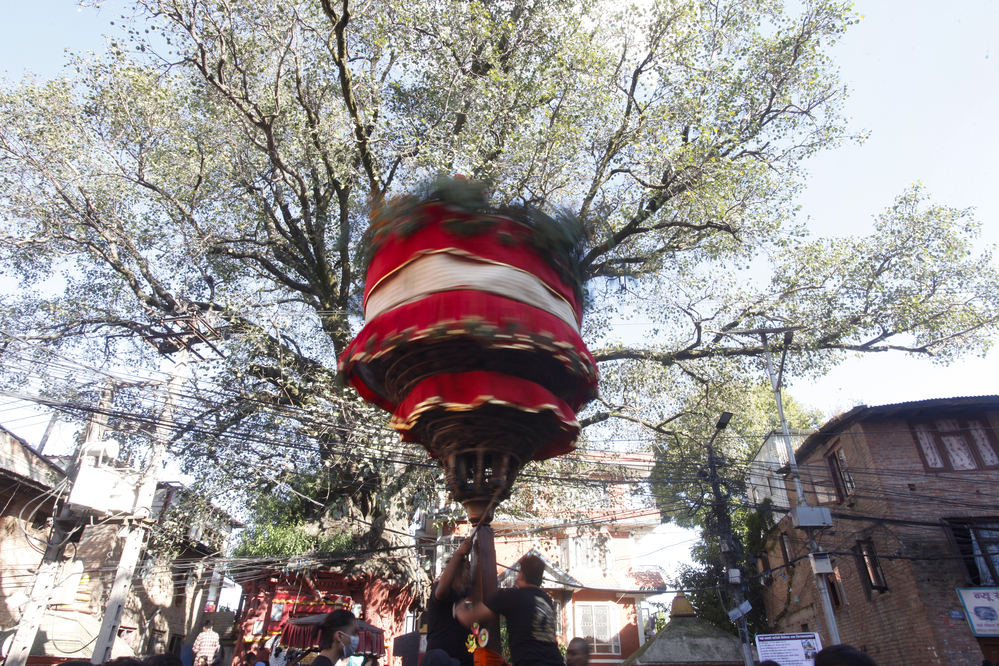
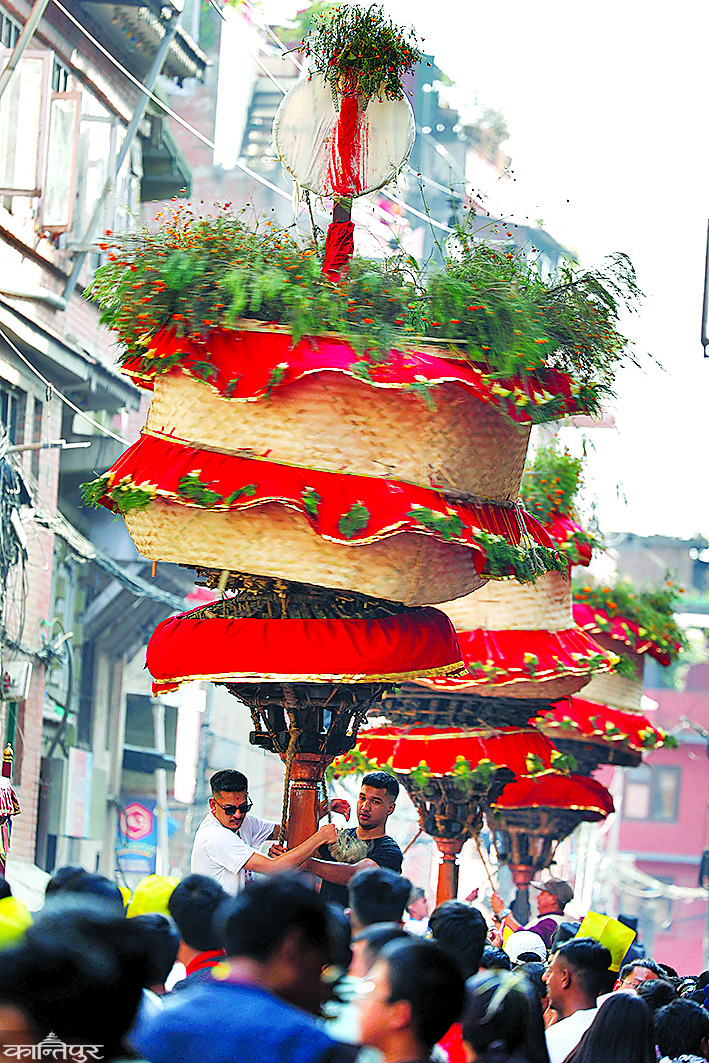
Handigaon's jewelry store remains calm throughout the year. However, on the seventh day of Baisakh, chariots come, flutes are played and the banks of the pond are colored by crowds of people.
We use Google Cloud Translation Services. Google requires we provide the following disclaimer relating to use of this service:
This service may contain translations powered by Google. Google disclaims all warranties related to the translations, expressed or implied, including any warranties of accuracy, reliability, and any implied warranties of merchantability, fitness for a particular purpose, and noninfringement.
In the popular tongue, 'Handigaon' always carries one word - a pilgrimage to nowhere. According to cultural experts, this proverb was born in ancient times to refer to the pilgrimage that has been going on in Hadigaon for two thousand years. Time has played a big role in these two thousand years. Settlements changed, eras changed and pilgrims came and went by the millions. But, the proverb? It has been living in exactly the same form as Raithane.
The grand entrance of the erstwhile capital, the ancient pillars and the stone paths which were considered the heritage of this settlement, all became non-existent. And also, Handigaon's 'Nowhere's Pilgrimage' continues in the new year. In a way, the Jatra of Handigaon is the memory of that time, which has re-published the thousand-year-old city-expression.
Therefore, ``Kahin Nai Jatra Handigaon Ma'' is not only a proverb, but it is also a mantra to remember that ancient city, which weaves history and myth into a single thread and dwells in people's throats.
It seems that time has left immortal stories in the streets of Handigaon. This is the story - of Bhat and Bhateni, of their faith, of sorrow and of the heartbreaking moment when their child was blown away by chills. This story is also about the gold stick that was lost on the banks of Gahanapokhari, about Harguhar that reached Tundal Devi's lap. And, yes – the mystery of the journey to search for jewels that has been going on since Lichchavikal. It seems, no matter how much Handigaon changes its appearance, this story will live on, no matter what age comes and no matter what storms shake it.
If you have been to Handigaon, you must have seen a peaceful pond. Its name is Gahanapokhari, which is also called the heart of Handigaon. The pond remains serene with the serene reflection of the sky throughout the year. However, on the seventh day of Baisakh, the pond is moved with great festivities. Here chariots come, flutes play and crowds of people paint the banks of the lake. This is the day to look for jewels. This is the day the lost gold returns. This is the day to wake up a dead child! Isn't it fun? Is there such a procession anywhere beyond Hadigaon?
Standing on the edge of the pond, it seems that not only its water, but also the story carries depth. In this story of Lichchavikal, the king's inscription is also found, where he said to his raitis, "Celebrate the festival, give a thousand panas, offer odd clothes and ornaments and take twenty copper jugs." However, the life of this story is not only in the inscription, but in the tears of two ancient couples, Bhat and Bhateni. His mind is in a fog. It is in her child's smile, which was blown away by the chill, but returned by Tundaladevi. Blessed Tundal Devi !
The story says – long ago in a corner of Handigaon, in a small mud hut, a couple named Bhat and Bhateni lived. They were Brahmins, but poverty made their lives hard. He had verses of the Vedas in his hand, but no grain in his stomach. He had faith in his heart, but there was no happiness in his life.
Bhat's eyes always had a dream of prosperity and happiness. And he used to say to Bhateni, 'Our faith will one day make us dry.' Hearing this, Bhateni would probably smile and the hut would light up with her glow. And she used to ask Bhat with a bit of sarcasm, 'Okay, it will be dry later, but what will our stomach eat today?' Every day they went to the temple of Tundal Devi and prayed. Bhateni was Tundal Devi's daughter, who kept her head on her mother's lap and said, 'Mother, why are we so sad?'Tundal Devi's statue reflected compassion, but she remained silent in her words.
One day, a rich Mahajan came to his hut. On his face was the enthusiasm of the pilgrimage, but in his heart he was worried about his wealth. He sold all his wealth and bought gold and hid the gold in a wooden stick. He entrusted the stick to Bhat and Bhateni and said, 'My wealth is in your faith. I will take it when I return from the pilgrimage.'
Bhat and Bhateni kept the stick in the corner of the hut, as if it was a symbol of their faith. Mahajan went to the pilgrimage and time began to flow in Handigaon. Years passed. It has been eleven years since Mahajan passed away. There was a small hope in Bhat and Bhateni's life – their child was born. The baby's first cry in the little hut lit up her heart. However, poverty did not leave him. There was no money to rub oil on the child, no food to feed the baby. Bhateni used to cry looking at the child's stubborn face. In Bhat's mind, the battle of faith and necessity was going on. One night he said to Bhateni, 'Mahajan has been gone for eleven years. He probably won't come back. Let us save the child by selling the gold of this stick.'
She asked, 'What about our Iman?' Bhat lowered his eyes and said, 'Iman did not save us, but this gold can save our child.' So, they took out the gold from the stick. His hands were shaking, as if the soul was leaving him. But the child's smile comforted her. They sold gold and anointed the child with oil. Color came to the child's face for the first time. And, because the pine of faith fell from his face, it was fug.
But what a game of luck! Exactly in the twelfth year, Mahajan returned. He had the peace of a pilgrim on his face, but the lust of his wealth in his eyes. He asked Bhat and Bhateni, "Where is my stick?" Where is my gold?' Bhat's heart was heavy. He tried to lie, 'The stick was eaten by worms.'
Mahajan turned red with anger. He screamed and cursed, 'May the chill eat your child'. At that moment, their child, who was lying in the sun covered with oil, was stung by a hailstorm from the sky. Bhateni screamed, Bhat cried. His world turned dark.
Mahajan stood and looked and angrily said, 'You have broken my trust. Your faith was false. Now you will never be able to set foot on the earth.' Bhat and Bhateni, after losing the child, were cursed by Mahajan. A fire of repentance burned in their hearts. They ran towards Tundal Devi's temple, where Bhateni's mother lived.
Bhateni put her head on her mother's lap and cried and said, 'Mother, our child is gone. Our faith is gone. What happened to us?'
Tundal Devi said, 'My daughter, telling the truth is not always easy. But only the truth will set you free.” She suggested, “Tell Mahajan, the gold is lost. I will return that jewel.' Bhateni and Bhat went to Mahajan after Tundal Devi's suggestion. They said, 'We made a mistake. The gold was actually lost. But, Tundal Devi will return it. Mahajan did not believe, but the name of Tundal Devi brought peace to his heart. He said, 'Okay, I will forgive you if the jewel is returned.' But, without saying it, the jewel was found in the pond. Blessed Tundal Devi !
And, Bhat-Bhateni was freed from Mahajan's curse. And her child got a new life.
In memory of this story, chariots are pulled across the pond every year and jewels are searched for. That is why the pond is called the jewel pond. How was the first year of Jatra? What can be guessed is that on the seventh day of Baisakh, the chariots arrived at Gahanapokhari. Bhat, an idol of Bhateni and her child, brought from the temple of Tundal Devi. He was stripped of his clothes, dyed and carried to the temple of Tundal Devi as a dead body was played. In the temple of Tundaladevi, Bhat and Bhateni were suspended in the sky, as if Mahajana's curse had kept them from the earth. He was presented with ornaments and clothes.
The people of Handigaon went to Kharpan carrying twenty copper pots to worship Tundal Devi. And, they prayed, 'O Tundal Devi, return our jewels. Save our child.'Then the chariots were brought to the jewel. Chariots raced across the pond. A wave of water touched the chariot and the people shouted, 'Jewelry found!' The chariot returned to the temple. A statue of a child was decorated. The child woke up. Bhat and Bhateni's tears mixed with smiles!
Thus a story and a journey ends here. However, this Jatra is not just a story of chariots and ornaments, it is a story of faith, a story of repentance, a story of forgiveness. If there is no faith, if there is no repentance after it is gone, and if no one forgives even after repentance, how cruel and cursed is life? Our ancestors may have put this story to tell this deep vision. This is the glory of Sanskrit, that philosophy and mysticism brings together everyone once a year by giving celebration, color and music to life. Like, the Jatra of Handigaon is still doing.
According to cultural experts, Handigaon was called Andipring during the Kirant period and Andigram during the Lichchavi period. This name has been corrupted and became the current Handigaon! Whatever the case, this is not just a mud and stone village. It is a village of stories. It is a village of pilgrims. And yes, a village of faith and hope.
Standing on the banks of the jewel pond, when the chariot collides, it seems that this is not just a battle of chariots, it is a battle of life, a battle of faith and greed, a battle of regret and forgiveness. What a profound symbol the Jatra of Handigaon carries! Where does the Arugaon Jatra carry such a symbol?
Bhat and Bhateni, they are not just characters in the story. They are the conflict of every human mind. With one heart we are honest, with one heart we are greedy. With one mind we sin and with the other we repent. So Bhat and Bhateni's mistake is our mistake. Their repentance is our repentance. Their children, are our hope. Tundal Devi is not just a goddess, she is the compassion of our heart, a mother's bosom, who forgives us even when we make mistakes.

