Nepali society always has the same reaction to rap-language and rapper's clothing - wasted, destroyed! For 'Bhaladami', who seeks decency and sanskar in lyrics, rap is just a 'bunch of obscene words that are ruining society'. In order to preserve civilization, the state is moving forward to not want the stick.
We use Google Cloud Translation Services. Google requires we provide the following disclaimer relating to use of this service:
This service may contain translations powered by Google. Google disclaims all warranties related to the translations, expressed or implied, including any warranties of accuracy, reliability, and any implied warranties of merchantability, fitness for a particular purpose, and noninfringement.
Not only the 'civilized', 'honest' and 'decent' people of the society, sometimes the authorities are also 'dissing' rappers and arresting 'Vhiten' on the charge of using 'slang'. The state does not understand - 'Slang' is the jewel of rap all over the world. However, rap can have its limits – word usage and message.
Music-Sampada Rap is being loved by youth-Laskar. However, the state and 'Bhaladami' society hate! The state is a system designed to subvert, subjugate, and oppress the rapper. This is the truth of this time.
It is not uncommon for a rapper to be arrested if he is involved in criminal activities and his work causes hatred in society. However, being caught for singing a rap song is a crime committed by the state against him. The rapper should also understand - he is a hero who speaks against discrimination, inequality and injustice in society! And, low-literature, 'non-creative' music will work at times to produce the best rap, but it won't last.
In a society full of discrimination, injustice and inequality, not only rappers, but also artists and poets are rebels. He has given his life in the name of rap and freedom.
Hip-hop, born in the 1970s in the dark alleys of the Bronx County in New York, was hit with the greatest blow of 'obscenity' since its birth. But he stood firm against poverty, injustice and discrimination. What happened if the government opposes, hates the "respectable" people of the society? It is extremely popular among a large number of young people - rap! Let's take a look at the song 'Hami Ishta Ta Ho Ni Bro' by Jagal Bhiten, which has garnered 3.5 million views on YouTube –
I smoke a lot, drink a lot,
Thirathari Khaire I meet, international hubby
I have fun drinking alcohol inside the police station,
I gave crores of loans to Shah Rukh Khan A
rapper stands out from the crowd. The street where he grew up, Bhirpakha, friendship and enmity, association and influence, social and political rap stories. For 'good social beings' who seek decency, decency and culture in those songs, rap is just 'a pile of obscenities that are ruining society'.
They are often found rapping and rapping the rapper, rapping the lyrics. As the language, style and form of presentation of rap is in the West, the same style is reflected in Nepal. Nepali society always has the same reaction about rap language, rapper's 'Langfang' clothing - wasted, ruined, they spoiled the society.... "Street-singer" Viten has effectively questioned those "decent" people through the song - "What is the benefit of spoiling the society that has deteriorated?"
A masterpiece film has been made on the life-story of the rapper - 'Galli Boy'. The main question of the film is - How does the society view the rapper? Does society accept him? This is not a fictional story, but a film about the lives of street rappers Devine and Nazi. At the heart of the film is a series of tensions, father-son conflict, caste-class inequality and social disdain, which are added to the house when Murad Ahmed, the son of a poor father, starts singing rap!
Why is rap 'obscene' in society's eyes for 5 decades? Is the color of the wrap just funny? Is there a mix of serious social consciousness in it or not? What is Nepali society's view of rap? That view should be changed now or not?
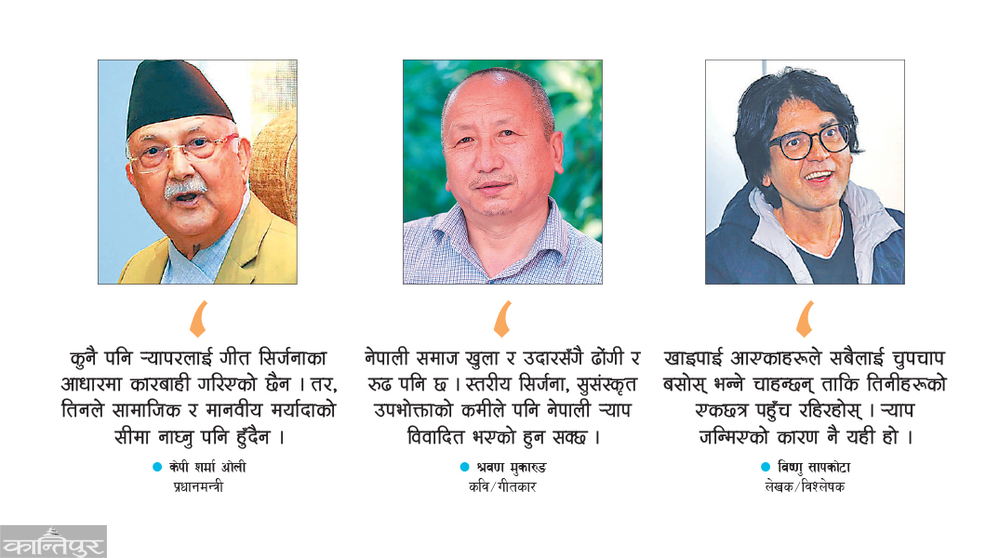
Prime Minister KP Sharma Oli said on Thursday with 'Kantipur' about rap-songs, 'No rapper has been prosecuted on the basis of song-creation, it should not be done. However, he should not exceed the limits of social and human dignity, he should be aware of this. I appreciate the interest of today's generation in music, so I meet them, listen to them. May their creations also be timeless, not ugly, be alive even after a hundred years.'
In Oli's opinion, the creator himself should understand the difference between beauty and obscenity. "Beauty gives cool entertainment to the society, makes it happy, obscenity leads to excitement, lack of conscience and valuelessness," Oli said, "Our culture is based on the welfare of all, the well-being of all." Creations should focus on this. Blasphemy, censure does not live forever, only conscience lives forever. I look at beauty and wisdom in music.'' Even though the Prime Minister said that 'rapper has not been prosecuted on the basis of song-creation', intellectuals and rap connoisseurs are saddened that the state arrested the rapper on the basis of singing.
The rappers have sung the autobiography of the beauty of life and dear life. In that 'Rhythm and Poetry' he has filled the inner energy of life. The song says – there is more pain in life than joy. People have their own stories. They are bitter, but also sweet. That is within the story – many plots of tears, laughter, pain and joy. Six – enthusiasm and motivation, satisfaction and dissatisfaction.
The real connoisseur of rap is Jen-G, who made the rap-singer Balen a celebrity, winning the mayor of the capital city. Writer/analyst Vishnu Sapkota's insight into rappers, ballen and rap is unique. Let's delve into his rap experience.
He grew up in a society where one must be "wise and knowledgeable" to be "successful". In his youth, those who did 'disco' or 'break dance' belonged to the degenerate group. When many years after his youth, Vishnu was attracted to an unknown rap, he felt that he was spoiled. And, by the time of 'breakdown', his son had already become a 'teenager'. He thinks that there is no limit to the time of 'deterioration'. Then he came to the conclusion - I have been forced to suppress my interests by the social pressure of becoming a 'Bhaladami'.
Society's saying 'Be Bhaladami' means 'keep quiet and accept what is, don't be a rebel'. "Bhaladami society does not like rappers. The thing called the state is occupied by such tyrants. The group that came to Khaipai, who want to keep quiet about whatever 'established' rules they have. So that they can continue to reach each other," says Vishnu, "This is the reason why rap was born. That's why the state doesn't like rappers. I don't consider myself a rapper, I like rappers.'
When the votes of the Kathmandu mayor were being counted, Vishnu also sang a rap full of excitement, for the first time in his life - in the scene where he went to address the staff for the first time after winning the election! As an unpublished writer, he became a rapper in-house. Vishnu's son has been living in New York for some years. There is also a possibility of a rapper (Zohran Mamdani) being the mayor next November. He is thinking - at that time, the mayor of the city of both of us, father and son, will be a rapper.
Balen He still feels a 'mystery'. "How boring, how dull the former Vidyasundar was. As much as Balen has done/tried to do, well done. Sometimes they get bored, they get bored. I find the perpetually flamboyant to be more dangerous. Because man is not like that by nature,' says Vishnu.
People who are only interested in old music say, 'Rappers spoil the song.' Vishnu's question and suggestion to him is - is music your personal property brought to you when you were born and others spoil it? As your music is 'music' to you, so is his music to the rapper.
The rhythm of life is not only one, but its music is many. That's why there are other genres of music in society, including rap. Poet Shravan Mukarung believes that rap music is a rebellious or liberated style, so the state finds its presentation uncomfortable. Shravan understands that democracy will be strengthened only if the state protects the freedom of expression of artists.
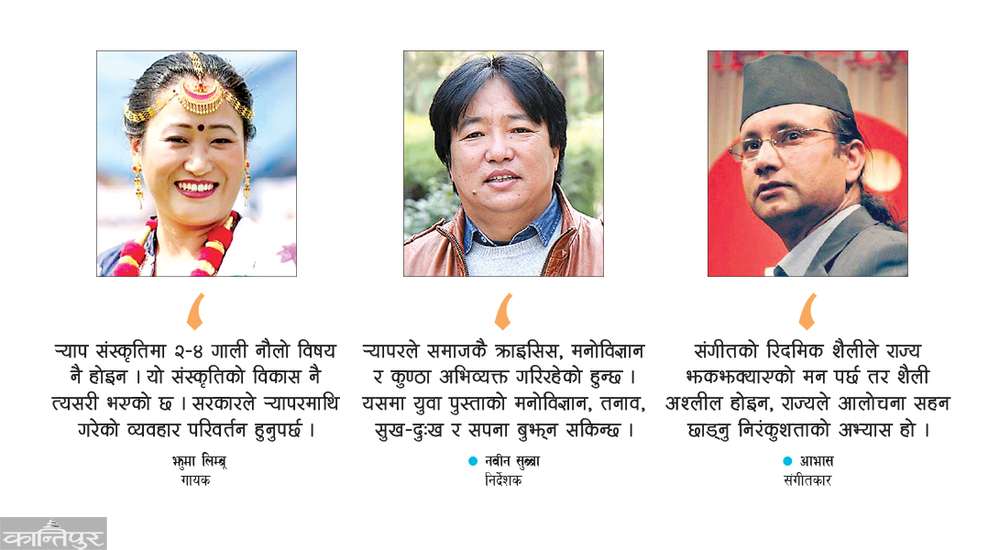
"In Nepali society, this style of music is not connected to any campaign or issue, but as fashion or entertainment, it is natural that the society is divided in terms of assimilating it," Mukarung says, "Nepali society is as open and liberal as it is hypocritical and rigid." Therefore, sometimes unusual circumstances may arise in its presentation. And, due to the lack of quality creation and cultured consumers, Nepali rap music may have been controversial many times.'' Rap is also a style that brings out the various aspects of society in a rhythmic way. Raithane music activist, singer/composer Jhuma Limbu opines that rap is not exactly a song. There is a lot of anger expressed in rap, good things are also expressed. Two or four slurs are not new in rap culture, they are common. This is how this culture has developed. Without understanding rap culture, the behavior of the government towards rappers should be changed, rappers are creative people,' says Jhuma.
If the rapper is to be jailed because of his 'lyrics', the police will come even on double evenings, says Jhuma. Why? "There is no more dirty talk in doubles", she says, "In double songs, jokes are going on, society calls the word dirty, that's natural. That's why rap is taken in the same way.'
A distinctive part of hip-hop culture, rap includes heavy rhyming and word games. Flow, the rhythm between words and melody, is the lifeblood of rap. Beat, bar, hook, verse, diss, free-style, punch line, twist are its components. And, rhyming, rhythm, spoken language are the life of rap.
Lyrics/music and literature essayist, critic and music-addict Rajkumar Baniyan believes that rap is the 'compelling art of storytelling'. It is a popular style of music that binds the audience emotionally. It should come from the heart's poetic expression, there is no place for abstraction, incompleteness or artificiality,' says Baniyan, 'therefore, it can break the boundaries of perceived social discipline. However, the Nepalese people do not have general literacy about hip-hop music, i.e. rap, and are unaware of the magical world of rappers.'
Baniyan is saddened by the state's suffering and arrest of the hip-hop singer. This is oppressed music. Some of its words are considered obscene and muted. Rappers are not criminals, gangsters are not Nike. But, the chaotic and rebellious are definitely. Therefore, considering rap as anti-social is short-sighted,' Baniyan thinks. In the experience of
rapper Nijhan Shrestha, youth ranks treat and respect rappers like a musician or a conscious singer. They say, "People have loved me and my songs." However, Vitain is upset with the authorities who arrested him for singing the song and showed him the behavior of a "criminal". Witten's question is, "Is singing a song a crime in Nepali society?"
film director Naveen Subba thinks - the understanding of rap in Nepali society is wrong and those who consider rap as not serious, frivolous and low-key have a strong voice. In rap, the rapper is expressing the crisis, psychology and frustration of the society.
Therefore, if rap can be understood carefully, then one can understand the psychology, stress, joys and sorrows and dreams of the young generation. We think of rap songs as loose, we put singers in jail, so where do we end up?'
Actually, rappers who are looking for freedom from tradition, status quo and many constraints of life or choosing freedom and self-determination sing the story of a society bound by inconsistent slavery in their songs. Rappers who stand against traditional beliefs and against the ugliness of society are rebellion-images, who are telling society - there is no need for compromise here.
is recorded in the pages of history – the rhythmic-poetic language of rap used in protest marches in African and Western countries, which is still practiced. Therefore, arresting the 'Vidroh-Vimba' rapper, giving pain is not because of his musical style, but because of his harsh criticism, he says, the state is being destroyed - Musician Abhas. Our rappers also criticize the state in their own style. I like the rhythmic style of music and slogans to challenge the state, but I say that the style of protest should be poetic, not obscene," says Abhas, "The state's failure to tolerate criticism is an exercise in autocracy. If our state is giving pain to rappers and other critics, we should understand that the state is becoming despotic.
is the content of people's dreams, happiness, sadness, pain, health, faith-disbelief and the truth they have found in rap-rhythm. A person's 'truth' and 'belief' may not always remain the same. A rapper's drum and bass-beat backing track echoes his banter. That is a tune – a musical para/vaka sung to the rhythm of a drum-beat, dhang-dhang, dhang-dhang, with alliteration in front, back or in between. It became a rallying cry and the gangsters also marched on Para.
Rap's 'dis' is more popular in Nepal, says anthropologist Dumbar Chemjong. Rapper Vitain made the police an opponent after the police gave him trouble. The rap is "dis". Adopting the wrap style, a spectacle and the end, there was still the Nepali gossip rags, "says Comzng. & Nbsp; In the shlok of the rap of the rap, the rap of the rap, the rap of rap, and eat fluid potatoes, the inside of Peda is also heard of the skin. In playing a Gurung-Rodi in Nepal, "Why is the bridegroom 'of alcohol, why?' Cemjong says that Nepali wrap says. & Nbsp;
Nepalis is also associated with the asset to which eyes look at the rape. Like Youth Mannagar is in Rapa-Flood, the Old generations are not liable (in a negative level). "I see that the old generation seems to be a ramatic eye," says Cymjong, "Cymjong is a negative and not to assimilating the fact that the rape has negatively looked negatively. When the Nepali generation of old generations were enjoying his own wrap in his own. '& NBSP;
is understanding of these omnipresents, pioneers and changes. 'Because change makes them overturned. The state causes a physical dishes, Vitten rapaly dishes. Informed domestic overseers do, which a new generation makes a hypper. The character and nature of the state is all the same. '& NBSP;
is a single vowel of social size, volume and sensation - wrap. Yes, the flight and faith of emotion, wherever it is found - Jeijibhaism for life. However, education and education policy involve in education, education, education, education and education policy does not understand important contribution to music, art, and literature in life. Most of the society remains to be understood.
shikar, music Analyst Biplav Association is always fans of good music - whether it wrath, scrowny or Nepali modern music! 'None of the music and any form of music and art is not right to accept or refuse. We need to respect and accept everything that comes into existence in the world, "says what everyone should remember is that the rap is not easy. It is not possible to sing for the basic knowledge of music and the basic knowledge they are singing. '& NBSP; In view of the
symbol, Nepalis understand music in their own strength, they are incorn in musical matters and 'Christian Analysis' can do. 'Because most Nepali is not given to this Nepalese, nor in the country, says no sign, "says Nepali modern music, and Nbsp; thinks of Nepali modern music; think of itself. And, if anyone is heard that it is not a rebel on it when presenting them in a little aggression. '& Nbsp; Every raps of society is standing in the eyes of society as a poem-BREAK song is standing in the eyes of the society - surrounded by the guys of questions. His geography and canvas are really different. They are well heard and are on the edge. If the wrap is to keep singing, it is a mirror of those-psychology. Giving specific message to society is the rap, where society is a reflection. The wrap and the society should go to the parallel line, at some point it is harmful to both the branches.

