The rule of Sri 3 fell in 1951, but the tiger-rhino hunting did not stop, King Tribhuvan's son Mahendra was also fond of hunting like Sri 3, he used to hunt extensively, hunting was transferred from the Rana to the King.
We use Google Cloud Translation Services. Google requires we provide the following disclaimer relating to use of this service:
This service may contain translations powered by Google. Google disclaims all warranties related to the translations, expressed or implied, including any warranties of accuracy, reliability, and any implied warranties of merchantability, fitness for a particular purpose, and noninfringement.
Early nineteenth century. When the hottest 50 days of Meenpachas begin, the palace of Shri 3 Maharaj in Kathmandu suddenly gets busy. The people of Kathmandu were making arrangements to survive the winter, while the palace staff were busy preparing for the Maharaja's journey to the south. In the lowlands, the malaria-carrying mosquitoes became thinner with the falling temperature.
When the activity of mosquitoes slowed down, the Maharaja would wake up and begin – the grand hunt or the slaughter of tigers. As the mosquitoes disappeared and the temperature dropped, the tiger-rhino season was approaching. At that time, the Salka forest was entered by the guns of the Maharajas and the movement of elephants. Hundreds of elephants were prepared, hundreds of mahouts and thousands of helpers. Shri 3 Maharaj Jung Bahadur Rana started such a grand pilgrimage.
This kind of tiger slaughtering has been going on in neighboring India for a long time. India was under British rule and in Nepal it was under the rule of the Rana. The British were strengthening the rule by fighting the kings and maharajas of different states of India against each other.
The kings/maharajas of the small kingdoms competed to see who would be closest to the Nike of British rule. They were fond of hunting and occasionally invited British Nikes to hunt. Although British nymphs hunted regularly, most were occasional hunters.
Humans have been hunting for food for thousands of years, but the extreme form of hunting for beauty and dignity was seen when Britain started occupying different countries of the world. The British first occupied the countries of Asia and Africa, then they killed many wild animals by extensive hunting, tiger-rhinoceros were their victims.
The level of hunting was severe, and the British Lord Ripon, who became the Viceroy of India from 1880 to 1884, killed 556,813 animals at different stages of his life, including nine tigers and two rhinoceroses that were killed at the invitation of the Ranas in Nepal. In India, there used to be a bet on which Maharaja would hunt more.
Learning from there, Shree 3 Maharaj started going on a long hunting trip every year in Nepal as well. The kings and maharajas used to hunt for fun, but from the time of Jung Bahadur, the Ranas made hunting compulsory during Meenpachas. It was established as a tradition.
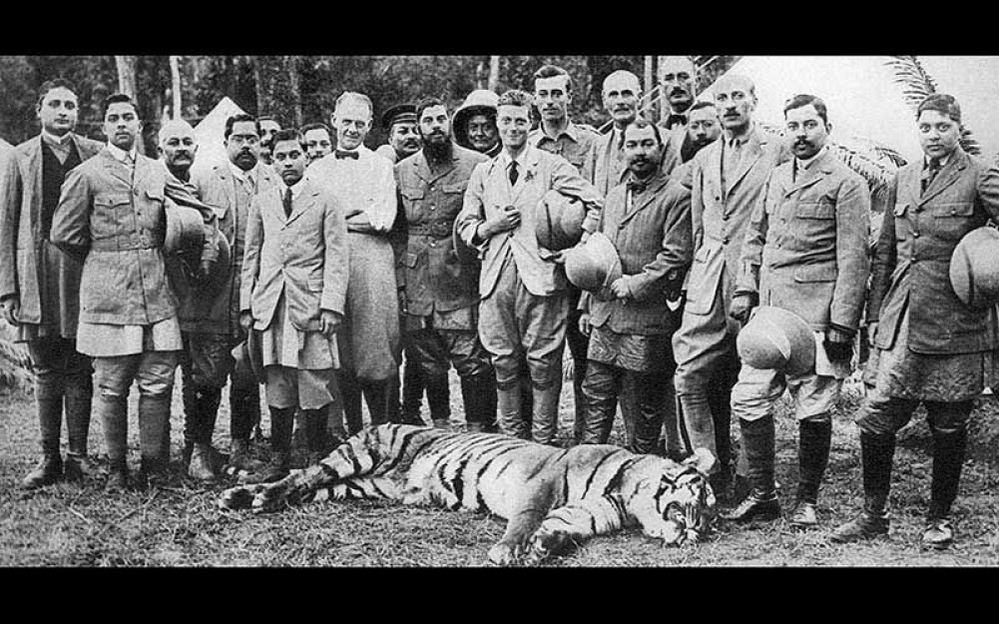
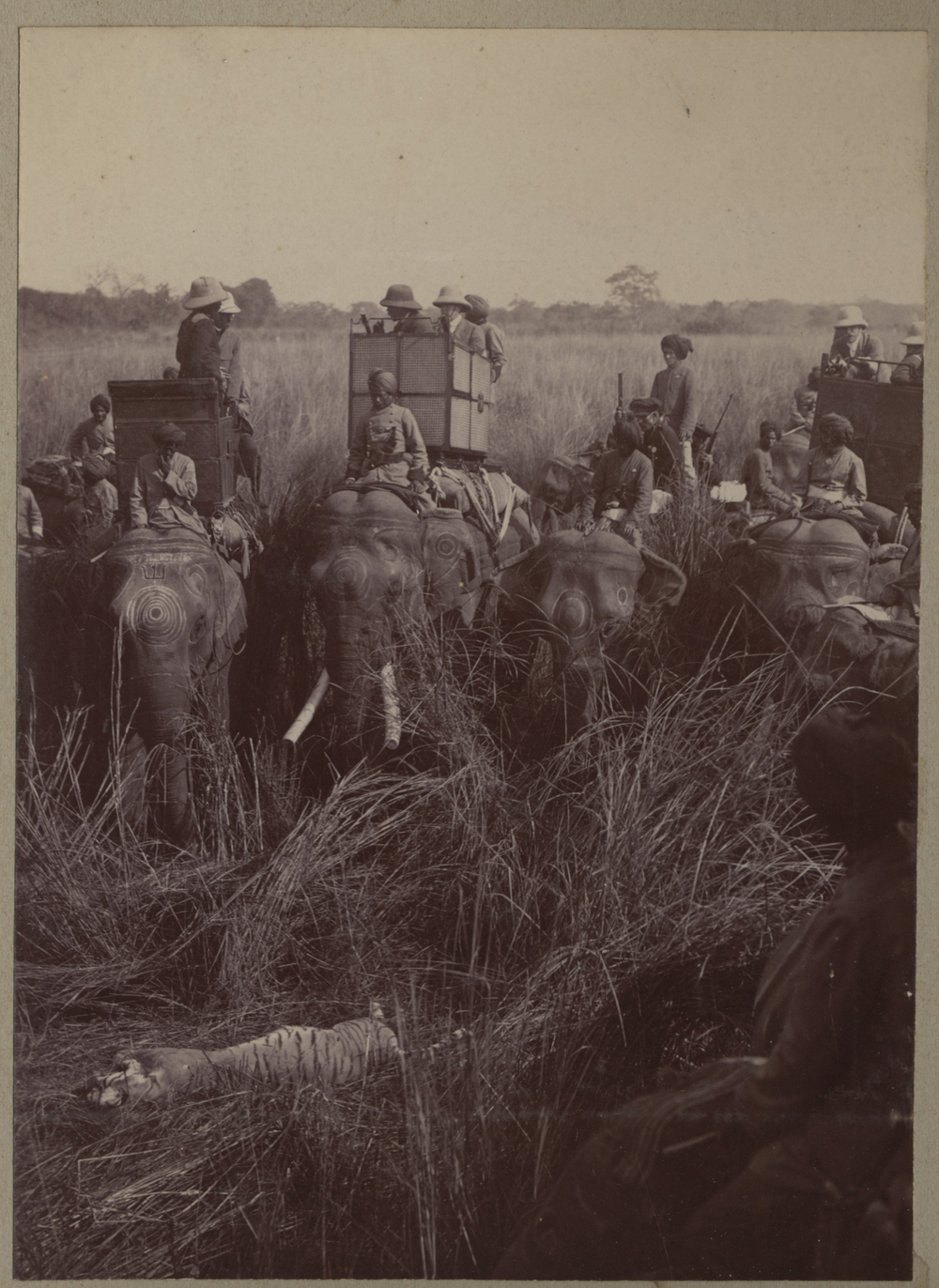 George V's hunting team.
Born in 1817, Jung Bahadur ruled Nepal from 1846 to 1877. Jung Bahadur, who had little interest in bookish knowledge, loved everything that involved physical activity – from sports to hunting. Every year during Meenpachas, Jung Bahadur alone killed more than 400 tigers in 31 Meenpachas.
Even before that, kings/maharajas used to go out to hunt for prey, but Jung Bahadur started a new practice i.e. killing the hunted prey as quickly as possible. This greatly increased the number of animals killed. He introduced a rule called 'Nepali Ghera' in hunting. What was done in Junge's law was that a pado or rope was taken to a place where a tiger had previously been and tied, due to which the tiger was attracted.
Then more than 300 elephants would form a circle around a two kilometer area. Little by little, the elephants would narrow the circle and the tigers inside the circle would disappear. Maharajas riding on hunting elephants used to kill the tigers inside the enclosure. It is said that up to 6 tigers were found in some enclosures. It was called hunting party.
In 1876, Jung Bahadur invited Prince of Wales Edward VII of Britain to hunt a tiger in Shuklaphanta, West Nepal. In 1911, Edward's son George V went on a week-long hunting trip to Chitwan, during the reign of Chandrashamsher. After 10 years in 1921, George's son Idarwad also hunted in Chitwan during Chandrashamsher's time.
Chitwan Khas was the capital of hunting. The grandest of these hunting expeditions was that of George V, in 1911. George V was crowned emperor of India in Delhi and entered Nepal to hunt. However, on the same day, King Prithvi Birvikram Shah of Nepal died. Shri 3 Maharaj Chandrashamsher decided not to stop the hunting trip of the British king even if the king died.
December 18, 1911 ie a day of Meenpachas! George was accompanied by Babarshamsher, the son of Chandrashamsher, who went hunting in a car on a 13-mile long road made for his visit from the camp at Vikana in Thori. The visit of the King who arrived at the south bank of the Rapti at 5:30 in the evening is written in the field notes of that time archived at the University of Cambridge.
600 elephants, 12000 porters and 2000 servants were used for that hunting trip. On the way the king killed two tigers, which were surrounded by a herd of elephants for their prey. Then, after a motor-journey of 19 miles, Lord Duhram killed a tiger and a rhinoceros, King George two rhinoceroses, and Lord Annaly one rhinoceros. After killing three tigers and three rhinoceroses, they moved to breakfast,' says the research paper printed by Kiis Rookmakar based on the paper of the university.
On Wednesday, December 20, fences were placed in places to attract tigers. Three teams were deployed, two teams for tigers, one for rhinos. The king killed a maiden trapped inside the first circle. In the second enclosure was a rhinoceros and her baby. The rhinoceros started attacking the elephants that surrounded him and managed to break the cordon and escape. In the third circle there were at least four tigers, who were roaring as if their hearts were being pierced.
Those tigers were also attacking the elephants while the mahouts were screaming. At that moment, King George raised his gun and killed four tigers. George's team killed 39 tigers, 18 rhinoceroses and four bears during their 11-day stay. Similarly, in another hunting trip in 1939, 120 tigers were killed at once, while in 1850, Jung Bahadur Rana alone killed 31 tigers in one hunting trip in Chitwan.
Maharaja Juddhashamsher alone killed 433 tigers in the seven years between 1933 and 1940, which is more than the total number of tigers in Nepal today. A series of tiger killings was worse in India than in Nepal. Between 1930 and 1955, the Maharaja of Udaipur, 250 miles south of Jaipur in India, killed 1,000 tigers, while the Maharaja of Surguja in central India killed 1,710 tigers during the same period.
On the one hand, the kings and maharajas were hunting tigers and rhinos. On the other hand, rich people in western countries also spend money in different countries of the world to go hunting and return with animals, i.e. collecting hunting trophies.
s were on the rise, especially after the First World War. A white man who started a company to do such work used to do some special hunting trips in Nepal even during the royal regime. American hunter Charles Cotter was the first white man to hunt wild game for money. In a study by history scholar Mark Leachy, he wrote, Kotar came to East Africa in 1910 during the British rule.
He founded the Cortes Safari Service in 1919, in Africa, with the aim of attracting rich American white hunters. After that, Kotar came to Nepal and developed friendship with the then Rana-Maharajas. Litchi's study states that the Maharaja even provided a palace for the use of the hunting clients of Kotar. In 1922, Kaishar Shamsher Rana paid Rs. 35,000, i.e. 12,600 dollars at that time, two rhinos were sold to a zoo in America. In this way, the Ranas learned from rich American white hunters to earn coins by hunting on safari.
Sri 3's rule fell in 1951, but the tiger-rhinoceros hunt did not stop. King Tribhuvan died in 1955 within four years of democracy. His son Mahendra became the king of Nepal. He imposed the panchayat system by massaging democracy. Mahendra was also fond of hunting like Mr. 3, he used to hunt extensively. The prey had shifted from Rana to Raja.
On the one hand, the kings-maharajas were hunting, on the other hand, the business of hunting the American whites, who were getting rich in the economy after the Second World War, was becoming widespread. He was doing business by opening a company that hunts big animals like tigers, rhinos, and lions from Africa and Asia. The number of whites also increased in Nepal. As the British were leaving, the arrival of the Americans also began to decline. The Rana were killed, but the hunting spirit was still there. Although not directly in power, they were around the king.
After Kotar's hunting safari, others did not run the hunting business in Nepal. However, when the Ranas left and the Shahs came, two fair men entered Chitwan for a hunting safari, especially under the auspices of Mahendra and his brother Bashundhara. They were white – American John Copeman and Iris Peter Warren. Mahendra was a fan of Koopman and Bashundhara's favorite character was Peter.
Mahendra opened the Royal Nepal Sikar Company in Nepal in 1958 within three years of becoming king. Before Koopman, Peter had obtained a hunting license on Bashundhara's orders - in 1953. Koopman said that in the 1960s, two wealthy American businessmen, Herv Klein and Toddy Le Wine, were brought to Nepal. Both merchants were fond of hunting. They opened the first hunting lodge in Chitwan – Tiger Tops.
The grandest hunting-ride after the Ranas was carried out by Mahendra, in Chitwan. He also organized a program to hunt the Queen of Britain in Nepal. Chitwan was decorated magnificently again. George V's granddaughter, Queen Elizabeth II, arrived 50 years after he killed the tiger. First, only the road was built, but the Nepalese army built a 4,000 feet long ship runway for Queen Elizabeth in Meghauli, within a month. Thousands of people were put to work, working day and night. Army, staff, police were all involved.
A settlement of camping and hunting tents was prepared in an area of two square miles within a month. The ground was made by laying the ground. A road was built to connect Meghauli from Bharatpur. 376 elephants were deployed in the Chitwan forest to hunt that tiger, which formed a two-mile long queue. Six elephants were used as a bar during hunting trips, where wine and beer were served to Queen Elizabeth and King Mahendra's entourage. However, even though she participated in the hunting program, the queen did not hunt.
In Western countries including Britain, there was protest against the killing of animals such as tigers and rhinos. However, Elizabeth could not refuse King Mahendra's request for a grand hunting trip, nor did she want to hunt. Elizabeth's husband, Prince Philip, put a bandage on his trigger finger to pretend he could not hunt King Mahendra. The animal was then killed by other members of his hunting team. In this way, activists and media began to protest against the infatuation of kings and maharajas in the Baghmara Campaign all over the world. Elizabeth and Philip also participated in that campaign. British newspapers wrote, "The Queen enjoyed the safari with a camera, not a gun."
Mahendra had also recently returned from a conference organized in Switzerland by organizations campaigning to protect tigers and rhinos. The British royal family participated in it. Mahendra also understood their distaste and gradually wildlife conservation campaign started in Nepal as well. However, Mahendra passed away in 1972 while on a hunting trip in Chitwan. After his death, tiger-rhinoceros hunting was banned in Nepal. The victim stopped being persistent. One year after Mahendra's death, i.e. in 1973, Nepal established the first national park, Chitwan National Park. From there the journey of 'Tiger killing not tiger watching' started.
Jungle Safari moved from the barrel of a gun to the lens of a camera. However, the maharajas used to hunt without knowing it. V.No. Even in 2035, wildlife conservationist Hemant Mishra, who was entrusted with the task of finding a male rhinoceros to offer Pitra Tarpan to King Birendra, has mentioned in his book 'A Soul of Rhino' that he got tired while identifying the sex of the rhinoceros with binoculars.
Finally the male rhinoceros he found was shot dead by King Birendra. Mishra has written, "After being taken to the camp, the organs were taken out one by one from the trunk of the rhinoceros and kept in buckets." The body of the rhinoceros was propped up with all four legs pointing towards the sky and the back resting on the ground. After worshiping the body of the rhinoceros with flower-akshata, the king entered the body of the rhinoceros. He stood inside the rhino's belly and closed both eyes. He joined both his hands full of rhinoceros blood and gave tarpan to his father.
However, later that hunting lodge in Chitwan was bought by British citizen Jim Edward in 1972 and another friend, Chuck McDougal, established it as a 'tiger killer, tiger watcher' lodge. On the one hand, the government started Chitwan as the first national park in 1973, while Tiger Tops started the work of organizing tiger viewing trips for wealthy foreigners. Safaris then moved from guns to cameras, from kings to maharajas to tourists.

