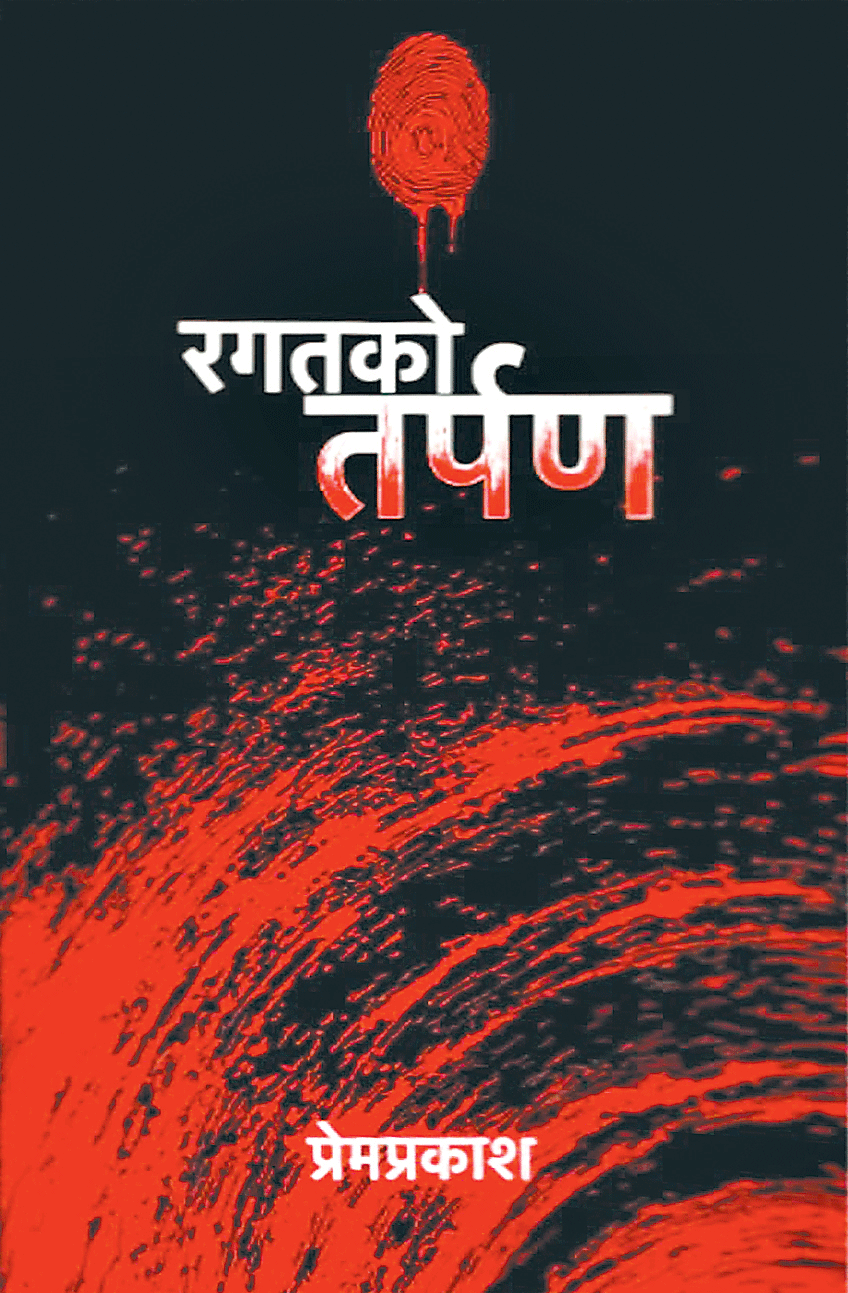
Who goes to the village dead? Who dances in the village? How is a village without people and malami a 'village'? The book takes you on a journey of reality across the country.
We use Google Cloud Translation Services. Google requires we provide the following disclaimer relating to use of this service:
This service may contain translations powered by Google. Google disclaims all warranties related to the translations, expressed or implied, including any warranties of accuracy, reliability, and any implied warranties of merchantability, fitness for a particular purpose, and noninfringement.
Poet Prem Prakash's new collection of poems - 'Ragatko Tarpan' - it is known from the memoir written on it - this is not the poet's first book. His poems and some ghazal collections in Magar Kham language have been published. Rolpa's Uwaka poet has brought all the red and hot Rolpa in the poem.
Although the title of the collection is 'Ragatko Tarpan', there is not only blood in the poem. The poems in it are divided into three sections - Some Rights Over Soil, Ever With Life, and The Grand Ruin of Feelings. Poured on the soil - the labor of mothers. Her husband and sons who left home have not yet returned. So the mother has the power and the mother is running the world.
The source of tribal consciousness is in poetry, the seed of primitive grain and thousands of years of struggle. When the state ignores the adivasis, the adivasis themselves are ashamed. Blood is the capital of poison. The capital of blood is sitting in blood, with burnt ashes on the chest, Thabang is waiting for those who leave. Six times in reverse travel. There is both hope and anxiety in the poem. Is the sinking of the Titanic of dreams? The question is - why is the blood stained black? The mountain is cold but the heat is alive within it. The dream is incomplete and I went to the airport. Suppose there is an auction of goods. Among the despair is the living culture of Bhume Puja and Chittijhyam and numerous images of Magar culture.
Poetry flows breaking the core of thought but manifests itself in the beautiful art of art. Sulalit Bimba has been filled with art. Nepal as a whole, and the Nepalese struggle, movement, desire for change, subsequent ideological ejaculation, concern about the wrong path of the movement are covered in various dimensions. Society is built by the fire of rebellion. Society is the history of class struggle. Marx gave a dialectical interpretation of social transformation.
Nepalese society has come here through many conflicts and struggles. During Lichchavi, Malla, Rana and Shah rule, there were many conflicts between the people and the ruler, 07 years, 36 years, 46 years, 52 years and 62, 63 years. As a result of this struggle, republicanism, secularism and inclusiveness are emerging in the country. It was at the peak of power repression and discrimination when the society was divided by the Civil Act of 1910. Many people, including Kavi Shyamal, accept that its foundation was shaken by the 'People's War' in the role of collection.
It is clear that there were and are honest fighters who fought against discrimination and oppression in the 'People's War'. We give examples of Che Guevara who fought in Cuba, write poems, wear t-shirts. And, we do not see Che Guevara of our country. Comrade Syaula who lost his arm in Thabang, Indra Bahadur Budha Sir with a bullet in his chest. There are no people in Rolpa who are not suffering, who are not oppressed. We sit in the capital and do big things but we cannot feel the sacrifice of Thabang.
The fight against discrimination and injustice was not for Prachanda, but for Baburam and Mohan Vaidya. The 'people's war' was fought with the heat of dreams for the common people. Hope remains and poetry has arrived. The current generation is writing what Bhupi Sherchan didn't see, what Vairagi Kaila didn't write. Prem Prakash has come with the matter of Rolpa, the matter of the Magar community. I remember the poet Ahuti. He says, he should write his own words, from his own angle, from his experience, not by others. Prem Prakash is doing just that.
has been changed to Rolpa and Thabang. Roads have been reached, buses are running, cement houses have been built. Thabang should be able to change. This is a social rule. Values, norms and social structures are constantly changing. Sometimes it is in simple lines and sometimes it is a bit complicated. In the era of extreme capitalism and globalization, its effects touch every element of society. However, change should be changed in such a way as to inspire hope, not despair.
Traveling to the flag, hearing the verdict of victory. Now the people of Thabang are disappointed. are still neglected by the state. They have reached the Gulf, Arabia and Korea for foreign employment. The entire country seems to be in a hurry. Where is the country trying to go with tears in its eyes, legs raised while shaking? If the village dies, who will go to Malami? If the village is over, who will dance? How can a village be a village without people and malami? In this way, the poem takes the reader through the country and the village on a journey of reality.
The second section is – Jeevan sem jihada bhabi and there is the poem ‘Ragatko Tarpan’. Blood means history maker. Creator of human society. Thinking that if there was no blood, the earth would exist or not. Evolutionary chronology and disorganization. There is a barn of dreams, a factory of feelings. The lamppost of dreams is burning in the dark night.
Darshan is urged not to sit in a drawer, not to sleep on paper. It is the dawn of life, the children are awake, the dream is flowing. The weight of life cannot be stopped halfway. And six, the third section – the magnificent ruins of Bhavas. Poems written from the heart. Poems of love and separation. Poems of Missing and Remembering. A poet's affection flows from the innermost part of the heart.
bunot is velvety, touching. There is the love of the desert and the love of the guerrilla. The poet is in the depths, has flown like a bird, drowned in the ocean of memory. Love is eternal, the poet keeps on wandering in that eternity. There is emotion, it is grand and somewhere in ruins. This is how the multi-dimensionality of the poem is presented within the offering of blood.
Some writers/poets are reading the Communist Manifesto upside down while trying to count Marx's door. Wondering, what is the society we understand? What is the literature, poetry we write? The line that Pablo Neruda took, Langston Hughes, Bertolt Brecht took, that is the line of poetry.
Bertolt Brecht who was born in 1898 in Germany and appeared after 1900. General and Tank's poetry, people's bread, for future generations, etc. are excellent poems. India has Avtarsingh Pass, Dhumil, Sarveshwar Dayal Saxena and Mangales Dabral. Kavita is walking the same path that Gopal Prasad Rimal, Bhupi Sherchan and Parijat walked in Nepal. Bimal Niva, Meen Bahadur Bishta, Krishnasen willing and Purnviraam, who can be forgotten by the populist world, their path is bright.
Far from reality, poetry does not lay foundation of wind in imagination. Poems have their own rhythms, dreams, thoughts, images and symbols. A poem is created by combining all of them. The journey of poetry is long. As poet Shyamal said, if you take this as your starting point and practice poetry, you will definitely make a place to be proud of in the Nepali poetry genre. When Rolpa starts writing poetry, the poetic image of rural Nepal is present.

