Who will send a letter without writing an 'email' so that it can be accessed immediately on the mobile, laptop or computer? Now the system of 'Postal Inquiry and Tracking Service' has been implemented, due to which the postal service has to pay the postage fee in advance and there is no practice of sticking stamps.
We use Google Cloud Translation Services. Google requires we provide the following disclaimer relating to use of this service:
This service may contain translations powered by Google. Google disclaims all warranties related to the translations, expressed or implied, including any warranties of accuracy, reliability, and any implied warranties of merchantability, fitness for a particular purpose, and noninfringement.
Have you sent someone a letter? If so, after putting the recipient's address in the letter-envelope, before dropping the letter in the mailbox, it must have been necessary to buy a postage stamp and wet it with saliva.
If you don't remember in life, you've never used the Postal Service, or you're a member of the "Gen G" generation who grew up after the age of electronic mail. Not both and you have sent the letter, but if the stamp is not affixed, one thing is for sure, your letter never reached the addressee and never will. Because, postal service will not deliver the letter without stamp to its destination.
So, in the movie 'Truck Driver', Karishma Manandhar crying saying 'Chitthi Aayen...Mero Mayaluko Maa Chitthi Aayen', the emotional scene can also happen in the life of an impatient recipient waiting for a letter. I don't know, how many times this has happened in the life of many people after getting lost in the middle of the letter. Do you also have such a memory or the movie scene of waiting for your girlfriend's letter in the post office makes you so 'nostalgic', if a letter in your memory must have many colors, patterns and moments of use of postage stamps.
Because, you definitely represent the generation that grew up before the internet was born. Although I remember sending many letters, it is now a distant past. Who will send a letter without writing an 'email' so that it reaches the recipient's mobile, laptop or computer immediately? Why stick to the ticket? In addition, even though the letter has to be sent now, due to the implementation of the 'Postal Inquiry and Tracking Service' (PIT) system, there is no practice of keeping postage stamps as the postage fee has to be paid in advance to the postal service.
As a result, there is no need to come into contact with this small piece of paper other than the need to stick a postage stamp when applying for citizenship or government work. Thus, to remind people of the stamps that are being forgotten due to the advancement of technology, the Department of Postal Service last week exhibited the stamps. Collectors' rare stamps were also kept in the department's office at Babarmahal.
After seeing the exhibition of various patterns and colors, old and new, I thought, not only a small piece of paper needed for postal purposes, but also a stamp, it is also a proof of history and an effort to protect biodiversity from art.
Collecting rare and old stamps is also a personal hobby of people. And, there is an international organization involving people with such hobbies, the 'World Philatelic Society' which collects, studies and exhibits postage stamps. The French word philately is made up of two separate words 'philos' and 'atelia'. Philos means – love and Atelia means – free from taxes.
There was a time when the recipient had to pay a hefty fee for sending a letter. Recipients refused to understand most of the letters because of the hassle of paying. This made the postal service a loss-making and inefficient operation. To put an end to it, Sir Rowland Hill, an enlightened person from Britain, came up with a revolutionary idea.
What is that, paying for the letter in advance by sticking the ticket. By doing this, the recipient would get the letter for free, and since the money for every letter sent would be recovered, there would be no question of the postal service going into losses. Following Hill's suggestion, the British Postal Service issued the world's first postage stamp, the Penny Black, in 1840. This stamp, featuring Queen Victoria's image, could send up to half an ounce of mail across the country for a penny. It revolutionized the UK postal service, which was followed by other countries around the world.
Exactly 41 years after that, in 1881 i.e. 1935, during the time of Rana Prime Minister Ranodwip Singh, a post office was established in Nepal. And three years after that In 1938, the first Nepali postage stamp was published. The stamp, which has a value of one anna, bears Khukuri Cross and Sripech. Jung Bahadur's trip to Britain, the strong postal system he saw there, and Gidde Press, which he brought to Nepal, played a big role in the publication of stamps in Nepal just 5 years after the establishment of the Universal Postal Union.
Since then, Nepal has published 1,468 types of postage stamps. The Postal Service has most of these stamps. However, Kedar Prasad Pradhan, president of Nepal Philatelic Society, has a collection of all the stamps so far. Pradhan, who has been fond of collecting stamps since he was in class 3, is now 77 years old and last week he exhibited some of his rare stamps at the invitation of the Postal Service Department. Among those placed there, the map of Nepal published in 2015 caught the attention of the director general of the department, Manmaya Pangeni.
'Look, the Chuchche map has already been printed,' she indicated, pointing at the stamp placed in the Pradhan's exhibition, 'I didn't even know this.'
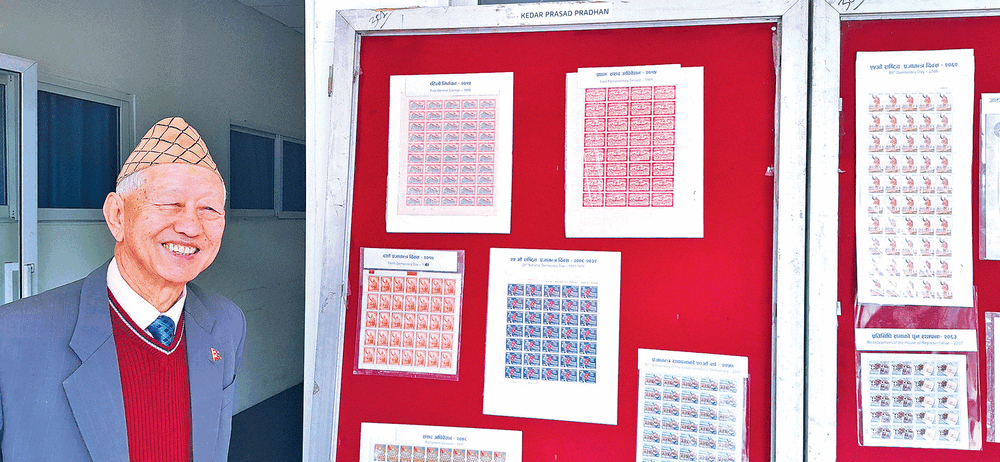
Not only in Nepal, before the advent of postage stamps, correspondence was limited only to the wealthy class. The ticket made this service accessible to the general public. Families were joined, trade expanded and this led to an increase in literacy.
Postage stamps played an important role in trade, diplomacy, and colonial administration by ensuring reliable communication between continents. It accelerated globalization by connecting nations. After 1993, Nepal and India signed an agreement to send letters to each other using Nepali and Indian stamps, which greatly facilitated news transactions between the residents of the two countries.
vs. On October 26, 2013, Nepal became a member of the Universal Postal Union. It made it easy for Nepalese to communicate all over the world. To make the postal service reliable V. No. In 2019, the Postal Act and V.No. Postal regulations were prepared in 2020. After 8 years in 2028, Department of Postal Services was established. Director General of Postal Service Department Pangeni insists that the 146-year history of postage stamps has given Nepal a unique identity on the world map.
This little piece of paper makes a wonderfully easy mechanism for letting two lovers know we're missing each other, from diplomatic news. In old movies, the scene of an impatient lover or relative waiting for a letter often makes the audience emotional.
Initially stamps were minted in the name of rulers and administrators, but over time postage stamps were also printed to commemorate various objects, events and important social works. In course of time, Nepalese stamps also started to stamp Everest, Buddha and martyrs, endangered flora and national heritage, abandoning the legacy of Sripech and Cross Khukuri. Recently, the Department of Postal Services issued a stamp of 'Panchamark Mudra', which is the youngest stamp in Nepal, commemorating a rare Buddhist coin found during excavations at Kapilvastu.
Once artist KK Karmacharya used to design postage stamps for the department. After her retirement, Purnakala Limbu, art officer of the department, has been handling this job for fifteen years. During this period, she designed 372 stamps. His first design was the stamp with the logo of the Nepal Shiksha Parishad issued on the occasion of the Diamond Jubilee.
"Some martyrs and rare plants stamps are ready to come, these are my latest designs," says Purnakala, who studied fine arts and was born in Fungling, Taplejung, "We print people, culture, plants and other important things on stamps." The increasing use of the Internet also led to a decline in the use of postage stamps. How can the postal service, which is becoming irrelevant over time, be made more relevant by making it technology-friendly? Director General Purnakala Pangeni thinks about this now. To remind people about postage stamps, he held an exhibition last week, giving stamp collectors a chance to display their collections. Those who went there to see knew the old things. The department currently has about 300 million worth of postage stamps in stock.
She is in the process of advancing a proposal in the government mechanism that money can be earned from these assets by implementing the system of sticking tickets even if they go to the pit system. Even now, 10 rupees tickets are being used a lot in government work. There is also a 500 stamp printed by the department five years ago. The department is trying to introduce the use of tickets instead of court fees.

