Shailendra Adhikari's style has not only individuality, but also a unique craft which is different from others in contemporary Nepali literature and captivating with its own style.
We use Google Cloud Translation Services. Google requires we provide the following disclaimer relating to use of this service:
This service may contain translations powered by Google. Google disclaims all warranties related to the translations, expressed or implied, including any warranties of accuracy, reliability, and any implied warranties of merchantability, fitness for a particular purpose, and noninfringement.
Who is Buddha? What is his most important country? A small and scattered sentence cannot answer this question. And also, it has to be said day after day - Buddha Siddhartha is not Gautama, his desire is not to obey by faith, but to go by one's own experience.
Others said - Trust in God. Buddha said - you yourself become bright. Those who said 'I am Guru' always taught the disciple to be devoted to himself. Shraddha was his first condition. Buddha said to believe in yourself. It is as simple and clear as saying that one cannot be enlightened by believing in someone without coming to one's own experience.
Krishna says –
Sarvadharmaparityajya Mamekan Sharanam Vraj
Ahan twan sarvapapevyo mokshayishyami ma sucha:
Mane, give up all religions and come to me, I will save you from all sins, don't worry.
Buddha says -
Attadipa Viharath, Attasarana Anjansarana,
Dhammadeepa Viharath, Dhammasarana Anjansarana
That is, become your own island, go to your own refuge, there is no other refuge. Make the truth your island, take refuge in the truth, there is no other refuge.
In this way, we get the world's religions, creeds and knowledge on one side and Buddha's words on the other. Because, he discovered the path of self-liberation, which was not in practice, but by his own strength, not by any Guru or scriptures.
and moved its map made in the heart to the lives of countless other women. Then the question may arise here - what gave him the basis to do this? The answer is simple – his wisdom gave. The question is again - where was that wisdom before? It was born with him as all beings have it.
As there is oil in every mustard seed and as the bright rays of the sun in the womb of every night, so is Buddhahood inextricably present with every being. Siddhartha Gautama searched for it and realized where it was. He became a Buddha because he understood that. So Buddha is not the name of a man. It is a state of being, where we all have a fixed destiny. The only question is time.
Someone could become a Buddha at this very moment due to the intensity of his search and the purity of his mind. Some people are hundreds of births away from becoming a Buddha because they cover the natural light of the heart with thousands of layers of clay and chaitsika, like covering the water under the ground with paper. However, just as all rivers meet the sea, all living things will one day realize their natural state.
That state is enlightenment. Therefore, every sattva is a future Buddha. He is the eternal possessor of wisdom. So Buddha said - Appa Deepo Bhava.
Thus, on the one hand, there is the truth that the truth will not shine until it becomes enlightened, and on the other hand, the fact that people have been deceived when they believe that they will be free from suffering by holding the idea of a guru, scripture or creed, is on the other hand. In this way, the Buddha said at the last moment so that people can directly realize the truth without wandering around - you will be your own support, no one will support you. Truth is your refuge, there is no other refuge.
In recent years, the initiative to publish sporadic books on Buddhist philosophy has begun in mainstream literature. And, the writer Shailendra Adhikari has come to join the process with great strength. His recently published book 'Arhat' is proof of this fact. As anyone interested in Eastern philosophy knows, another term similar to 'Arhat' is also popular, 'Arihanta'.
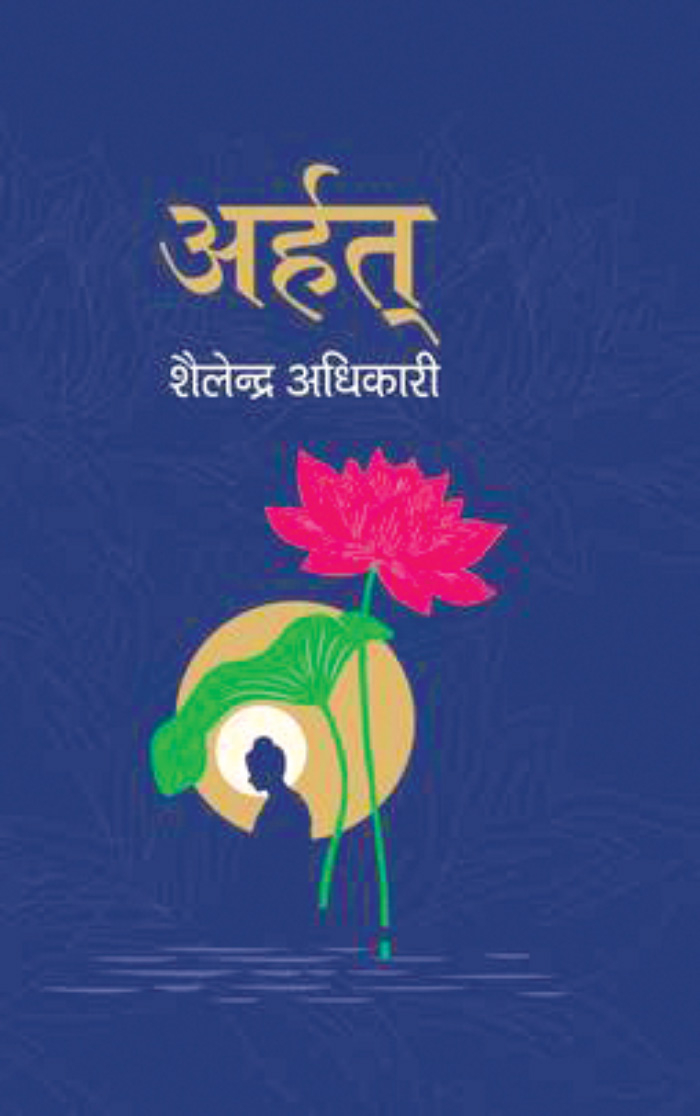
Here Ari means enemy and Hanta means enemy. He who kills the enemy is called Arihanta. Who is Khas Arihanta? It has to be said deeply, Arhat is Arihanta. Because, the main enemy of man is not another human being, but he is the sufferings and chaitsikas within himself, who are working day and night to gather faith for the purpose of movement in the world and the elimination of endless suffering. Man cannot recognize Bodhichitta and Buddhahood within himself because of the Kleshadi cover.
and continues to suffer. Siddhartha Gautama saw this in a flash. And, the enemy who was always causing pain, i.e. 'Ari', was 'Hant' by the fire of knowledge, i.e. killed, incinerated. And, he was freed from suffering i.e. attained Nirvana. Those who have reached this state of mind are called 'arhats'. So, it was natural that the book "Arhat" "Arihanta" should focus on the biography of Buddha.
While turning the pages of 'Arhat', the reader naturally realizes that the 80-year life of the Buddha has been narrated by the author Adhikari with a lot of study, research and investigation, which is interesting to read and valuable to count. Despite the intensive use of obsolete Sanskrit words, the book does not feel burdensome due to the clarity of expression and the clarity of sentence formation. As a writer, Adhikari's style is not only unique, but also has a unique craft that is different from others in contemporary Nepali literature and captivating with its own style.
A 9-page long list of new-sounding words used in 'Arhat' at the end of the book helps the reader out of the complexities. The book is essentially a biography of the Buddha, narrated by Adhikari in his own style.
The hologram statue looks like Ganesha from one side and Kumar from the other side, this book with a total of 299 pages, except for the index, looks like a biography when read as a biography, and when read as a story, it looks like a biography. The book begins with the Buddha's death rites, the first sentence of which is as follows: In Kushinagar, Gautama Buddha's enlightenment took place.
The method of the Buddha's death after leaving the body, the scriptural method and the devotion of a large group of monks, nuns, sramanas, worshipers and worshipers suddenly experienced an emptiness and to deal with it, the main servant Ananda, who spent 25 years with the Buddha as his shadow, is the origin of the novel. structure is
Ananda's dialogues with the Buddha, the sermons given by the Buddha to thousands during his lifetime, and the Dharma Sangayana when Ananda tried to remember them and the collective memory of other monks who had benefited from meditation and reached the state of qualification, produced three baskets of books, which have been given three different names. – Vinaya Pitaka, Sutta Pitaka and Abhidhamma Pitaka.
The Arya Ashtangik Path taught by the Buddha for the liberation of suffering – Samyak Smriti, Samyak Sankalp, right speech, right action, right life, right practice, right memory and right samadhi can be divided into three main categories – Sheela, Samadhi and Prajna.
Sheel prevents future suffering, Samadhi prevents ongoing suffering and Pragya even uproots the root of suffering and ends it forever. Thus, there is a Buddhist philosophy that a proper balance of sheel, samadhi and prajna can lead to enlightenment in anyone's life. This philosophy is collected by the Vinaya Pikat from the Tripitaka, Sheela and Sutta, and the Abhidhamma Pitaka, which is a collection of Buddhist sayings that evoke samadhi and wisdom.
In Shailendra Adhikari's story, Buddha himself came and told the story of his life in the voice of joy, and in that story there are mostly references from Vinaya and Sutta Pitaka. By narrating the original events from the birth of the Buddha to his death in small chapters in a Sanskrit-style Pranjal style, Shailendra has given Nepali literature the material that helps to understand the life of the Tathagata from one perspective, which is certainly a meaningful contribution to the Buddhist literature that has suffered a great drought. His actions are commendable for this.
After Buddha's passing away, different schools of thought developed based on the understanding of those who heard his teachings. Among them, Madhyamik, Yogachara, Sautrantric Sarvastivada are the main ones. The Sutra Yana and Tantra Yana are combined within Madhyamika and Yogacara Mahayana. Sautantrik and Sarvastivada are related to Hinayana i.e. Theravada. These branches and sects have somewhat different views of the Buddha's life and biography. As the Mahayanis consider it an insult to call the Buddha only an 'arhat'.
According to Yogachara and Madhyamika opinion, Arhat means a state of decay of suffering only in one way before attaining full enlightenment. There is a Mahayani opinion that Siddhartha Gautama became 'Samyak Sambuddha' not by the virtue of his birth and by the power of right resolution and determination. Samyak Sambuddhatva is the state in which, even after being freed, there is a great determination to guide all beings on the path of salvation, who are not an Arhatma.
The title of the author Adhikari's book is 'Arhat', so it is clear that his study or inclination is with the Theravada sect. Accordingly, he has tried to show the biography of Buddha in his own style in the book. If we forget what vegetables we ate yesterday, the question of whether the biography of Shakyamuni Buddha, who ran the Dharmachakra twenty-five hundred years ago before the beginning of the written tradition, is correct or not, is enough for intellectual debate. Because
, it lacks authenticity. Belief, reason and empirical understanding lead to a different history of life and events from person to person. However, author Shailendra Adhikari has depicted Buddha in 'Arhat' in a beautiful manner so that there is no controversy. This is a very commendable act.

