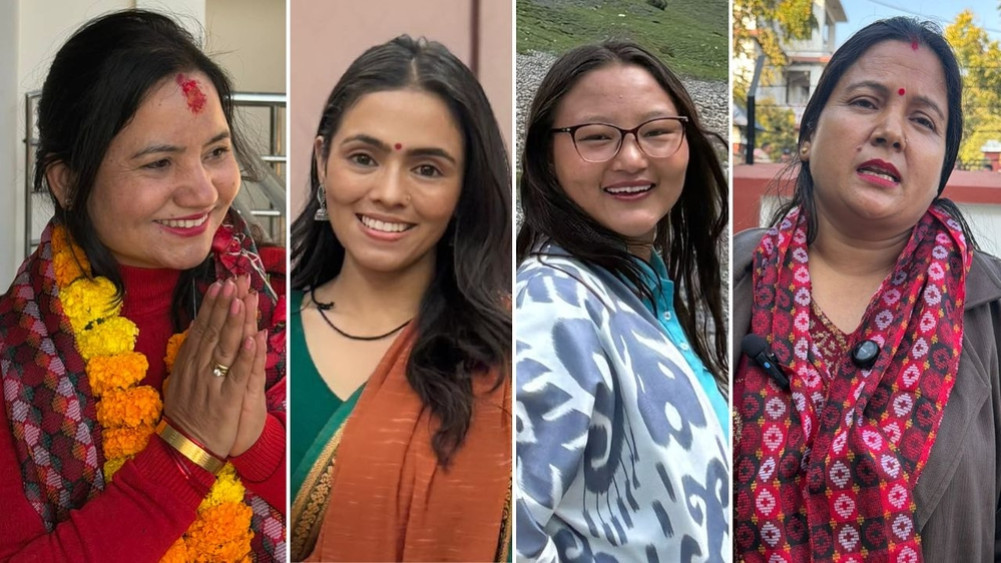
There are 127 male candidates in 12 constituencies across 10 districts of Karnali, while only 11 female candidates have been able to stand as candidates.
We use Google Cloud Translation Services. Google requires we provide the following disclaimer relating to use of this service:
This service may contain translations powered by Google. Google disclaims all warranties related to the translations, expressed or implied, including any warranties of accuracy, reliability, and any implied warranties of merchantability, fitness for a particular purpose, and noninfringement.
The number of female candidates running directly for the House of Representatives elections to be held on February 21 is very low.
Gender imbalance has been recurring in Karnali politics as even the new parties that came with the slogan of change have not been able to prioritize women candidates.
There are 127 male candidates in 12 constituencies of 10 districts of Karnali, while only 11 women have been able to become candidates. Despite the parties' repeated commitment to inclusive representation, the issue of women's representation in the candidates selected this time has once again been seen as weak.
Looking at the candidates fielded in 12 constituencies of Karnali, it does not seem that gender equality in politics has yet been established in practice. In 10 districts of Karnali, the CPN-UML and the Nepali Communist Party did not give a single woman a chance. The Nepali Congress does not seem to have given women a place in any other district except Dailekh.
Only independent and small parties have registered their candidacies in the name of women. Even the Rashtriya Swayamsevak Sangh (RSS) has fielded only two candidates in 12 constituencies of 10 districts, despite its new slogan and the fact that youth should get opportunities. Although it is a constitutional obligation to ensure 33 percent women in the House of Representatives, political parties seem to be reluctant to allow women to become candidates.
The then Chief Minister Mahendra Bahadur Shahi, a member of the House of Representatives, has himself become a candidate. Similarly, CPN-UML's provincial chairman Gulab Jung Shah has become a candidate for the House of Representatives, while Nepali Congress's provincial chairman Lalit Jung Shahi is a candidate for the National Assembly. The leaders who are in the body that recommends candidates have themselves become candidates.
Nepali Communist Party's provincial chairman Bimala KC said that men got the opportunity because there was no one who wanted to contest directly. 'I myself could not contest as the chairman, there was a bit of a problem in organizing the district, so others took the opportunity,' she said, 'Our sisters did not dare to contest directly.'
According to her, there was less confidence in proportional representation than in contesting directly. While there are 32 male candidates in Kalikot, Jajarkot and Mugu, the number of women is zero.
Tulsi Khadka of Nepal Workers and Peasants Party has been nominated in Surkhet, Tirtha Kumari BK of Aam Janata Party from Dailekh, Babita Shahi of Rastriya Prajatantra Party, Menka Shrestha of Aam Janata Party from Dailekh, Basna Thapa of Congress, Prema Damai of Aam Janata Party, Rukum Paschim, Tasi Lhajom Lama of RSP Humla, Binita Kathayat of RSP Jumla, Junu Bhandari of Meteri Party Dolpa, Kamala Dangi of Rastriya Janamorcha and Anisha Nepali of Rastriya Prajatantra Party have been nominated from Salyan.