”You act, sing songs, do whatever but Aheb pani ban hai Kancha,” Meena used to hesitate. Perhaps, if Meena had continued, Nazir could have fulfilled this dream of his mother. But she left in the middle. Nazir was alone. That dream did not come true.
We use Google Cloud Translation Services. Google requires we provide the following disclaimer relating to use of this service:
This service may contain translations powered by Google. Google disclaims all warranties related to the translations, expressed or implied, including any warranties of accuracy, reliability, and any implied warranties of merchantability, fitness for a particular purpose, and noninfringement.
A boy came and said, "I am not married and I am taking care of my mother." Mohini took it. Fasi ta gayen, gai ta gayen,' Meena narrated her love story to her son Nazir Hussain one day while heating the fire in the stove during the harsh winter. After Maya's death, the Raithane girl from Kathmandu ran away and reached an unknown place in the Terai.
On whom she abandoned everything, he left her alone. The cycle of grief began from that day. Why would I run away if I knew that he was married? I thought of going back, I had your brother in my stomach. I left without falling in love again, I felt love too,' Meena said that she was forced to stop.
Meena, raised in Hindu culture, became the daughter-in-law of a Muslim family. Then his surname was changed. At first it was difficult to accept the identity behind the name. Begum, what Begum? Tasko Begum?' she teased herself. As everyone was calling me with love, later that name became dear. She became Meena Begum. Meena Begum's story is currently being narrated by her son Nazir. He used to call out to his mother in his poems, who kept crying when he remembered home, "Sauli Chowk has everything, but you are not mother." Nazir writes stories, tells stories, plays in stories. In the
film 'Gunyucholi', he also filled Meena's life. Astute listeners of Nazir's poetry will find the imagined Meena in the film as well. Nazir remembers his mother looking at the mirror hanging on the wall and drawing her curly hair. Who are lying separately in dhoti. After that, she is going to the health center with her hair braided. Balkh Nazir is following him. He would forget to sleep without Meena. The habit of not sleeping without his mother did not leave Nazir till later. Even though he sees mothers sleeping with their children in their arms, Nazir is haunted by the memory of Meena Begum. Nazir's character gets a mother while filming. Nazir sees Meena Begum in that character too.
When the birthday comes, Nazir's ears are covered by the sounds of coins. Meena kept piling up the coins in the khutruke throughout the year. On her son's birthday, she used to burst into tears. And, taking it with her hand, she would say, "Kancha, this is all yours." Nazir remembers, "Now that doesn't happen even if you want it." It was a recurring event every year on his birthday. That is why Nazir is still obsessed with coins. While working on the film 'Agastya', he was walking on the streets of Thamel. He saw an old mother selling garlands in a shop. Old garlands of rusted coins were hanging in the shop. The sound of coins ringing on birthdays started ringing in the ears. He bought the garland of hanging coins without bargaining.
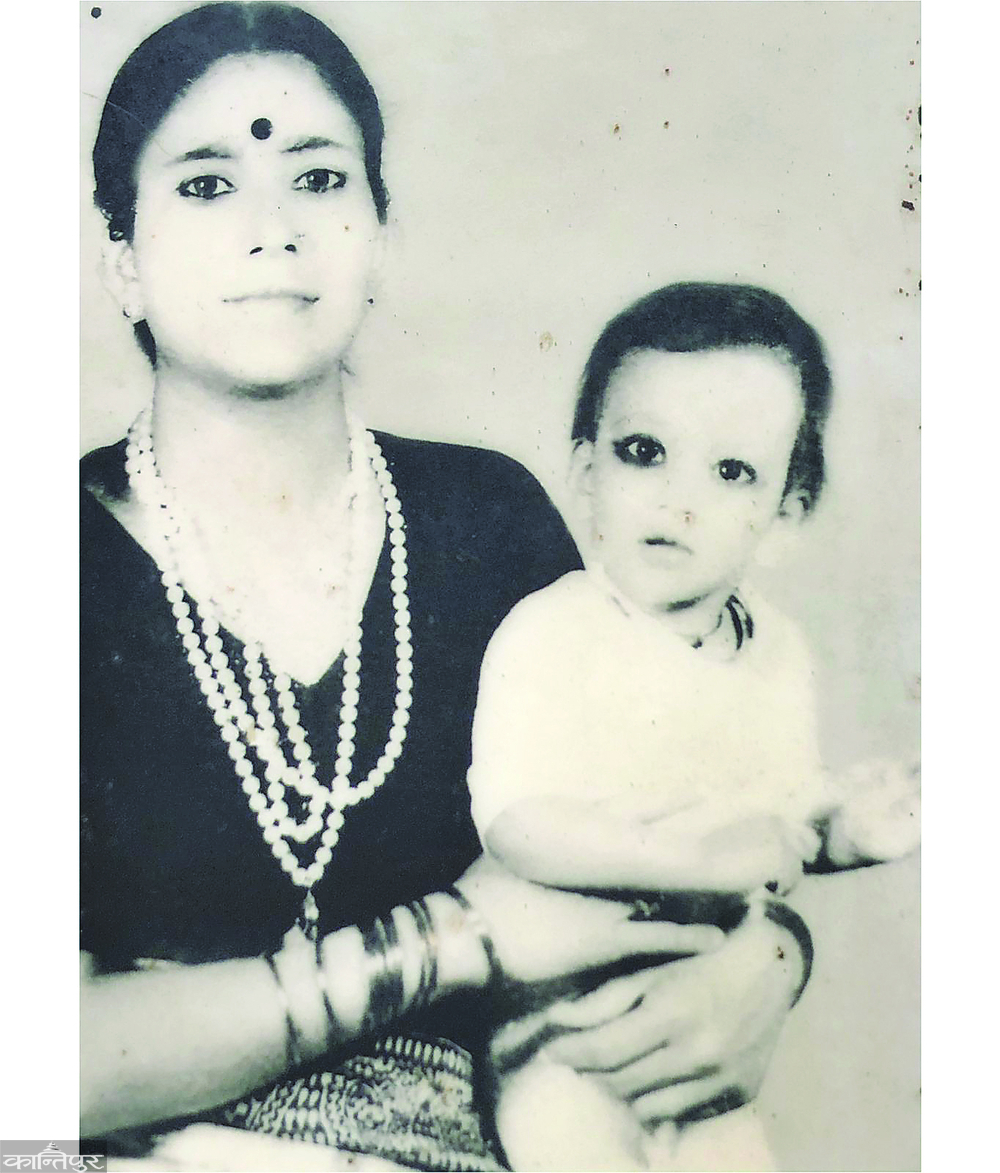
Once upon a time, coins filled Nazir's shortage. Even now, the coins fulfill the lack - of the mother. Not only coins, even if you see a bag hanging somewhere, you remember Meena Begum. Amaji used to have cloves and sukumel in her bag. Taking out money from the bag and giving it to her, mother's lust came. That lust is still following me,” Nazir reminisces about his mother.
Mother used to plant a field and grow rice. Along with paddy, she used to grow the dreams of mother and son. One day while making rice crackers in the yard, she said to Nazir, "Little one, you earn so much money by selling rice that after that mother and son will take a plane to Kathmandu." The boy Nazir thought that he would fulfill his mother's dream of flying with a plane flying in Simra. He made a paper ship and flew it with his mother's name written on it. And he went to his mother and said, 'Your dream has come true.' Now, while going home by ship from Kathmandu, Nazir is badly hit by gusts of wind. The mind is heavy as the ship descends from the sky of Simra. Eyes get wet. "Now I have money, but no Meena Begum to fulfill my dreams," says Nazir in a trembling voice.
Meena had a crush on Nazir's girl friend with long hair. Teasing her son, she would say, "He is the youngest one who deserves to be a daughter-in-law." Nazir used to talk openly with his mother. He used to tell his mother the things that he didn't even listen to his favorite pranks. On days when her son was sad, she used to tease, 'I will call that girl, and will you be happy?' The mother had big wishes for her son. But she kept her desires limited to jhumkas, sarees and kurtas. Meena used to wear a maxi while staying at home. Dhoti when going to office. Even though Audhi wanted to wear kurta-surwal, it was taboo in his society. Mother loved to break taboos. She used to say to Nazir, 'Look, little one, one day I will walk in this Syauli Chowk wearing a kurta-suruwal.'
Meena, who worked as a health volunteer at a health center, wanted to see her son become a boss. She used to say, 'I will stay as a volunteer until later. You come as Aheb.' But at that time, Nazir liked to play Madal. Loved acting. I loved being an artist. "You act, sing songs, do whatever but Aheb pani ban hai Kancha," Meena used to hesitate. Perhaps, if Meena had continued, Nazir could have fulfilled this dream of his mother. Meena left in the middle. Nazir was alone. That dream did not come true. Nazir still has a desire, "If I get to play the character of Aheb in a film one day, my mother's dream will come true, even if only for a moment." Growing up, Ba's love for Nazir never warmed. Ba was more out of the house. The mother fought all the battles of sorrow alone. Ba never joined his mother's struggle. While studying at school, Nazir's children left home. Mom kept looking for Ba until her last breath. Baa could never be a Baa, nor a husband. New place, new language, new customs. Mother spent many years embracing that unfamiliar world. Despite adopting the new rites, Meena Begum never became a full-fledged Muslim. She used to celebrate Dasain-Tihar.
"Since I was a child, I saw my mother pouring water on the peepal plant in the morning when I was returning from Simra on my bicycle after praying," says Nazir. Nazir, who grew up with both of these rituals, realized after a long time, 'A person has his own relationship with God.' Now Nazir also fasts and prays in the mosque. Aarti is also observed in Pashupati. In Dasain-Tihar they also perform Tika. It was Meena Begum who taught Nazir to combine religion with harmony.
Meena raised her children by selling buffalo milk. After the marriage of the sisters, the buffalo had to be sold. Regular income stopped. How to teach a son? The sleep disappeared from Meena's eyes. She took a big risk. At the back of the house was Pali. Nazir saw his mother cooking the stove one day in Pali. Soon after, the mother also found that she had hidden a vessel for making alcohol. "It was a terrible thing for the society for a Muslim daughter-in-law to drink alcohol," Nazir returns to that awkward situation, "but Amaji used to wake up at one o'clock in the night and drink alcohol so that others would not find out." It was very difficult to know that I did this to pay my school fees.'
Nazir repeatedly begged his mother, 'I would rather do other things, don't drink.' But Meena did not stop drinking despite hiding her grief. When Nazir would return from school, his mother would give him money to buy marcha and sugar. At that time, people who bought white sugar were considered rich. Black sugar or buffaloes had to be bought to feed the cattle, or to make alcohol. There were no buffaloes in his house. Nazir used to say to his friends, 'My job is you, go.' When he was out of sight, he would run to the shop where he bought sugar. I used to buy marcha and sugar in the shop and hide it in my school bag. At that time, I was very afraid that the person selling sugar would ask if you are not Hussain's son,'' he recalls.
One day the mother who went to Jitpur market to sell liquor came back angry. On understanding, the mother is not getting the price of the liquor sold. Nazir was tempted to go there and collect money by fighting. One day the tempo in which the mother was carrying alcohol met with an accident. Mother returned home feeling sad. And she said to Nazir, 'Young man, even the wine has been spilled. But don't worry, nothing has happened to me.' But the mother's hand was injured, fully bent. At that time it happened to me that my mother would not work. Even when I was sleeping at night, I felt like drinking wine was broken,' Nazir remembers.
Fearing that someone would find out, the mother and son dug a hole and brought the sons (cut). Gradually this became a rumor among the relatives. One day, Dadi came and started giving a sermon, 'Do you want to do this as the daughter-in-law of a Muslim? Stop making it.' The grandmother who gave the sermon couldn't promise to help? Nazir's heart is full when he remembers. Nazir feels that whatever the mother did by fighting the society to educate her children, she did it in an honorable way.
In those days, in the middle of the night, there was a sound of mother crying. 'Did you cry yesterday?', when asked by Nazir in the morning, mother never said 'yes'. She kept hiding her tears in front of her son. Where could Nazir hear his mother crying? One day he said, 'No more. That you stop making alcohol, that I will go to Kathmandu and look for work.' Meena said hesitantly, 'Don't do this, instead I will stop making alcohol.' Then they started raising goats. Nazir used to work as a wage earner in the village, also taught school and taught tuition. He used the money he collected to add things to the house. He added to his mother's happiness.
In parts of Nazir's poetry, the moments when a mother creates a dream for her son are reflected -
You sold your dream and bought my dream!
By selling your old age
I, my youth Don't buy
.
Nazir thought, 'I will earn a lot of money one day. I will keep my mother as the empress.' But Nazir did not see the day when he would earn money, and his mother fell ill. His kidneys stopped working. He was brought to Veer Hospital in Kathmandu. Disease was added to disease. Back in 2012, Nazir had severe convulsions. A 19-year-old boy, who is cutting a healing cube for his mother. After a month in the hospital, the mother stopped recognizing people. At one point she called Nazir as 'mother'.
Mom kept waiting for Ba until the last moment. "You can't talk about old people to your children, call your husband," she persuaded. They called Baa. Ba said he would come, but he didn't. After knowing that Ba would not come, the mother said, "Then take me to the village, I will die there." The doctor had also given up treatment. He said, 'Now he wants whatever he wants. Do that.'
Nazir was applying oil to his mother's hair. Meena took out the earlobe and put it in her hand and said, 'I couldn't do anything to you, now I should go. Malai nasarape hai.' These deep words of mother could not cover Nazir's eyes. He cried for a long time. Meena Begum was taken to the village. Even after reaching the village, the memory of her husband did not leave her. Maybe she wanted to say something, something she had kept to herself for years.
 That night Nazir wrapped his mother in his arms. His hand was on his mother's cheek. Nazir, who did not sleep at any other time, has become dry at that time. At 4 in the morning Phupoo of Nazir came. She took out her mother's pillow. Nazir woke up. The hand on the mother's cheek was full of foam. At that time, Phupoo said, 'Sister-in-law has passed away.' Nazir remembers only that he screamed and cried at that moment.
Nazir's life took a different turn after his mother passed away. He was studying in the second year of graduation and missed his studies. Along with education, mother's dream also disappeared. Nazir, who had entered the city to become an artist, returned to the village after leaving his own desires behind. But I have been so immersed that if the stage is not there, I will be more sad. I thought I would get healing from theatre,' Nazir remembers. What happened after returning? Then Nazir started telling the story. your story He did not only bring the face of Madhesh in the film. Bring the life of Madhesh, bring sighs. Whenever I do a character, I remember all the people in the village. I remember my friends going to cut the grass. I try to bring everything I have seen and experienced,” says Nazir.
When Mandla Natakghar (currently Thapagaon) in Anamnagar was being built, the foundation of Nazir's artistry was also being laid. He used to gossip to his mother on the phone in a film style, 'Spotlight inside the black screen, there comes your son. And what do you do and old man? You cry You cry.' Mother shyly said, 'Ah, I feel ashamed. Everyone looks at you and keeps clapping. I sit and watch the last one.' In the
drama 'Sunkeshari', the light turned on inside the black screen. Nazir swung. There was applause from the audience. But she was not a mother who would sit and watch 'Last'. Mother had gone on a never-to-be-returned journey without keeping her promise. At that moment when others were celebrating, Nazir continued to shout without anyone seeing. Since then he has made many bets in his career. From plays to films, he established himself on the screens. Nazir now has a lot of things that the mother and son saw yesterday. But one thing, Meena Begum is not. Nevertheless, Nazir weaves the mother into a poem and continues to resolve -
Your one-fingered dream as seen by Gauntli
Still in the fields
In the waves of the river
In the mango flowers
In the streets of the city
Grows
Flows
Fruits
And runs
This is how it feels
I can hold on to your one-fingered dream for years

