After ritually worshiping the pandit, the chhawa was named 'Vinamrakali' on the advice of Ganesh Pant, Chief Conservation Officer of Chitwan National Park. As the third child of Tirthamankali, Humikali was born on 30th of June.
We use Google Cloud Translation Services. Google requires we provide the following disclaimer relating to use of this service:
This service may contain translations powered by Google. Google disclaims all warranties related to the translations, expressed or implied, including any warranties of accuracy, reliability, and any implied warranties of merchantability, fitness for a particular purpose, and noninfringement.
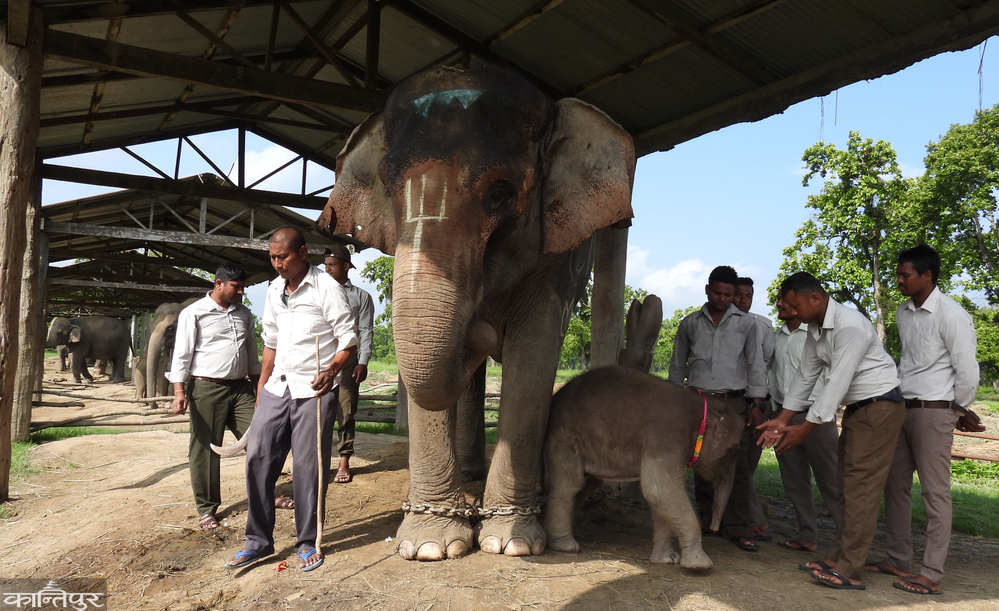
At Khorsor Elephant Breeding Center in Sauraha Aad, preparations were being made for the rescue of a new-born chawa (baby elephant) on Tuesday. Navaran, which occurs on the 12th day after the birth of Chhava, is not new to Khorsor. About three months ago, on Chait 20th, a camp was raided in Khorsor.
But on Tuesday, a little different girl camp was going on. It had been a long time since 'Kali' i.e. female chava was born in Khorsor.
After three and a half years, Pothi Chhawa was born in Khorsor. In the meantime, we thought that when three-four roosters are born consecutively, the rooster will be born. But I was happy when the female was born,' said Manpuran Chaudhary, head of Khorsor Elephant Breeding Center. After ritually worshiping the pandit, the chhawa was named 'Vinamrakali' on the advice of Ganesh Pant, Chief Conservation Officer of Chitwan National Park.
As the third child of Tirthamankali, Humikali was born on 30th of June. Earlier, a male Ramsargaja and a female Simsarkali were born from Tirthamankali. It is customary to add 'Gaj' or 'Prasad' to the name of the elephant if it is male and 'Kali' or 'Mala' if it is female. Chaudhary, head of the centre, says that female elephants usually become pregnant after 10 years of age. Chhawa is born 22 months after conception.
After the birth of Chhawa, the tradition of methodical burial is complete. Earlier, when Hatti Chava was born, the name was decided from the court even though Navaran was in Khorsor. After the popular movement of 2062/63, that order was broken. Born on June 11, 2063, Chhawa was given the name 'Lokatantrakali' not by the palace but by the park officials. After a long time, when a female child was born in Khorsor, the head of the park, Pant, was also happy.
A female child was born for the first time in three to three and a half years. A female for the center is better. Because this is where elephants are produced and used. If it is only a male, it is not suitable for breeding,' said Chief Conservation Officer Pant. Female elephants in parks and other private farms are often impregnated by wild male elephants.
Wild male elephants roaming in Chitwan Park have been inseminated in female elephants from 'Ronaldo', 'Dhruvey', 'Govinde'. Chowdhury, the head of the breeding center, says that it is rare for children to be born from domesticated male elephants. Therefore, he said that it is better to have a female child. According to Pant, the head of the park, the continuous birth of roosters is a matter of concern.
Why is this happening? It seems necessary to study it. Because of the effects of climate change, the male-female baby ratio in elephants is different than before? This is a matter of speculation. It needs a study,' said Pant. An elephant breeding center was established in 2044 at Khorsor under Chitwan National Park. Since then, 67 babies have been born so far, said Chowdhury, the head of the center.
The park's government elephants are used for conservation purposes including patrolling. Elephants are sent from here to Chitwan as well. Chowdhury said that there are currently 57 elephants in Chitwan Park alone, of which 31 are male and 26 are female. He said that everyone was happy when a female elephant was born at the center when there were more male elephants than females.

