We use Google Cloud Translation Services. Google requires we provide the following disclaimer relating to use of this service:
This service may contain translations powered by Google. Google disclaims all warranties related to the translations, expressed or implied, including any warranties of accuracy, reliability, and any implied warranties of merchantability, fitness for a particular purpose, and noninfringement.
An art exhibition titled 'At the Tipping Point: Art and Ecology from the Rooftop of the World' has started depicting the impact on nature through various means. The exhibition started at Taragaon Cultural Center on the occasion of World Environment Day.
Working for an effective combination of environmental awareness and contemporary art, Sagarmatha Next organized the exhibition in collaboration with Sarraf Foundation by renowned Indian art historian Dr. Coordinated by Arshiya Lokhandwala. She informed that the exhibition was organized keeping in mind the global ecological needs. At the
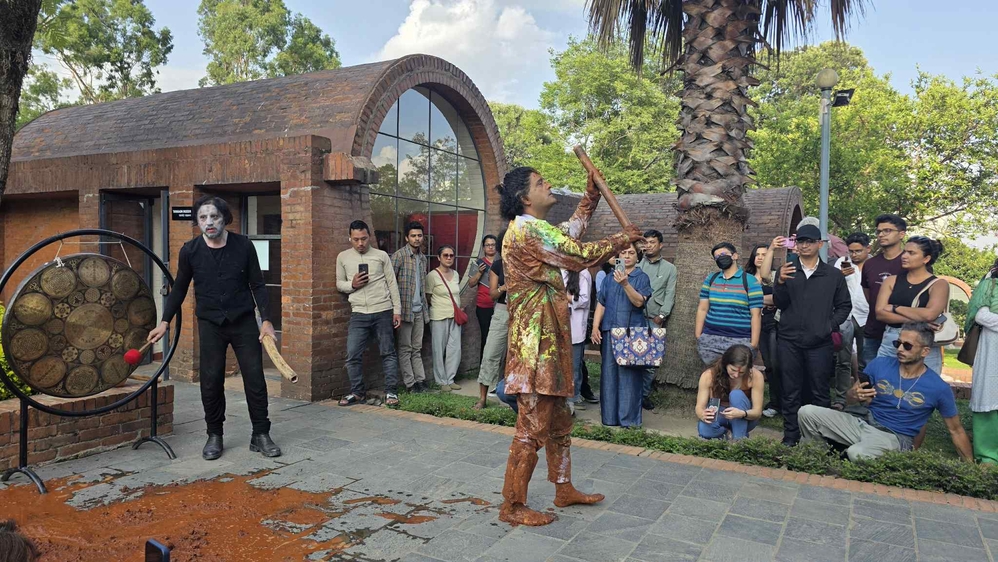
exhibition, artist Salil Subedi's team gave a special live performance called 'Earth Emergence'. The exhibition, which witnessed the earth by covering the body with red soil, highlighted the relationship between humans and soil. The original concept of the exhibition was based on the 'planetary' idea of the famous post-colonial thinker Gayatri Chakraborty Spivak. In the
exhibition, 12 international and Nepali artists have presented various perspectives on the environmental crisis through their unique creations. Filmed in the snow region of Svalbard, Himalayan Singh Soin's poetic video raises questions about colonialism, climate change and failed mining.
Ursula Bimann's video essay 'Forest Mind', created in collaboration with the Inga community in Colombia, presents the forest as a source of conscious knowledge. Utsa Hazarika's living sculpture 'Yantra Bloom' will attempt to give new life to Delhi's Samrat Yantra sandhill through jasmine flowers.
Maksud Ali Mandal's 'Fungal Habitat' presents a self-developing sculpture made from a combination of mushrooms, clay and wood. Similarly, Samayukta Bhandari's 'Echoes of Survival' reflects the voice of sparrows that are disappearing amid urbanization through technology and sound.
Amit Machamsi has presented Bhaktapur's disappearing arable landscape through three photographic series. Monika Ursina Jaeger's 'Liquid Time' critically presents the cycle from mountain rock to sand to concrete construction. Joanna Moll's '4004' digitally links the microchip manufacturing process to the decline in insect populations.
The pictures and film of albatross birds that have died due to marine plastic pollution have been excellently presented by Chris Jordan. Saurganga Darshandhari has presented the sculptures associated with the Yomari festival of the Newar community with food culture and ecological balance. Also, Robertina Shebjanic has presented the invisible side of environmental degradation through The Atlantic Tales and Co Sonic with a sound installation. The
exhibition binds the world from the Arctic to the Andes, from the fields of Nepal to the digital cloud in one artistic frame. An entry fee of 200 for students and 300 for others has been set to view the exhibition which will last for three months.

